
Solo Brands’ Financial Reset: Debt Refinancing and Operational Overhaul Shape Future
Solo Brands is undertaking major financial restructuring and operational simplification to counteract losses and navigate challenging tariff landscapes.
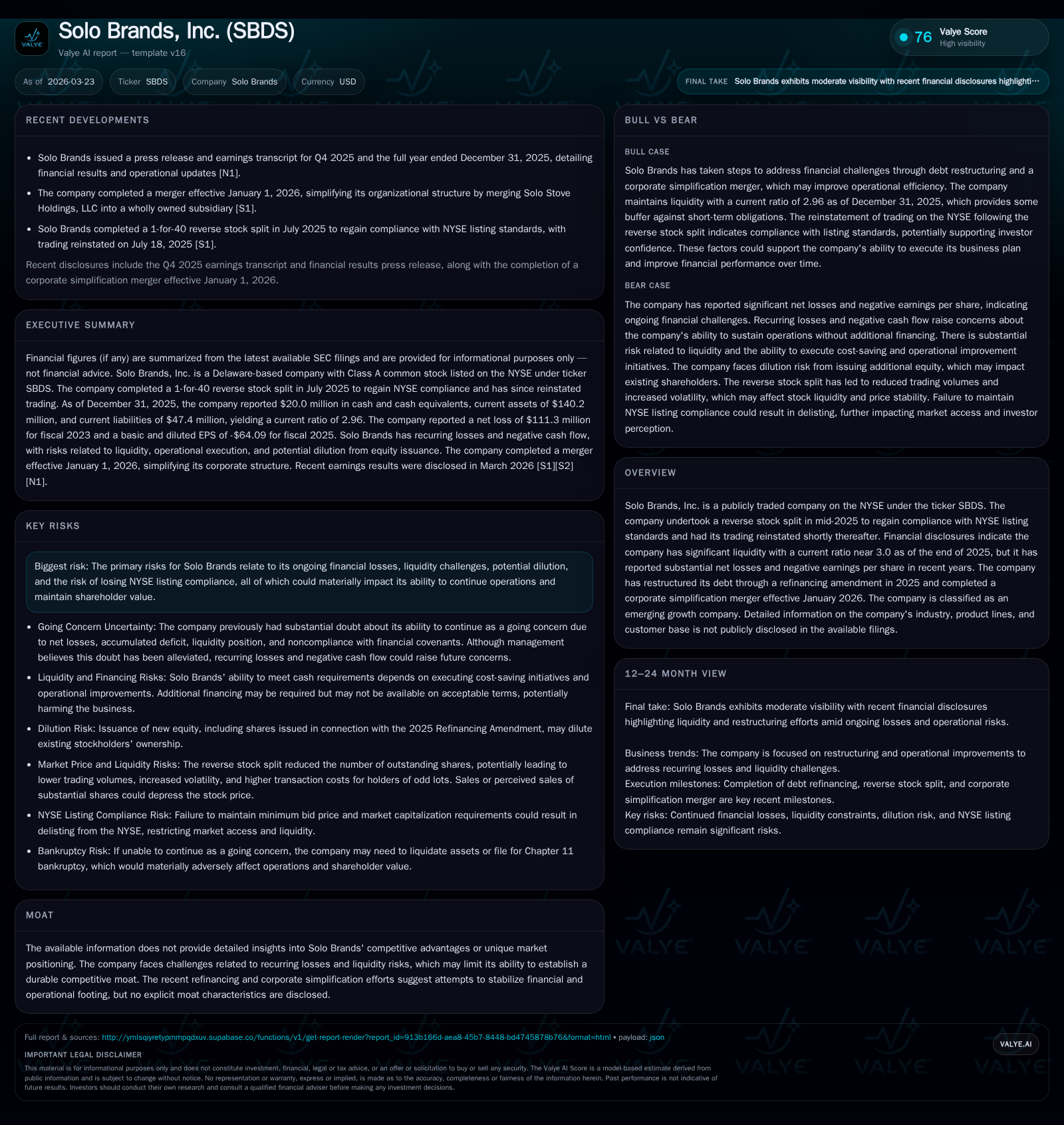
Solo Brands, following a reverse stock split in 2025 to regain NYSE compliance, has initiated significant financial and operational reforms to address sustained net losses and liquidity pressures. The company reported improved operating income but remains unprofitable, while implementing cost-saving strategies and corporate simplification through mergers. Tariff volatility, especially concerning steel imports and Mexico-related duties, adds trade uncertainty. Liquidity remains bolstered with a strong current ratio near 3.0, though negative free cash flow persists. Shareholder dilution from equity issuance accompanies an absence of buybacks or dividends. Monitoring legal outcomes on tariff challenges and post-merger earnings will be critical in assessing ongoing recovery efforts.
Evolution of Solo Brands: From Rapid Growth to Operational Hurdles
Solo Brands operates four premium outdoor brands—Solo Stove, Oru Kayak, International Surf Ventures (ISLE), and Chubbies—primarily selling through direct-to-consumer channels [S1]. Historically, Solo Stove’s free cash flow supported investments into vertical integration of fulfillment, R&D, marketing, and customer service functions to enhance customer experience and scalability. This infrastructure enabled acquisitions that broadened the product portfolio.
However, recent years have revealed operational challenges tied to capital constraints and fluctuating demand. The disposition of TerraFlame’s manufacturing operations in 2025 reflects portfolio focus shifts [S1]. While DTC remains key for customer engagement and product feedback, macroeconomic turbulence and tariffs have pressured costs.
2025 Financial Performance Highlights & Shifting Seasonality Trends
In FY2025, operating losses narrowed to approximately $113.5 million from $174.6 million in FY2024—a roughly 35% improvement signaling progress on cost controls [F1]. Despite this improvement, net income remains deeply negative [F1]. Operating cash flow turned sharply negative at about –$46.6 million in FY2025 compared with positive $10.5 million in FY2024 [F1], underscoring cash pressures beyond accounting losses.
Capital expenditures decreased over 68%, from $14.5 million in FY2024 to $4.6 million in FY2025 [F1], reflecting reduced investment amid cash conservation.
Notably, seasonality shifted in 2025 with Q1 retail sales surpassing Q3—a departure from historical patterns favoring Q2 and Q4 [S1]. This may indicate changing consumer behavior or channel dynamics requiring adjustment.
Historical performance (annual)
| FY | Net ($mm) | CFO ($mm) | OpInc ($mm) | Capex ($mm) | Net YoY |
|---|---|---|---|---|---|
| 2025 | -47 | -113 | 5 | ||
| 2024 | 11 | -175 | 15 | ||
| 2023 | -111 | 62 | -228 | 9 | -2151.7% |
| 2022 | -5 | 32 | 0 | 9 | -146.3% |
Source: SEC companyfacts cache [F1].
Capital returns and efficiency (annual)
| FY | Buybacks ($mm) | FCF ($mm) | ROE% |
|---|---|---|---|
| 2025 | -51 | ||
| 2024 | 0 | -4 | |
| 2023 | 37 | 53 | -46.2 |
| 2022 | 23 | -1.4 |
Source: SEC companyfacts cache [F1].
Note: Current ratio for FY2025 derived from current assets/liabilities data [F1].
Strategic Cost Saving and Corporate Simplification Initiatives
Facing significant losses and liquidity concerns flagged as recently as early-2025 [S2], management implemented comprehensive restructuring with strategic consultants focused on financial planning and cost reduction initiatives aiming for sustainable expense control [S1].
Effective January 1st, 2026 a corporate simplification merger dissolved the complex UP-C ownership structure by exchanging LLC units and Class B common stock for Solo Brands Inc. common shares [S19]. This streamlined governance enhances agility critical for emerging growth companies managing liquidity challenges.
These efforts align with a strategic shift toward leaner operations and tighter oversight amid volatile demand.
Tariffs Impact and Legal Challenges on Global Sourcing Costs
Solo Brands relies heavily on foreign-manufactured steel for Solo Stove products and components sourced from Mexico for Oru Kayak products [S1]. Tariffs imposed under various frameworks have materially affected input costs.
Following a February 20th Supreme Court ruling limiting tariff authority under the International Emergency Economic Powers Act (IEEPA), previous incremental tariffs were rescinded but replaced by new tariffs under Section 122 of the Trade Act of 1974 effective February 24th [S1].
Solo Brands filed suit in the U.S. Court of International Trade seeking refunds estimated around $8 million for tariffs paid during prior periods [S1][S3]. Resolution timing will be important for future cost management.
Outlook: Growth Prospects Amid Macroeconomic Uncertainties
Guidance for Q1 2026 anticipates ongoing challenges balanced by cautious optimism on volumes [N1][S21]. Inflationary pressures on raw materials combined with higher interest rates dampen discretionary spending affecting outdoor lifestyle goods demand.
Tariff volatility remains a key risk alongside evolving global trade regulations impacting supply chains [S1]. Demand sensitivity requires careful inventory and pricing strategies across brand segments.
Capital Structure Realignment and Liquidity Reinforcement
As of December 31st, current assets stood near $140 million against current liabilities below $48 million yielding a strong current ratio around 2.96 [F1], providing short-term liquidity buffer.
This follows a mid-2025 refinancing amendment restructuring revolving credit facilities and term loans with creditor waivers addressing prior covenant breaches linked to losses [S2][S4][S10]. Nonetheless, negative operating cash flows highlight ongoing liquidity risks without further capital or performance improvements.
Equity declined sharply reflecting cumulative deficits and equity issuance associated with refinancing actions [F1]. Management closely monitors covenant compliance while acknowledging potential dilution risks from future financing needs [S2][S7].
Shareholder Return Dynamics: Dilution Risk Versus Buyback Absence
No dividends or share repurchases occurred recently; last buybacks were nearly $37 million in FY2023 during stronger cash periods [F1][S6][S7][S11].
Equity issuance linked to refinancing introduced shareholder dilution impacting ownership percentages amid tightening liquidity demands [S8][S12].
The July 8th reverse stock split at one-for-forty aimed partly to stabilize listing status after NYSE delisting threats caused by low share prices also raised concerns about odd lot trading inefficiencies for retail investors [S7].
This combination reflects trade-offs companies face prioritizing survival over returns when under financial stress.
Key Milestones to Monitor in 2026 and Beyond
Investors should watch:
- Progress on CIT lawsuit over incremental tariffs potentially unlocking ~$8 million in refunds affecting margins;
- Quarterly earnings tracking whether restructuring savings yield sustained loss reductions;
- Updates on efficiencies post-corporate simplification including forecasting improvements;
- Liquidity reports assessing ability to meet covenants without further dilutive financing;
- Market responses to changing seasonality indicating shifting consumer purchasing patterns within outdoor categories.
This analysis is based solely on disclosures available through SEC filings and relevant news transcripts through March 23rd, 2026. It is intended as an informative overview rather than investment advice.
Disclaimer: This is research-only, informational analysis and not investment advice. It may include AI-generated interpretation and general industry context. Always verify important details using primary sources.

Comments