
ENB Financial Expands Market Reach with Cecil Acquisition While Sustaining Strong Local Banking Roots
ENB Financial Corp’s recent Maryland acquisition extends its community banking footprint while its core Pennsylvania market retains robust deposit dominance.
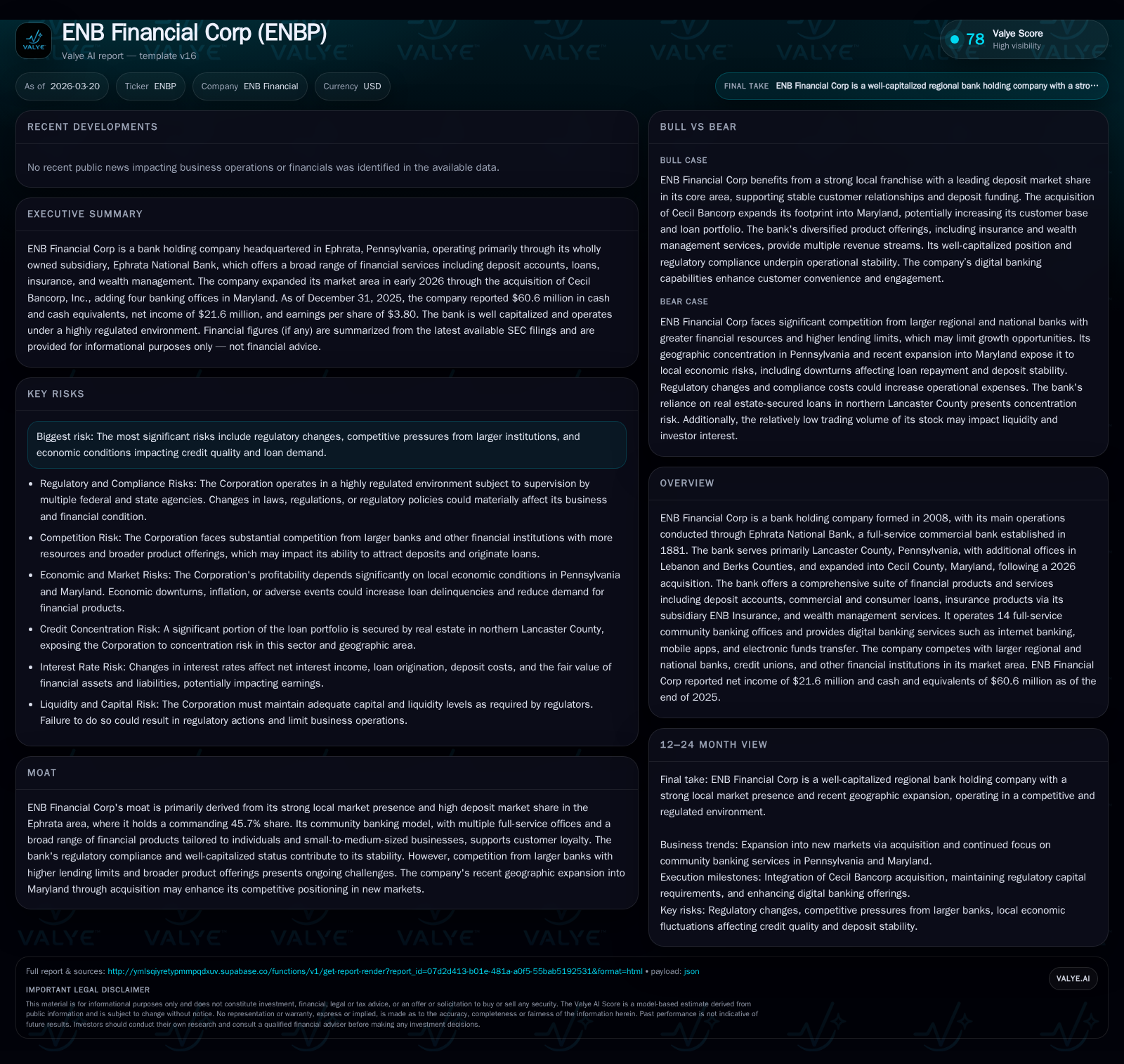
Founded in the late 19th century, ENB Financial Corp has leveraged its deep-rooted community banking model within Lancaster County, Pennsylvania, to establish a dominant deposit market share and sustained profitability. The completion of its acquisition of Cecil Bancorp in early 2026 marks a strategic geographic expansion into Cecil County, Maryland, broadening ENB’s regional presence and product diversification. Historical financials show a strong trajectory of net income growth with efficient capital utilization, while forward-looking considerations emphasize integration execution, competitive pressures from larger banks, and regulatory capital requirements as key factors shaping future growth dynamics.
From Local Heritage to Strategic Expansion: ENB’s Historical Growth Trajectory
ENB Financial Corp’s narrative begins with Ephrata National Bank—established in 1881—anchoring ENB's longstanding community banking roots primarily across Lancaster County, Pennsylvania. Before the acquisition of Cecil Bancorp completed on February 1, 2026 [S1][S3], ENB cultivated a stable franchise characterized by twelve full-service branches in Lancaster County plus one office each in Lebanon and Berks Counties [S1][S5]. This footprint enabled ENB to capture an exceptional local deposit market share of 45.7% in Ephrata as of mid-2025—a cornerstone metric reflecting entrenched customer relationships and a sustainable competitive advantage [S13].
Over the four-year period leading into fiscal year 2025, ENB demonstrated steady but accelerating earnings growth. Net income advanced from $14.63 million in FY2022 to $21.56 million by FY2025—a substantial +40.8% jump over the last reported year alone [F1]. This surge partly reflects organic gains through growing loan origination and deposit gathering within its historic Pennsylvania market but also acknowledges acquisition-related impacts with Cecil Bancorp integration underway [S10]. The company’s community banking ethos—offering tailored financial products including commercial loans, consumer loans, various deposit accounts, and ancillary insurance via ENB Insurance—underpins this consistent net income growth while buttressing client loyalty amidst an increasingly competitive landscape [S1].
Historical performance (annual)
| FY | Net ($mm) | CFO ($mm) | Capex ($mm) | Net YoY |
|---|---|---|---|---|
| 2025 | 22 | 25 | 6 | +40.8% |
| 2024 | 15 | 16 | 4 | +23.8% |
| 2023 | 12 | 30 | 2 | -15.4% |
| 2022 | 15 | 22 | 2 |
Source: SEC companyfacts cache [F1].
Capital returns and efficiency (annual)
| FY | Div ($mm) | Buybacks ($) | FCF ($mm) |
|---|---|---|---|
| 2025 | 4 | 332000 | 19 |
| 2024 | 4 | 1318000 | 12 |
| 2023 | 4 | 572000 | 29 |
| 2022 | 4 | 116000 | 19 |
Source: SEC companyfacts cache [F1].
Note: Approximate ROE calculated as Net Income divided by Equity for the respective year.
Financial Performance Trends: Profitability and Operational Cash Flow Analysis
Analyzing ENB's profitability reveals a resilient balance between earnings power and cash flow generation despite industry headwinds common to regional banks operating outside major metropolitan hubs [F1][S1]. The approximate return on equity of ~13.4% reported for FY2025 aligns with efficient usage of shareholder capital relative to peers within similarly concentrated community banking franchises [F1].
Operating cash flow exhibited volatility across several years but ultimately surged by nearly +59% in FY2025 compared to FY2024 [F1]. This rebound offset a previous trough largely caused by swings in working capital and investment activities typical for banks managing inorganic growth and IT modernization [F1]. Capital expenditures also escalated notably to $5.94 million in FY2025 (+38%), signaling strategic investments possibly linked to technology initiatives enhancing digital channels such as internet banking platforms and mobile apps [S1]. Such capex is crucial for maintaining competitiveness against both large banks and fintech entrants.
Acquisition of Cecil Bancorp: Implications for Geographic and Product Diversification
A pivotal development in early CY26 was ENB’s acquisition of Cecil Bancorp Inc., completed on February 1st for approximately $31.3 million in cash consideration [S3][S10]. This transaction added four community banking offices situated in Cecil County, Maryland—a neighboring yet distinct regional market [S10]. At the end of calendar year 2025, Cecil brought $218.66 million in total assets with $153.48 million tied up in loans and deposits amounting to $187.42 million [S10].
This move diversifies ENB’s geographic concentration previously limited to primarily Pennsylvania counties (Lancaster, Lebanon, Berks) [S13], granting an entry into Maryland's community finance sector where competitive dynamics differ somewhat due to varying local economies and regulatory nuances.
Management indicates intentions to leverage cross-selling across expanded client bases alongside gradual integration of products like wealth management services offered through ENB Wealth Solutions [S10]. While initial costs related to branch consolidation or systems harmonization might apply transiently to margins post-close, long-term benefits include scaling operational efficiencies and broader revenue diversification.
Market Positioning Amid Regional Competition: Leveraging Community Bank Advantages
Despite expansion initiatives, ENB remains a classic community bank facing stiff contestation from national regional banks boasting larger balance sheets, superior credit capacities for jumbo loans, and broader product portfolios including advanced treasury management solutions favored by larger commercial clients [S6]. Such competitors may also exploit economies of scale translating into more aggressive pricing on loan rates or deposit yields.
However, ENB’s formidable deposit market share within Ephrata (~45.7%) underscores potent customer loyalty anchored by personalized service quality inherent in its decentralized branch network [S13]. Effective customer relationship management supported by integrated CRM systems tailored for small-to-medium business clientele adds stickiness absent at some larger institutions where relationship managers cover wider territories less intensively.
The firm faces digital competition but has invested steadily in online banking capabilities packaged within its proprietary "ENB Bank on the Go!" mobile app—an essential defensive vector against fintech disruption targeting younger demographics or tech-savvy users accustomed to fully digital experiences [S1].
Interest Rate Sensitivity and Risk Management in Asset-Liability Strategies
ENB's earnings critically depend on net interest income—the spread between interest earned on loans/securities versus interest paid on deposits/funding liabilities [S1]. Ongoing fluctuations in monetary policy directly influence both sides; an adverse scenario arises if deposit rates rise faster than loan yields compressing net interest margin (NIM).
Management emphasizes active asset-liability management strategies aiming to align durations/interest sensitivities to limit mismatch risk—though challenges persist given the traditional fixed-rate nature of many mortgage real estate loans versus adjustable-rate liabilities like deposits or subordinated debt notes issued late-2025 totaling $42.5 million at initial fixed rates before transitioning to SOFR-linked floaters post-2030 maturity window [S23][F1].
Credit risk is managed prudently with diversified loan portfolios largely weighted towards residential real estate but supplemented by commercial loans supporting local businesses—a segment balancing yield with collateral quality tightly monitored under OCC guidelines [S17][S9]. Adverse macro conditions affecting Pennsylvania or Maryland economies could amplify provisions impacting future earnings.
Capital Allocation Review: Dividends, Buybacks, and Return on Equity
Capital stewardship at ENB reflects conservative financial discipline consistent with well-capitalized status per Basel III standards mandated by regulatory agencies governing bank holding companies below $3 billion asset thresholds like ENB itself [S11][F1]. Equity expanded meaningfully from $97 million in FY2022 to $161 million by FY2025 mirroring retained earnings bolstered by profitable operations alongside fresh capital instruments issued recently [F1][S26].
Dividend payments have trended upward moderately in absolute terms ($3.81M FY22 rising to $4.08M FY25), representing stable shareholder returns balanced against reinvestment needs for organic growth and capex plans [F1]. Share repurchases have occurred but remain modest relative to dividend outlays ($332K buybacks FY25), emphasizing liquidity retention over aggressive buyback strategies amidst acquisition funding demands [F1][S25].
Free cash flow computed as operating cash flow minus capital expenditure approximates $19 million for FY25—an ample buffer financing both shareholder distributions plus strategic investments without incurring substantial debt leverage beyond subordinated notes issued for capital purpose late-2025 [F1][S23].
Future Opportunities and Constraints in ENB’s Strategic Roadmap
Post-acquisition integration will be pivotal; incremental synergies arise from cross-selling opportunities between Maryland-based customers desiring expanded product sets available through ENB's existing insurance or wealth advisory arms [S10][S13]. Personnel additions are planned selectively reflecting anticipated volume upticks tied to consolidation activities without diluting cost efficiencies already achieved pre-acquisition [S10].
Regulatory risks remain salient: potential Basel III capital buffer enhancements or revisions could increase required capital reserves limiting rapid expansion unless matched with proportionate earnings growth; simultaneous pressure from large banks leveraging scale advantages challenges margin preservation especially given local jurisdictions’ economic variability relevant for credit underwriting models applied regionally [S12][S20].
Technological change mandates ongoing IT investments beyond current capex run rates ensuring cybersecurity posture mitigating reputational risks associated with data breaches or system interruptions—risks materializing industry-wide albeit without historical incidence recorded thus far at ENB per recent disclosures [S16][S27].
Key Metrics and Milestones to Monitor Moving Forward
Investors should observe credit demand evolution within both Pennsylvanian legacy markets and newly acquired Maryland branches as an indicator of successful local economic engagement post-entry; sustained net interest margin stability will reveal efficacy of asset-liability strategies amidst interest rate volatility; monitoring deposit trends vis-à-vis increasing competition—including online-only institutions—remains critical given deposits form majority funding base supporting loan originations.
Additional milestones include updates on regulatory capital ratios confirming maintenance above "well-capitalized" thresholds; quarterly commentary around integration progress showing expense rationalizations or revenue synergies materializing; dividend policy adherence indicating confidence in free cash flow sustainability; advances or setbacks around technological upgrades impacting user engagement metrics within digital channels.
Disclaimer: This analysis does not constitute investment advice or recommendations regarding securities or strategies mentioned herein but aims solely to provide a detailed factual summary grounded entirely on publicly filed data sources as of March 20, 2026.
Disclaimer: This is research-only, informational analysis and not investment advice. It may include AI-generated interpretation and general industry context. Always verify important details using primary sources.

Comments