
FiEE, Inc. Transforms Legacy Networking Into AI-Driven Digital Service Growth
FiEE pivoted from traditional networking hardware to an integrated SaaS platform with AI and blockchain capabilities, marking a critical inflection point in its business trajectory.
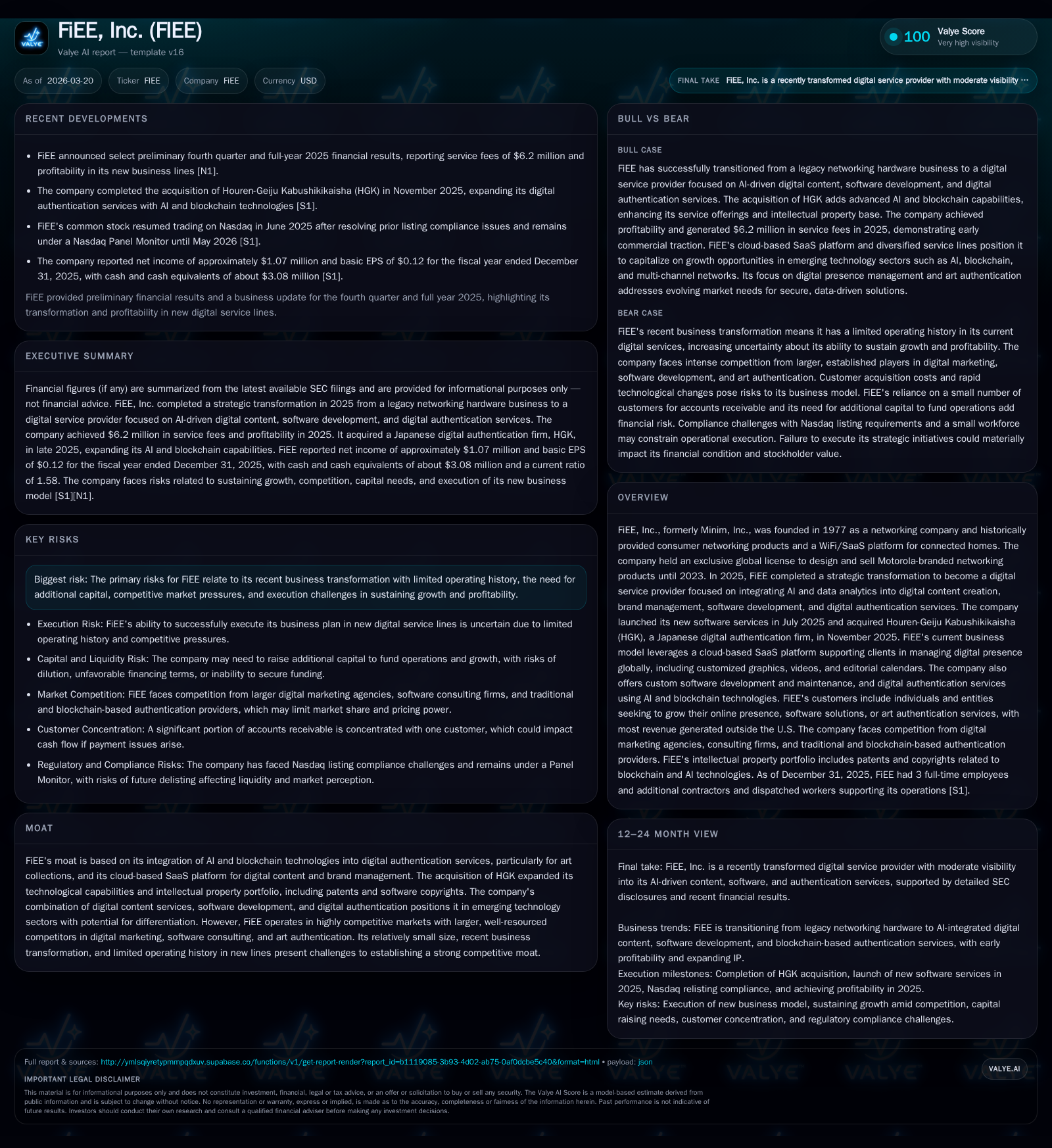
Originally founded in 1977 as a networking hardware company, FiEE, Inc. completed a strategic transformation by 2025 that repositioned it as a digital service provider focused on AI-powered content creation, brand management, software development, and blockchain-enabled digital authentication. This pivot ended legacy product lines and launched new revenue streams resulting in positive net income for the first time in years. The November 2025 acquisition of Japanese firm HGK broadened FiEE’s technological footprint into digital authentication using AI image recognition and blockchain provenance. While fundamental financial metrics indicate a turnaround with operating income of $1.55M and net income of $1.07M in 2025 alongside improving cash flows, the company faces execution risks amid highly competitive sectors dominated by larger incumbents.
Historical Performance Reflecting Inflexion: From Networking Hardware to Digital Services
FiEE’s origins trace back to consumer networking products including cable modems, routers, and mesh WiFi systems sold under license for the Motorola brand until 2023 [S7]. Revenues grew steadily from approximately $32.3 million in 2018 to nearly $48 million by 2020—a compound annual growth indicative of demand for connectivity hardware during this period [F1]. However, this legacy business model faced mounting operational losses beginning in 2021: operating income was negative $1.93 million in that year, deepening drastically to nearly negative $17 million both in 2022 and 2023 [F1]. Net income mirrored these trends with significant losses culminating in a near break-even position in 2024.
From this precarious footing marked by recurring losses associated largely with legacy operations, FiEE executed a full transformation by the end of 2024–early 2025 [S9]. The company pivoted decisively away from hardware manufacturing toward developing a suite of digital services centered on AI-enhanced content creation tools, brand management solutions, customized software development offerings launched mid-2025, and blockchain-based digital authentication [S7][S8]. This strategic reset generated service fees of $6.2 million and culminated with positive operating income of approximately $1.55 million and net income just over $1 million for fiscal 2025—marking the first profitable year since before the downturn [F1]. Operating cash flow swung favorably to about $3.64 million from persistent outflows during prior years [F1].
Historical performance (annual)
| FY | Net ($mm) | CFO ($mm) | OpInc ($mm) | Capex ($) | Net YoY |
|---|---|---|---|---|---|
| 2025 | 1 | 4 | 2 | 186095 | |
| 2024 | 0 | +100.0% | |||
| 2023 | -18 | -4 | -17 | 162270 | -13.4% |
| 2022 | -16 | -12 | -15 | 276665 |
Source: SEC companyfacts cache [F1].
Capital returns and efficiency (annual)
| FY | FCF ($mm) | ROE% |
|---|---|---|
| 2025 | 3 | 16.3 |
| 2024 | ||
| 2023 | -4 | -15212.5 |
| 2022 | -12 | -95.1 |
Source: SEC companyfacts cache [F1].
*Note: FY2024 revenue not explicitly reported; net income approximated at zero. All figures USD.
Strategic Business Model Shift: Integrating AI, Blockchain & SaaS Platforms
FiEE’s current business strategy is anchored in redefining its value through advanced technology integration—leveraging AI not only for algorithmic content creation but also embedding data analytics for dynamic brand management across multiple platforms [S7][S8]. Its SaaS offerings serve clients seeking to orchestrate their digital presence globally by delivering tailored graphics production workflows combined with short video assets and editorial calendars aligned to targeted marketing goals.
The company emphasizes multi-channel network (MCN) dynamics within its digital content vertical where influencer partnerships enhance platform reach and monetization potential while maintaining operational control centrally [S22]. FiEE’s service plans range from basic account setup through comprehensive premium arrangements including SEO optimizations and detailed performance analytics supporting long-term engagement growth.
Software development services complement this ecosystem by providing customizable end-to-end solutions—from requirements gathering through coding to integration and testing—that fulfill client-specific functional demands [S22][S27]. Meanwhile digital authentication services represent an emerging frontier combining blockchain’s tamper-evident features with AI-driven image recognition algorithms enabling high-fidelity artwork provenance verification—an area receiving heightened interest since the acquisition of Houren-Geiju Kabushikikaisha (HGK) [S7][S8].
Gross margins vary across these segments: higher margins characterize digital content services which entail recurring customer investment cycles; software development margins depend heavily on project complexity; digital authentication harbors potential for superior scalability given proprietary IP leverage [S8].
Expansion Via Acquisition: Impact of HGK on Digital Authentication Capabilities
The November 30th, 2025 acquisition of HGK marked a key enhancement to FiEE's platform capabilities [S7][S4]. This Japanese firm specializes in AI-assisted art authenticity certifications underpinned by blockchain-based provenance tracking systems—technologies that align closely with FiEE’s strategic objectives.
HGK contributed valuable patents and software copyrights augmenting FiEE's intellectual property portfolio post-acquisition valued at $3.5 million [S11]. HGK’s high client-concentration receivable accounted for roughly one percent of total revenue yet represented approximately three quarters of accounts receivable balances—highlighting immediate revenue potentials alongside concentration risk [S4].
Integration efforts focus on synthesizing HGK’s AI image recognition modalities with FiEE’s SaaS-driven analytics architecture fostering enhanced provenance certification accuracy vital for art institutions or collectors increasingly demanding secured digitized certificates authenticated via blockchain smart contracts [S7]. This synergy positions FiEE as one of few technology providers capable of offering end-to-end digital asset lifecycle management within both content creation and authentication contexts.
Financial Turnaround: Profitability & Operational Cash Flow Improvement
The financial summary evidences a decisive turnaround from sustained prior-year losses exceeding $17 million toward modest profitability milestones achieved through aggressive restructuring primarily between late-2024 and fiscal-2025 [F1]. Operating income closed at about $1.55 million while net income reached just over $1 million by end-2025—translating into an approximate return on equity (ROE) near 16.3%, based on net income relative to shareholder equity totaling roughly $6.59 million at year-end [F1].
Cash generation metrics reinforce this narrative: operating cash flow markedly expanded from negative outflows surpassing $14 million in earlier years to a positive inflow above $3.6 million last fiscal year despite ongoing capital expenditures around $186k reflecting capital discipline compared to prior periods [F1][S9]. Consequently free cash flow approximates close to $3.45 million establishing stronger liquidity foundations.
Current ratio stands at approximately 1.58 indicating sound short-term liquidity supporting operational flexibility despite existing liabilities requiring careful working capital management [F1].
FiEE has not declared or paid dividends nor engaged in share repurchases consistent with its nascent growth phase prioritizing reinvestment over shareholder returns—though shareholder dilution risk persists given reliance on equity raises for expansion funding [S6][F1].
Future Growth Drivers & Market Challenges in Emerging Tech Sectors
Key growth drivers include accelerating global client acquisition across its three principal service verticals enabled by increasing digital marketing spend targeting influencer ecosystems integrated via MCN frameworks enhancing client retention [S8][S21]. Further technological innovations including enhanced AI-driven workflow automations within brand management software are expected to raise gross margins while increasing customer lifetime values.
Blockchain-based authentication innovations remain promising differentiation particularly as art markets seek trustworthy digital provenance amid counterfeit concerns—a niche reinforced by HGK’s foothold leveraged across broader cultural asset classes internationally [S21].
Challenges arise from intense competition spanning large-cap international digital marketing agencies commanding extensive MCN networks; multinational software consultancies offering scale efficiencies; plus incumbent art authenticators combining traditional expertise with tech solutions imposing barriers for rapid scaling or pricing leverage by FiEE's smaller footprint [S4]. Rising customer acquisition costs amid evolving platform rules governing influencer marketing pose further hurdles while emerging data privacy and AI regulatory frameworks add compliance complexities necessitating continual investment without guaranteed returns [S21].
Capital Allocation Strategy & Shareholder Returns Profile
FiEE demonstrates cautious capital allocation characterized predominantly by retaining earnings to finance organic growth rather than distributing cash via dividends or buybacks—a typical stance for companies navigating early-stage business model shifts requiring reinvestment commitments [S6][F1]. Authorized common stock ceiling stands at 60 million shares but recent private placements raised several million dollars underpinning current liquidity near $3 million cash equivalents per latest reports [F1][S11]. Equity financing remains primary capital source amid absence of meaningful debt obligations lending balance sheet conservatism but exposing shareholders to dilution risks inherent with future issuances necessary for scaling or acquisitions [S10][S11][S20].
Nasdaq listing reinstatement following previous delisting threats reflects improved governance but ongoing "Panel Monitor" oversight imposed till mid-2026 underscores persistent regulatory scrutiny which may curtail flexible financing strategies [S15]. FINRA penny stock guidelines pose practical constraints on broker-dealer recommendations affecting liquidity dynamics further complicating capital markets access impacting investor confidence significantly [S6].
Competitive Landscape & Risks in Highly Contested Markets
FiEE operates within segments crowded by competitors possessing substantially greater financial resources including international digital marketing conglomerates commanding large MCN networks; global consulting firms offering software engineering engagements at scale; traditional art authenticators supplemented increasingly by blockchain startups offering overlapping provenance verification services—heightening pressure on innovation speed as well as price competitiveness essential to maintain relevance [S4].
Execution risks abound given limited historical track record post-pivot coupled with lean staffing comprising only three full-time employees supported by contractors limiting bandwidth exposure—and rapidly evolving technology frontiers requiring constant product upgrades challenging resource-constrained players like FiEE into sustainability dilemmas frequently observed among emerging tech enterprises venturing beyond established archetypes [S25][S21]. Ethical concerns inherent with AI usage such as bias or hallucination phenomena could impair reputational standing if unmitigated appropriately—a material factor acknowledged explicitly within risk disclosures pointing toward heightened operational vigilance demands going forward [S21]. Cybersecurity vulnerabilities represent additional systemic risks capable of disrupting client trust critical within online brand management environments emphasizing secure data stewardship imperatives continuously escalating costs unexpectedly.
What Investors Should Watch Next: Milestones & Forward Indicators
Absent explicit forward-looking guidance disclosed thus far requires monitoring soft indicators reflecting business progress such as incremental customer win rates especially regarding higher-tier Global Premium Plan adopters within MCN cohorts contributing outsized monthly recurring revenues underpinning SaaS expansion narratives underpinned by platform engagement statistics periodically reported via corporate updates or filings.
Integrative success following HGK acquisition deserves scrutiny focusing on technology assimilation timelines evidenced through deployment case studies showcasing improved authentication accuracy or reduced fraud incidents securing new enterprise contracts—key milestones resonating strongly within investor sentiment building long-term confidence arcs.
Margin enhancement trajectories driven by mix-shift toward higher-margin digital content or authenticating services amid scaling revenue bases will provide tangible validation signals against competing incumbents whose scale advantages represent entrenched headwinds long recognized throughout technology-enabled marketing industries.
Liquidity preservation aligned against capital deployment pacing reflected through periodic cash flow statements complemented by any announced secondary equity offerings could materially influence share count trends affecting ownership concentrations requiring attentive tracking within quarterly disclosures.
This analysis incorporates facts presented from official SEC filings dated March 20th, 2026 ([F1], [S#]) alongside Valye proprietary research insights without expressing investment advice or recommendations. Readers should consider this report strictly informational and conduct further due diligence tailored to individual decision contexts.
Disclaimer: This is research-only, informational analysis and not investment advice. It may include AI-generated interpretation and general industry context. Always verify important details using primary sources.

Comments