
WORK Medical Technology's Growth Moderated by Loss Recovery and Capital Restructuring
The company leverages established AI-enabled medical devices amid capital structure overhaul and regulatory challenges.
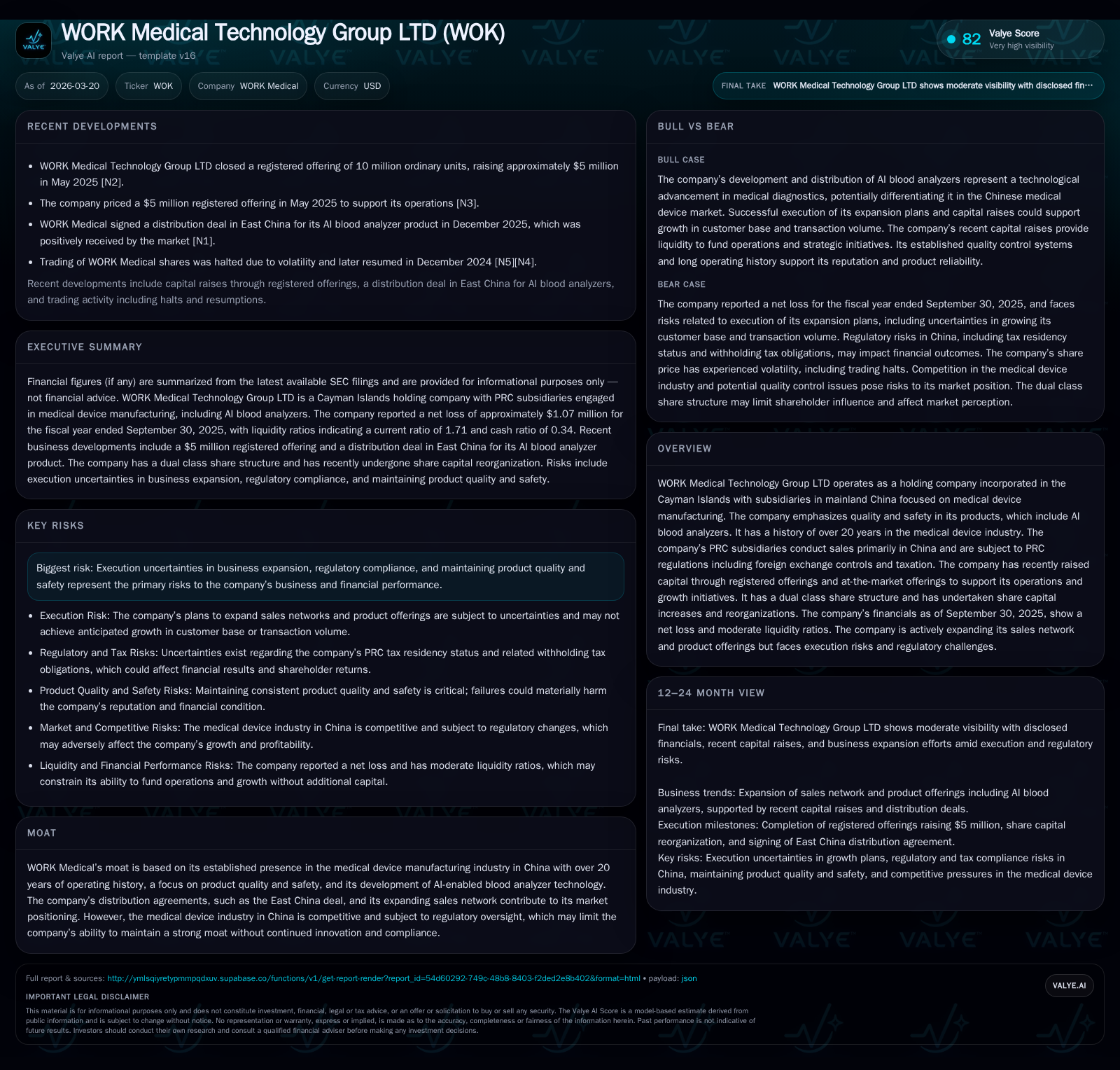
WORK Medical Technology Group LTD, with over two decades in medical device manufacturing in China, reported improving operating cash flows and narrowing net losses through FY2025. The firm advanced its capital structure via a significant share consolidation and reduction approved in early 2026 to meet Nasdaq listing standards. Its expansion focuses on broadening sales networks and product offerings, particularly AI blood analyzers, within a tightly regulated Chinese market. Key risks include execution uncertainties in expansion, stringent regulatory compliance, and maintaining product quality in a competitive environment.
Company Overview
WORK Medical Technology Group LTD operates through subsidiaries predominantly based in mainland China, focusing on manufacturing AI-enabled medical devices like blood analyzers with an emphasis on rigorous quality control and safety standards. Incorporated in the Cayman Islands, the company has navigated complex PRC regulations concerning foreign exchange controls and taxing regimes that directly impact its dividend repatriations and operational liquidity [S1].
Their more than 20-year operating history underpins a moat centered on technological innovation combined with expansive distribution agreements (notably in East China) and an expanding sales footprint within China’s competitive medical device sector .
Historical Performance and Drivers
A review of key financial performance indicators reveals that WORK Medical Technology has been progressively stabilizing its operations:
Historical performance (annual)
| FY | Net ($mm) | CFO ($mm) | Capex ($mm) | Net YoY |
|---|---|---|---|---|
| 2025 | -1 | 6 | 1 | +69.3% |
| 2024 | -3 | -2 | 9 |
Source: SEC companyfacts cache [F1].
Capital returns and efficiency (annual)
| FY | FCF ($mm) | ROE% |
|---|---|---|
| 2025 | 5 | -5.8 |
| 2024 | -11 | -26.5 |
Source: SEC companyfacts cache [F1].
(Financials as of Sept 30) [F1]
The near-term narrowing of net losses is principally driven by enhanced operational efficiencies that translated into positive operating cash flows after prior deficits. A marked reduction in capital expenditure reflects strategic restraint relative to prior years’ heavy investments.
Equity growth corresponds with capital raises including IPO proceeds and registered offerings used to fund debt reductions and key acquisitions, bolstering balance sheet stability [S11][F1].
Capital Structure Evolution
In February 2026 shareholder meetings approved critical corporate actions: a substantial increase in authorized share capital—from $100 million divided into millions of Class A/B shares with $5 par value each—to a vastly larger pool with minuscule par values ($0.00001 per share). This entailed share consolidation where multiple existing shares were merged into fewer shares to elevate market price compliance for Nasdaq requirements without altering economic ownership meaningfully [S2][S16][S24].
These steps also included creating distributable reserves from canceled paid-up capital to facilitate balance sheet flexibility for loss offsets or future distributions under Cayman Islands law subject to shareholders’ approval.
Growth Prospects
WORK’s future expansion plans mainly target enlarging its footprint in China through broadening its sales network and product portfolio—especially leveraging its AI blood analyzer technology which remains key for competitive differentiation . However:
- Regulatory constraints remain significant; navigating PRC foreign exchange controls injects currency risk into profitability.
- Industry competition is intensifying as both domestic and international players innovate rapidly.
- Market acceptance hinges upon maintaining rigorous product quality amid scale-up.
Management’s strategy includes strategic acquisitions (e.g., ELEFUN Group) aimed at complementing organic growth initiatives with synergies across distribution channels and product categories [S11][F1]. Nonetheless, execution risks carry weight given the complexity of scaling compliance-intensive medical device operations.
Financial Forecasts & Milestones to Monitor (Analysis)
While explicit guidance is not detailed in filings as of this report date, critical indicators to watch for include:
- Revenue trajectory vis-à-vis expanded sales reach within China;
- Profitability inflections reflecting controlled costs and increasing margins;
- Successful integration outcomes from recent acquisitions;
- Compliance milestones addressing regulatory audits or approvals;
- Effects of dual-class structure dilution strategies on shareholder equity dynamics.
Given the absence of near-term dividend plans or buybacks—typical for companies at this growth phase—the focus remains on reinvestment into business operations and deleveraging [S7][S15][F1].
Capital Allocation & Returns
WORK’s governance confirms a commitment to prudent capital deployment post-major equity raises:
- Net proceeds from IPO and subsequent offerings exceeded $14 million used largely for loan repayments (
$6.7M), acquisition financing ($6.3M), and asset purchases (~$1.3M) signifying efforts toward strengthening operational foundations [S11][S15][F1]. - The company currently does not pay dividends nor execute share repurchase programs reflecting reinvestment priorities coupled with ongoing loss structures [S7][S20].[F1]
- Approximate return on equity based on latest filings equates to negative 5.8%, highlighting ongoing earnings recovery efforts [F1].
- Free cash flow realized at approximately $4.9 million evidences healthier liquidity from positive operating income gains minus capital spending obligations [F1].
Industry & Regulatory Environment Analysis
China’s medical device sector is heavily regulated; companies like WORK must navigate multiple layers:
- Strict product registration requirements alongside quality certification impose continuous compliance overheads;
- Foreign exchange controls complicate cross-border earnings repatriation impacting working capital management;
- Competitive pressure from both multinational firms eyeing Chinese market entry and indigenous innovators fosters imperative for constant R&D investment. Maintaining high-quality output is non-negotiable due to direct health impacts associated with their products—a risk that can materially affect brand reputation if compromised despite extensive control systems mentioned by management [S12][S14][S19].
Risks Summary & Governance Considerations
Key risks articulated include:
- Execution risk tied to geographic expansion efficacy amidst increased competition;
- Regulatory risk particularly relating to product approvals and financial controls required under U.S. GAAP reporting frameworks given company’s NASDAQ listing status as a foreign private issuer;
- Capital structure complexities arising from dual-class shares potentially diluting influence of certain shareholders causing governance frictions [S12][S18];
- Potential material adverse effect from any failure of internal controls or cybersecurity issues though none materialized thus far [S22];
- Shares’ volatile trading prices reflecting emerging growth profile dynamics noted by management disclosures affecting investor sentiment [S12].
The Board has taken active steps including auditor transitions aimed at reinforcing financial reporting integrity—a critical governance enhancement evident since FY2024 filings [S21].
Conclusion
WORK Medical Technology Group LTD operates within the nexus of high innovation demand, regulatory complexity, and market expansion potential unique to China’s healthcare equipment sector. Its historic legacy paired with AI-enabled products offers competitive differentiation but also requires strategic execution precision. The company has visibly improved cash flows while narrowing losses indicating operational leverage potential as it adjusts capex spend patterns post-heavy investment phase. Capital restructuring initiatives underscore adaptation towards compliance with Nasdaq marketplace rules enhancing likely liquidity profile. Future performance hinges critically on effectively managing scaling risks intertwined with maintaining product excellence under evolving regulatory scrutiny. Investors should monitor operational execution metrics alongside regulatory developments given their outsized impact on sustainability of WORK’s improvement trajectory.
Disclaimer: This analysis is based solely on publicly available SEC filings up to March 2026 and internal assessment of company-provided data without any investment recommendation or advice.
Disclaimer: This is research-only, informational analysis and not investment advice. It may include AI-generated interpretation and general industry context. Always verify important details using primary sources.

Comments