
Okeanis Eco Tankers Corp. Advances with Modern Fleet and Environmental Edge
Okeanis leverages its young, fuel-efficient tanker fleet and a balanced chartering approach to maintain profitability despite market volatility.
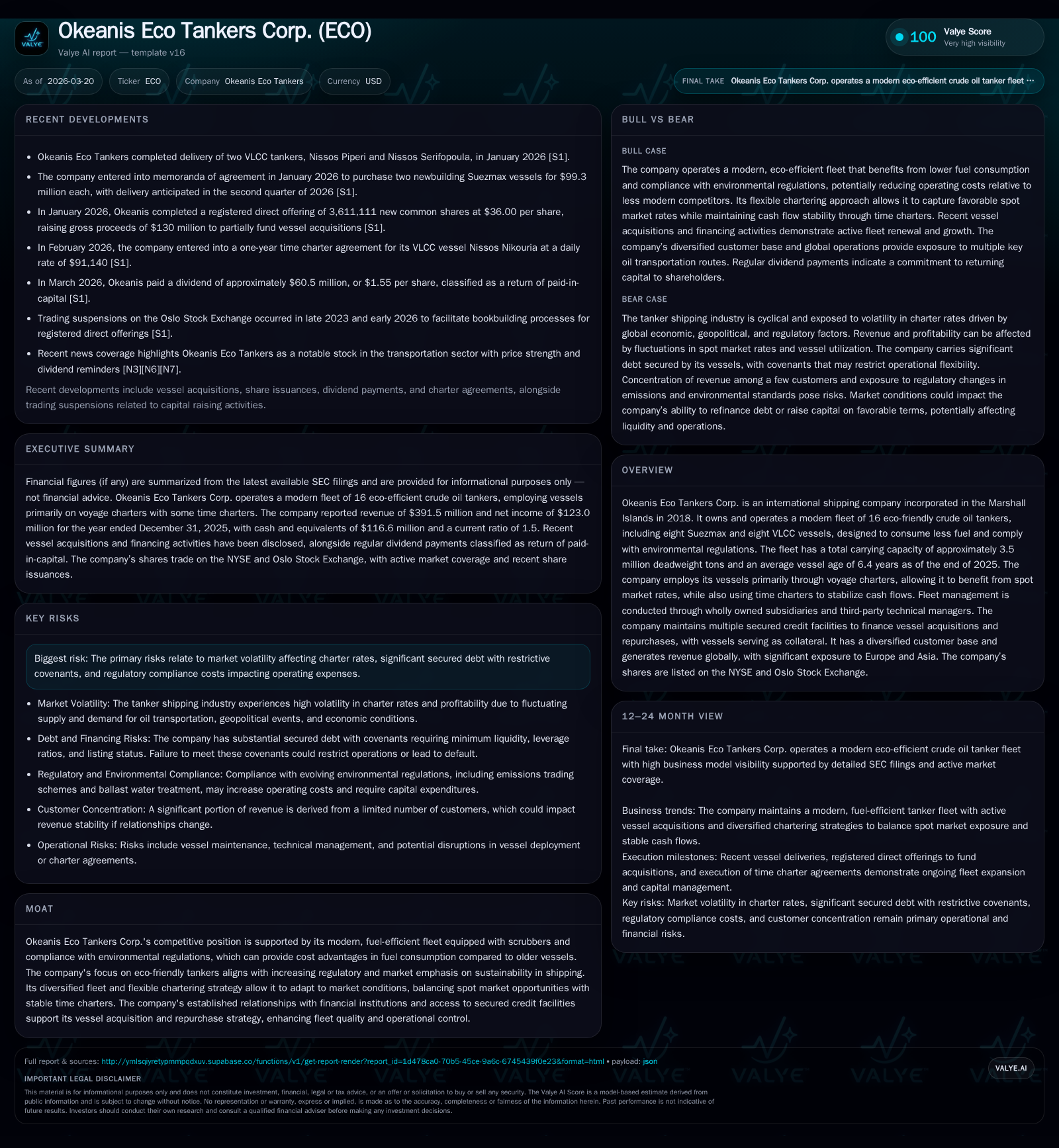
Okeanis Eco Tankers Corp. operates a modern fleet of eco-friendly crude oil tankers that offer competitive fuel efficiencies aligned with tightening environmental regulations. Despite a slight revenue decline in recent years, the company improved net income through disciplined cost management and fleet operational advantages. Its dual charter strategy blends spot market exposure with time charter stability, enabling flexibility amid volatile tanker rates. Capital allocation reflects prudent debt management alongside an increasing dividend payout, signaling confidence in cash flow sustainability. Key future growth drivers hinge on new vessel acquisitions and regulatory compliance costs, while close monitoring of credit covenants and market dynamics remains essential.
Modern Fleet as a Growth Engine: Historical Performance Summary
Okeanis Eco Tankers Corp., incorporated in the Marshall Islands in 2018, operates a substantive fleet of 16 eco-friendly crude oil tankers split evenly between Suezmax (approx. 157,000 dwt) and VLCC categories (approx. 300,000 dwt). The fleet's average age stood at 6.4 years as of December 31, 2025 [S1]. This relatively young fleet is equipped with environmentally focused technologies such as scrubbers and energy-efficient shaft generators installed during drydocking cycles.
The company reported revenues of $391.5 million for FY2025, marking a slight decline of 0.4% from $393.2 million the prior year while trailing the $413.1 million recorded in FY2023 [F1]. Notably, net income improved by nearly 13% in FY2025 to $123.0 million after a dip in FY2024 ($108.9 million) following a stronger FY2023 ($145.3 million) [F1]. This divergence between revenue and earnings highlights enhanced operational efficiency resulting from the fuel-saving advantages inherent in their modern fleet combined with effective cost controls.
Equity expanded sharply by approximately 39.7% to $573 million as of year-end 2025 from $410 million prior year-end [F1], reflecting retained earnings accumulation bolstered by profitability improvements as well as capital raises.
Historical performance (annual)
| FY | Rev ($mm) | Net ($mm) | Rev YoY | Net YoY |
|---|---|---|---|---|
| 2025 | 392 | 123 | -0.4% | +12.9% |
| 2024 | 393 | 109 | -4.8% | -25.1% |
| 2023 | 413 | 145 |
Source: SEC companyfacts cache [F1].
Capital returns and efficiency (annual)
| FY | Div ($mm) | ROE% |
|---|---|---|
| 2025 | 27 | 21.5 |
| 2024 | 26.5 | |
| 2023 | 3 | 35.6 |
Source: SEC companyfacts cache [F1].
The table encapsulates Okeanis’ financial evolution over three years emphasizing slight revenue pressure but better margin management.
Chartering Philosophy: Spot Market Flexibility Meets Time Charter Stability
Okeanis implements a dual-pronged chartering model comprising voyage charters—where vessels are contracted for single trips charged on spot rates—and time charters that lease vessels for fixed periods to charterers responsible for voyage costs such as bunkers, port fees, and canal tolls [S1].
Voyage charters provide exposure to volatile spot prices allowing upside participation during favorable market swings but introduce unpredictable revenue streams due to fluctuating tanker rates and fuel price risks borne by Okeanis as operators paying voyage expenses directly [S1].
Conversely, time charters offer steadier cash flows with lower margin potential since charterers take on voyage expense risk but do not fully capitalize if spot rates spike.
This blend enables Okeanis operational flexibility: it captures improving tanker freight markets through voyage contracts while maintaining baseline earnings via time charters that mitigate downside volatility—a typical strategy among modern tanker operators seeking risk-adjusted returns.
Navigating Market Dynamics: Factors Impacting Year-on-Year Revenue and Profitability
Tanker commodity markets are inherently cyclical driven by global oil demand-supply balances, geopolitical tensions affecting trade routes, seasonal weather influences on sailing conditions, and evolving environmental regulation impacting operating costs [S1].
In FY2025, revenue dipped marginally due largely to softer spot charter rates amid global economic uncertainty affecting energy demand [S1]. Meanwhile, net income growth was supported by lower finance expenses—interest paid decreased significantly from prior periods—and disciplined operating expense management including crew cost optimization and maintenance scheduling aligned with drydock inspections [S12].
Drydocking activities for scheduled special surveys occurred prominently in FY2025 involving Suezmax ships Nissos Sifnos and Nissos Sikinos with drydock costs above $3 million per vessel including upgrades such as shaft generator installations adding to fuel efficiency [S7].
The interplay between tight financial covenants from secured credit facilities—restricting excessive leverage—and ongoing capital investment needs has been carefully managed to preserve liquidity without compromising investment in fleet quality or compliance [S4][S10].
Investment in Sustainability: Upgrades and Eco-Friendly Vessel Features Enhancing Cost Efficiency
Okeanis’ fleet modernity manifests not only through younger vessel age but also proactive capital expenditure on environmental compliance infrastructure such as exhaust gas scrubbers reducing SOx emissions below IMO limits [S1].
Noteworthy is the integration of shaft generators in scheduled drydock periods enhancing onboard electrical efficiency thus lowering overall fuel consumption—a critical operating cost component given bunker prices influence direct voyage expenses during spot charters [S7].
Such investments contribute directly to competitive advantage by potentially lowering operating expenses relative to legacy fleets lacking these features.
Furthermore, financing agreements incorporate sustainability-linked margin adjustments tied to verified CO2 efficiency metrics ensuring alignment of corporate financing costs with environmental performance targets [S16][S22].
Future Growth Catalysts and Constraints
Looking ahead into early 2026 developments disclosed in SEC filings indicate Okeanis is expanding its holdings through strategic acquisitions including two newbuilding Suezmax tankers priced around $99 million each expected mid-2026 delivery plus exercised purchase options on two leased VLCC vessels valued at about $94 million total [S20].
These additions will increase carrying capacity beyond the existing ~3.5 million dwt footprint enhancing revenue base potential provided that market rates hold or improve.
However, restrictive debt covenants limiting new indebtedness levels pose constraints on further aggressive expansion absent equity capital raises or asset disposals [S4][S11].
Regulatory risk persists with tightening marine emissions standards likely demanding continued capex inflows into fleet refits or higher operating expenditures potentially compressing margins if not offset by freight rate improvements [N6][S1].
Capital Allocation Strategy: Managing Debt, Liquidity, and Shareholder Returns
Okeanis maintains a sizable yet manageable leverage profile; net debt at approximately $605 million declined modestly from $645 million one year prior aided by active repayments while cash balance nearly doubled crossing $116 million at end-2025 providing cushioning liquidity [F1][S12].
Leverage ratios are carefully monitored to remain under covenant thresholds typically requiring liabilities below ~75% of asset carrying values with adjustments for market valuations of vessels pledged as collateral [S4][S10].
Return on equity translates favorably into ~21.5% using FY2025 net income over equity base illustrating effective use of invested capital amid challenging shipping markets [F1].
Shareholder returns have increased steadily; dividends climbed to $26.6 million distributed in calendar year reflecting confidence in sustainable free cash flows even amidst expansion outlays [F1][N3][S23].
Notable is the successful share issuance early-2026 that raised over $110 million gross proceeds supporting recent vessel purchases without unduly raising additional debt levels [S20].
What to Watch: Key Milestones and Market Indicators Ahead
Investor monitoring should focus on shifts in charter rate dynamics particularly the balance between voyage versus time charters dictating revenue volatility profiles.
Key indicators include the delivery timelines for the purchased newbuildings expected second quarter of calendar year ’26 which will influence capacity metrics.
Credit covenant compliance remains paramount given high secured debt outstanding; any deterioration could trigger prepayment demands or operational restrictions.
Regulatory developments on IMO emissions targets post-2030 may require additional retrofitting impacting expense forecasts while freight market factors such as refinery utilization rates globally or geopolitical disruptions would drive tanker demand-supply fundamentals material to Okeanis’ earnings.
Overall liquidity trends supported by ongoing cash flows versus capex commitments warrant continued attention alongside market rates influencing spot charter premiums.
This analysis summarizes publicly available data up to March 20, 2026 based on SEC filings ([F1],) and verified news sources (). It does not provide investment advice or recommendations.
Disclaimer: This is research-only, informational analysis and not investment advice. It may include AI-generated interpretation and general industry context. Always verify important details using primary sources.

Comments