
4D Molecular Therapeutics Advances Lead Program While Managing High Cash Burn and Developmental Risks
4DMT drives growth through proprietary genetic medicine platforms targeting ophthalmology and pulmonology, facing typical biopharma capital and regulatory challenges.
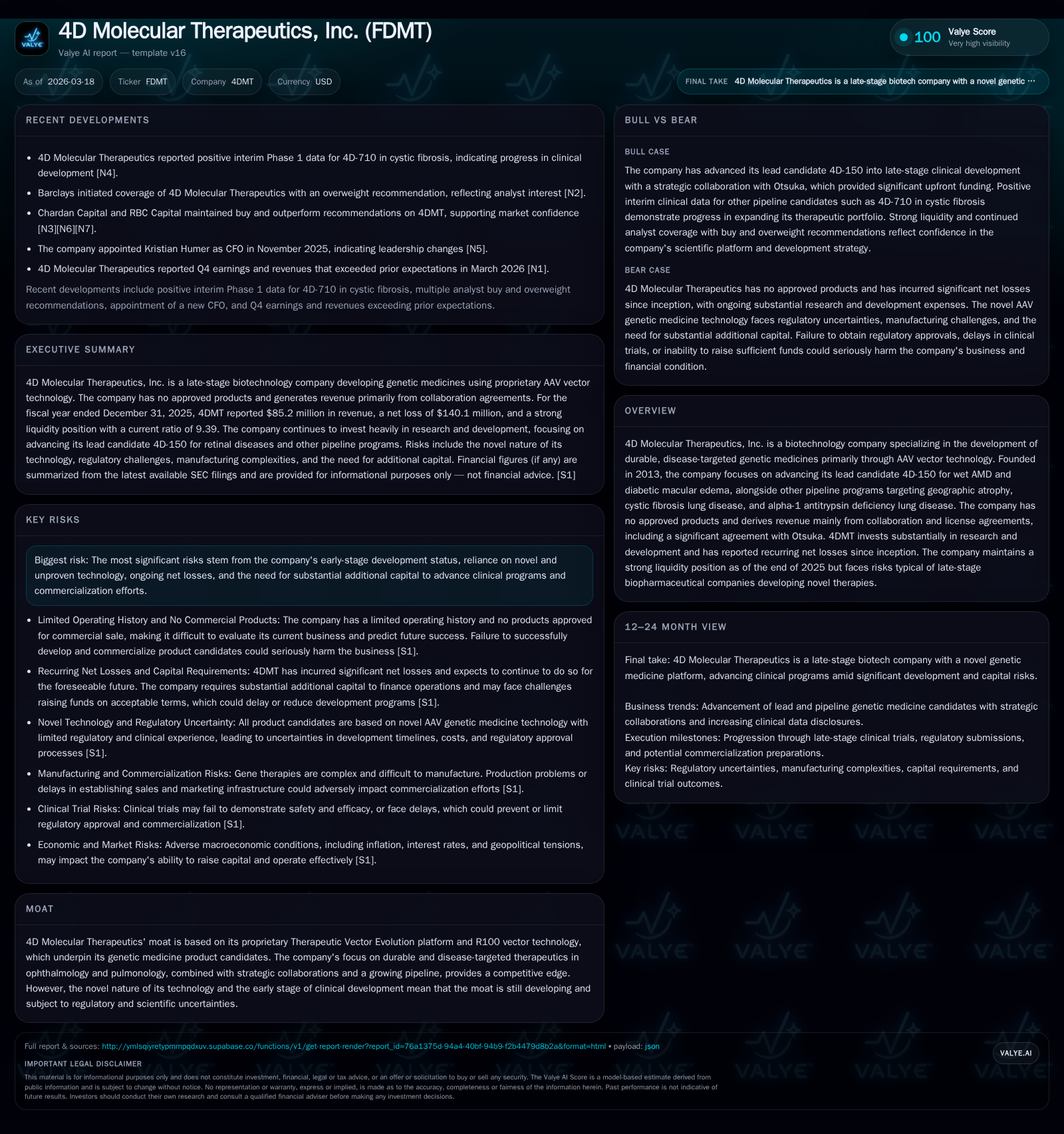
Since its founding in 2013, 4D Molecular Therapeutics has focused on developing durable genetic medicine therapies anchored by its Therapeutic Vector Evolution platform. The company’s revenue surged significantly in 2025 due primarily to collaboration agreements, though it continues to incur substantial net losses and negative operating cash flow driven by ongoing R&D investment. With lead assets targeting wet AMD and diabetic macular edema now in late-stage development, the firm's near-term prospects hinge on clinical progress, regulatory milestones, and continued capital access. 4DMT maintains strong liquidity but faces considerable risks inherent to novel gene therapy development.
Company Overview and Historical Performance
Founded in 2013, 4D Molecular Therapeutics (4DMT) is a biotechnology company specializing in the development of durable, disease-targeted genetic medicines primarily through adeno-associated virus (AAV) vector technology [S1]. Its proprietary Therapeutic Vector Evolution platform underpins novel gene therapy candidates focused on ophthalmology indications such as wet age-related macular degeneration (AMD), diabetic macular edema (DME), geographic atrophy, as well as pulmonary conditions including cystic fibrosis lung disease and alpha-1 antitrypsin deficiency lung disease.
Financially, the company maintains no approved products or product sales revenue to date. Instead, revenue generation derives primarily from collaboration and licensing agreements with pharmaceutical partners—most notably a significant deal with Otsuka Pharmaceutical [S1]. The firm’s historical financial footprint reveals recurring substantial net losses driven by heavy research and development (R&D) spending necessary for advancing its clinical programs.
The following table summarizes key annual financial metrics over recent years [F1]:
Historical performance (annual)
| FY | Rev ($mm) | Net ($mm) | CFO ($mm) | OpInc ($mm) | Rev YoY | Net YoY |
|---|---|---|---|---|---|---|
| 2025 | 85 | -140 | -109 | -160 | +230194.6% | +12.9% |
| 2024 | 0 | -161 | -135 | -188 | -99.8% | -59.5% |
| 2023 | 21 | -101 | -76 | -113 | +562.3% | +6.2% |
| 2022 | 3 | -107 | -87 | -110 |
Source: SEC companyfacts cache [F1].
Capital returns and efficiency (annual)
| FY | FCF ($mm) | ROE% |
|---|---|---|
| 2025 | -110 | -27.7 |
| 2024 | -138 | -31.5 |
| 2023 | -79 | -32.8 |
| 2022 | -98 | -46.5 |
Source: SEC companyfacts cache [F1].
Revenue recorded an extraordinary increase of over two hundred thousand percent year-over-year between FY24 and FY25. This jump reflects milestone payments or license fee recognition linked to strategic collaborations rather than organic product sales [N1][S1]. Despite this rise in top-line figures, operating income remains significantly negative at approximately -$160 million in FY25—consistent with an investment-heavy business model focused on clinical advancement.
Net losses continue but have narrowed modestly in absolute terms from prior years. Operating cash flow mirrors this trend deep into negative territory (-$109 million in FY25). Capital expenditures decreased substantially to just over half a million dollars in FY25 from multi-million-dollar levels previously. This contraction likely signals operational efficiencies or scaling back of fixed asset investments amid ongoing R&D prioritization.
The company’s balance sheet demonstrates solid liquidity as evidenced by an unusually high current ratio near 9.4 times—backed by $60.2 million cash & equivalents alongside $413 million in total current assets against modest current liabilities of $44 million at year-end 2025 [F1][S17][S28].
Growth Drivers and Competitive Moat
4DMT’s technological moat centers on its Therapeutic Vector Evolution platform combined with its proprietary AAV vector technology [S1]. This suite facilitates highly targeted delivery of gene therapy payloads aimed at durable therapeutic effects across both eye diseases and lung disorders—a strategy aligning well with unmet medical needs in chronic genetic or degenerative conditions.
Its lead candidate program is the gene therapy agent dubbed 4D-150 targeting wet AMD and diabetic macular edema—the former representing a large indication with substantial patient populations that currently rely on frequent anti-VEGF injections [S1]. Successful clinical validation could displace standard care by offering potentially longer-lasting treatments.
Additional pipeline programs address geographic atrophy (dry AMD subtype), cystic fibrosis-related lung disease, and alpha-1 antitrypsin deficiency lung conditions—all chronic ailments where gene delivery holds promise for modifying disease natural history rather than symptom management alone.
Strategic collaborative arrangements especially with Otsuka provide crucial non-dilutive capital infusion plus commercialization leverage for global markets where resources alone would impede the scale-up required for approval and launch.
However, the novelty of AAV-based gene medicines inherently poses significant developmental risks: limited clinical precedent heightens uncertainty around trial success probabilities and regulatory timelines [S2]. Regulatory agencies like FDA are still calibrating frameworks around gene therapies—potentially increasing approval costs and duration compared to conventional biologics.
Future Prospects and Key Milestones
The company's outlook hinges materially on progressing lead candidates through pivotal studies toward marketing authorization. Upcoming clinical data releases for programs like 4D-150 will serve as critical inflection points [N1][S3]. Success would enable subsequent scale-up manufacturing efforts—an area requiring further investment—and eventual commercial launch planning.
Conversely, failure or delay in demonstrating safety or efficacy might necessitate pipeline reprioritization or resource reallocation toward internally identified opportunities more likely to succeed under prevailing scientific understanding.
Despite accelerated revenue recognition attributable mostly to partnerships rather than product sales at present, the absence of any FDA-approved products caps near-term revenue potential [S1]. The company emphasizes that product sales revenues are unlikely before several years due to clinical timelines.
Capital raising activities remain essential given sustained net outflows; recent equity issuances raised significant funds ($93.5M gross proceeds reported during FY25) reflecting investor appetite but also underlying need for growth capital [F1][S17][S24].
Capital Allocation and Returns Profile
Given the absence of profitability or positive free cash flow generation so far, return measures like ROE are negative—approximated at about -27.7% based on latest figures from FY25 net loss relative to equity base [$140M / $506M] [F1].
Operating cash flows remain deeply negative owing primarily to upfront commitments for R&D expenditure required for novel gene therapy programs ($-109M CFO recorded).
Capital expenditures are currently modest relative to operating expenses indicating focus likely centered on clinical trials rather than fixed asset expansion; capex dropped sharply by nearly 86% year-over-year between FY24 and FY25.
The company has never declared dividends nor engaged in share repurchases consistent with pre-commercial stage biotech norms where capital reinvestment into pipeline development supersedes shareholder distributions [S1]. Financing strategies center largely on equity offerings supplemented possibly by ATM programs or other instruments—actions critical to sustain operations given ongoing cash burn rates documented [F1][S17].
Risk Factors Summary
In line with late-stage biopharmaceutical peers developing first-in-class gene therapies that face unique regulatory scrutiny and scientific hurdles:
- The unproven nature of the AAV genetic medicine platform introduces high uncertainty around time-to-market and approval success probabilities despite promising technology [S2].
- Significant ongoing net losses underscore need for continuous external funding exposure risks should capital markets tighten or partnerships falter [F1][S24].
- Commercialization competence gaps exist since no internally marketed products yet; reliance on partner alliances critical but adds complexity [S21].
- Regulatory compliance costs grow materially if/when products receive approval given complex healthcare law landscape governing promotion practices affecting marketing approaches negatively if not managed correctly [S6][S13][S22].
- Potential intellectual property litigation risks loom relating to novel technologies typical within biotech sectors threatening costly disputes or licensing encumbrances [S18][S26].
- Product liability exposures arise from clinical testing phases moving into human subjects requiring adequate insurance coverages which may be insufficient considering novel treatment risks [S19][S23].
- Macro-geopolitical tensions impacting biopharma supply chains or contract manufacturing organizations present possible procurement vulnerabilities beyond direct control [S20][S25].
Industry Context Note (Analysis)
Gene therapy is a rapidly evolving sector characterized both by scientific breakthroughs enabling targeted interventions for previously untreatable diseases and by considerable uncertainties related to long-term efficacy/safety profiles plus evolving regulatory landscapes worldwide. Market adoption timelines often extend several years post initial approvals due to reimbursement adjudications plus clinician acceptance curves uncommon compared to small molecules or traditional biologics.
Companies with proprietary vectors showing tissue-specific tropism gain competitive advantages; however viral vector immunogenicity mitigation remains a technical barrier frequently examined preclinically before upscaling manufacturing for commercial demand—a challenge that inflates cost structures relative to standard biological drug production.
Conclusion
4D Molecular Therapeutics represents a classic late-stage biotechnology enterprise aggressively pursuing innovative genetic medicines addressing serious ophthalmic and pulmonary diseases by leveraging a differentiated proprietary vector platform. Financially it remains firmly in investment mode with escalating revenue driven almost exclusively through collaborations yet burdened by enduring high net losses reflecting intense R&D demand.
Its future trajectory depends decisively upon successful demonstration of clinical efficacy/safety across lead indications paired with retention of adequate funding capacity amid a challenging regulatory environment uniquely stringent for novel gene therapies. While liquidity remains robust presently enabling ongoing operations without immediate solvency concerns, advancement milestones will recalibrate valuation inflections alongside heightened risk exposures customary among emerging biotech firms pushing frontiers of medicine.
This analysis is based solely on publicly available information as of March 18, 2026. It does not constitute investment advice or endorse any securities.
Disclaimer: This is research-only, informational analysis and not investment advice. It may include AI-generated interpretation and general industry context. Always verify important details using primary sources.

Comments