
Processa Pharmaceuticals’ Strategic Evolution Through Regulatory Science and Pipeline Challenges
Processa Pharmaceuticals advances oncology drug candidates by modulating metabolism and distribution, facing execution risks amid financial strain.
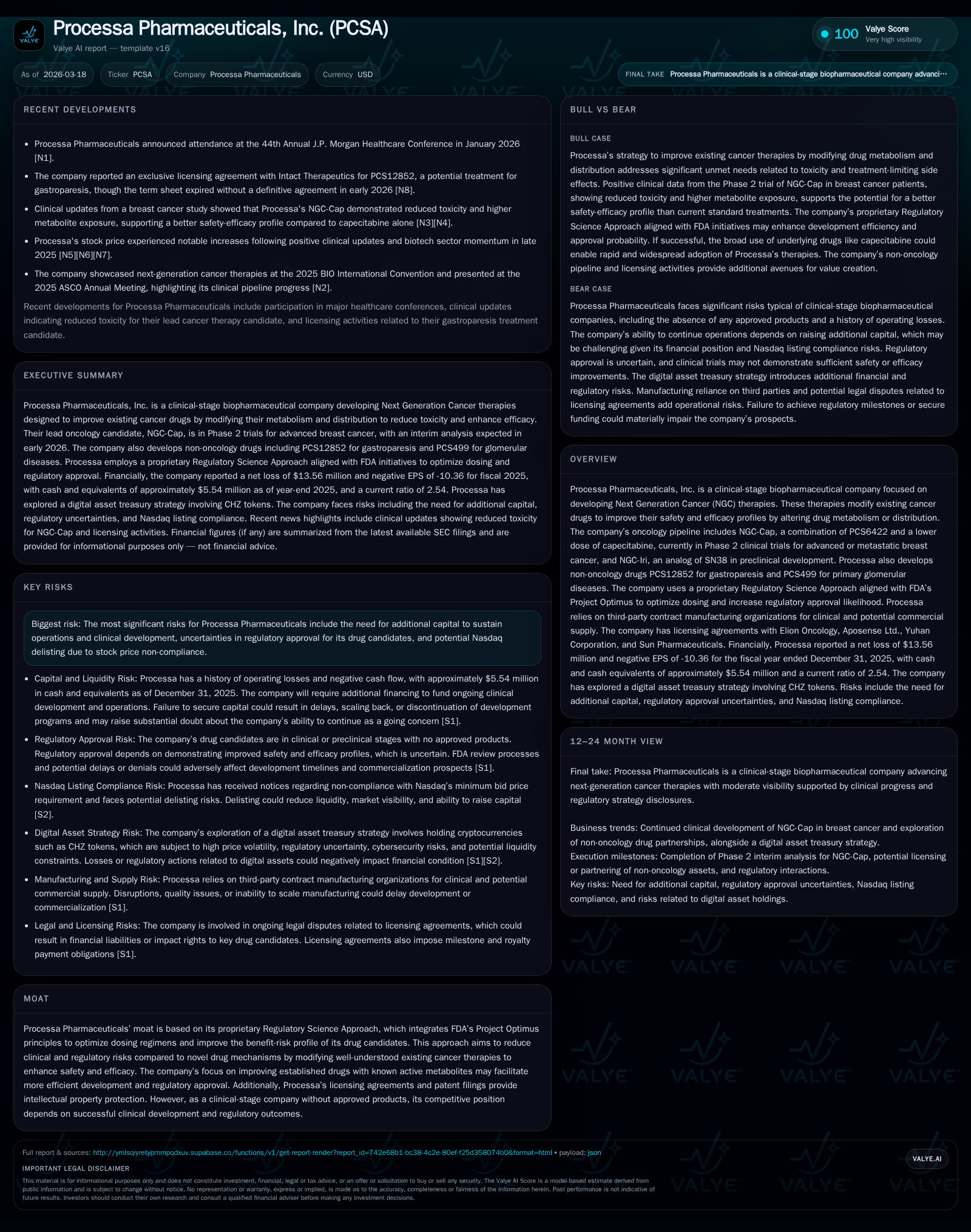
Processa Pharmaceuticals is a clinical-stage biotech developing Next Generation Cancer (NGC) therapies that optimize existing cancer drugs through pharmacokinetic modulation to improve safety and efficacy. Its leading candidate, NGC-Cap, is in Phase 2 trials targeting advanced breast cancer, supported by a proprietary Regulatory Science Approach aligned with FDA’s Project Optimus to enhance dose optimization and regulatory probability. However, the company operates under continuous net losses with minimal revenue, limited cash reserves, and ongoing legal disputes that heighten operational risk. Commercial milestones hinge on successful trial readouts and regulatory approvals while financial sustainability depends critically on securing additional capital amid Nasdaq listing compliance challenges.
Financial Trajectory and Historical Operating Dynamics
Processa Pharmaceuticals’ financial history depicts a challenging trajectory typical of clinical-stage biopharmaceutical companies without approved products. Revenues have declined precipitously from modest early figures — $312K in 2013 dropping to effectively nominal levels at $5K by 2016 [F1]. No meaningful commercial revenue has emerged since.
Operating income has remained persistently negative, with net losses expanding from around $11 million annually in the early 2020s to approximately $13.6 million in FY2025 [F1]. The operating cash flow trend similarly demonstrates sustained outflows: CFO was negative $11.4 million in FY2025 with free cash flow (CFO minus capex) comparably negative around $11.4 million due to minimal capital expenditures being offset by high operating spend [F1].
Liquidity metrics reflect a constrained but not critical position — Processa held roughly $5.5 million in cash and equivalents at end-2025 with current assets exceeding current liabilities by a factor of about 2.54 [F1]. Yet, this buffer is thin given ongoing losses and suggests rapid depletion absent new capital infusions.
Historical performance (annual)
| FY | Net ($mm) | CFO ($mm) | OpInc ($mm) | Capex ($) | Net YoY |
|---|---|---|---|---|---|
| 2025 | -14 | -11 | -14 | -14.5% | |
| 2024 | -12 | -11 | -12 | 3244 | -6.6% |
| 2023 | -11 | -8 | -11 | 2776 | +59.4% |
| 2022 | -27 | -10 | -28 |
Source: SEC companyfacts cache [F1].
Capital returns and efficiency (annual)
| FY | Buybacks ($) | FCF ($mm) | ROE% |
|---|---|---|---|
| 2025 | -243.2 | ||
| 2024 | -11 | -698.6 | |
| 2023 | 300000 | -8 | -222.9 |
| 2022 | 300000 | -367.1 |
Source: SEC companyfacts cache [F1].
Note: Revenue figures are nominal from FY2016 reflecting early-stage research activities rather than commercial sales.
Innovative Regulatory Science Approach Enhances Drug Development
Processa’s distinctive appeal lies in its proprietary Regulatory Science Approach which explicitly integrates pharmacokinetic modulation strategies within the framework of the FDA’s Project Optimus initiative. This initiative focuses on optimized dose finding — calibrating dosing regimens to balance therapeutic effectiveness against toxicity.
By modifying established chemotherapies’ metabolism or distribution patterns rather than pursuing novel molecular targets outright, Processa seeks to reduce clinical risk and accelerate regulatory acceptance via well-characterized active metabolites . This approach involves detailed metabolite safety profiling and dose optimization methodologies aiming for improved benefit-risk profiles over existing standards-of-care.
Such dose refinement may translate into mitigated adverse effects commonly associated with cytotoxic drugs—particularly relevant given high incidences of toxic side effects limiting patient adherence or necessitating discontinuations.
Pipeline Spotlight: NGC-Cap and Preclinical NGC-Iri Progress
Central to Processa’s pipeline is NGC-Cap (PCS6422 combined with lowered-dose capecitabine), currently advancing through Phase 2 clinical trials targeting advanced or metastatic breast cancer . Capecitabine itself is an oral prodrug extensively converted into the active cancer-killing compound 5-FU; however its catabolites induce problematic side effects such as Hand-Foot Syndrome (HFS) in as many as 70% of patients undergoing treatment.
NGC-Cap’s design leverages metabolate modulation of capecitabine catabolism intending to curb these debilitating toxicities while preserving antitumor activity—a strategy rooted in pharmacokinetics modulation that strives for enhanced tolerability without sacrificing efficacy.
Alongside this is the preclinical candidate NGC-Iri—an analog of SN38 aiming to similarly modify distribution/metabolism parameters to improve safety margins compared against irinotecan-based therapies . Both drug candidates illustrate Processa's commitment to next-generation oncology through chemical scaffolding improvements rather than purely novel targets.
The company’s non-oncology assets PCS12852 (gastroparesis) and PCS499 (primary glomerular diseases) remain in earlier developmental stages but represent attempts at diversifying pipeline risk outside oncology.
Operational Risks: Capital Needs and Nasdaq Listing Challenges
Operationally, Processa faces significant headwinds. The company’s ongoing requirement for additional capital to finance clinical trials and maintain R&D efforts has perpetuated a history of cash burn reflected in persistent operating losses [S1]. The latest filings underscore heightened doubt regarding continuation as a going concern absent successful capital raises [S1].
Nasdaq delisting risk compounds these challenges; Processa has notably failed minimum bid price requirements for extended periods prompting deficiency notifications [S2]. While it temporarily regained compliance early 2026 by January 6th reporting [S23], the threat looms given stock volatility compounded by lack of revenue generation.
Material legal proceedings further magnify operational risk exposure. The licensors Elion Oncology have contested alleged breaches leading them to attempt termination of vital license agreements crucial for Processa’s main oncology assets [S21]. Processa contests such termination through litigation initiated mid-2024 with ongoing discovery phases indicating unresolved disputes extending into 2026 [S21].
In addition to licensor disputes are investor-initiated lawsuits invoking claims of fraud and negligent misrepresentation related to a prior private offering financing round in early 2021 [S20]. These suits raise visibility concerns about governance quality within the public investor community.
Commercial Outlook and Key Milestones on the Horizon
Explicit near-term milestone forecasts are absent from disclosures; however critical catalysts will revolve around achieving definitive endpoints in Phase 2 trials for NGC-Cap evaluating safety efficacy improvements over standard capecitabine regimens . Success here would underpin potential NDA submissions aligning with Project Optimus principles emphasizing optimized dosing regimens.
Regulatory approvals rest heavily on demonstrating clinically meaningful mitigation of dose-limiting toxicities such as HFS along with maintained or improved antitumor activity. Additionally, processes underway around resolving licensing issues will materially affect commercialization timing.
Monitoring FDA reviews under evolving agency staffing and budget constraints impacting review cycle lengths remains prudent as regulatory disruptions have been cited explicitly as delaying factors for product approvals generally across the sector [S2].
Reimbursement considerations will also shape commercial feasibility given Medicare Part B utilization statistics for capecitabine exceed nine million dosing units annually—a sizable addressable market should improved formulations succeed clinically .
Capital Allocation: Cash Flow Trends, Equity Status, and Shareholder Returns
Processa’s financial stewardship reveals negligible capital expenditures relative to operating expenditures signaling prioritized allocation toward research activities rather than fixed asset investments [F1]. Equity balances reflect variability corresponding partially to financing events; equity stood at approximately $5.6 million at FY2025 year-end compared with nearly $7.5 million two years prior indicating modest depletion after net results adjustments and share issuances [F1].
Return on equity remains markedly negative at around -243% reflecting sustained losses from laboratory-to-clinic translational phases without commercial inflows [F1]. Dividend payments are presently non-existent consistent with typical clinical-stage biotech profiles where reinvestment into pipeline development takes precedence over shareholder distributions.[F1]
Buybacks have been minimal historically (~$300K), pointing toward limited capital return activities possibly constrained by liquidity requirements for core operations rather than shareholder yield strategies [F1].
Licensing Disputes and Legal Proceedings Impacting Strategic Stability
The litigation involving Elion Oncology revolves around contested termination claims purportedly stemming from alleged contractual breaches by Processa. The dispute directly impacts rights over key intellectual property applicable to PCS6422/NGC-Cap development programs which underpin the company’s lead therapeutic candidate [S21].
Litigation timelines indicate lengthy unfolding processes: filing dates starting mid-2024 followed by counterclaims from Elion culminating in prolonged discovery stages continuing through Q1-2026 without resolution visible yet [S21].
Simultaneously faced investor lawsuits related to earlier private placement transactions accentuate risks surrounding corporate transparency perceptions among stakeholders [S20]. Partial dismissals granted provide some relief but not full exoneration as some claims remain active awaiting adjudication outcomes.
Such legal entanglements could entail financial liabilities or operational delays influencing both trial conduct possibilities and long-term licensing security necessary for market entry strategies.
Regulatory Environment: FDA Engagements and Market Pricing Pressures
Regulatory interactions underpin Processa’s strategic approach given its focus on modified chemotherapies requiring demonstration not only of efficacy but superior safety via dose optimization aligned with FDA Project Optimus initiatives .
Broader FDA dynamics introduce uncertainty: government funding fluctuations potentially reduce agency staffing levels affecting review timelines adversely; recent departures of senior regulatory personnel exacerbate these bottlenecks creating unpredictable approval schedules reported across filings [S2].
Drug pricing landscape compounds complexity. U.S. reimbursement pathways including Medicare Part B coverage dynamics frame addressable patient populations though impose downward pressure due to mandated rebates under Medicaid Drug Rebate Program provisions intensified post-Affordable Care Act reforms [S10]–[S12], implying that even if approved pricing is acceptable initially it may face compressive adjustments affecting margins reduced appeal compared to originator drugs.
Outside U.S., diverse national reimbursement procedures add further variability requiring separate value demonstration efforts including pharmaco-economic studies—extensions of cost-effectiveness assessments essential to secure broad formulary inclusion influencing ultimate revenue realism [S18], [S19].
Compliance requirements post-marketing continue stringently enforcing promotional conduct limitations restricting off-label use promotion reducing commercial flexibility further exposing company risk should violations arise inadvertently from limited marketing experience [S16].
This report is prepared solely for informational purposes without any investment recommendation or advice regarding Processa Pharmaceuticals’ securities.
Disclaimer: This is research-only, informational analysis and not investment advice. It may include AI-generated interpretation and general industry context. Always verify important details using primary sources.

Comments