
Security Federal Corp’s Modest Growth and Stable Returns Constrained by Regional Market Sensitivities
SECURITY FEDERAL CORP, a community bank with CDFI certification, leverages its niche regional focus but faces growth limits tied to economic and regulatory factors.
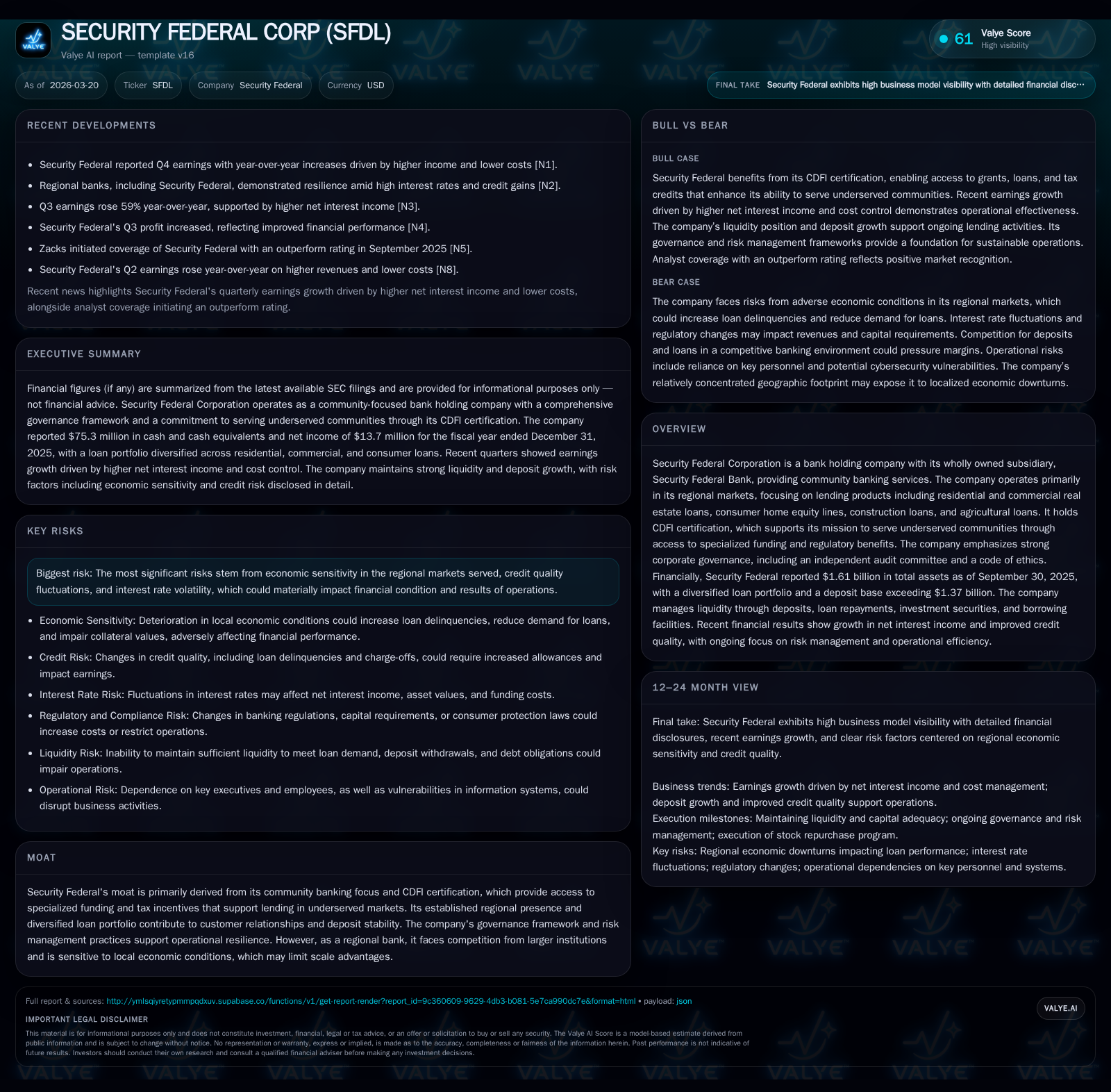
Security Federal Corporation operates as a regional community bank, emphasizing residential and commercial real estate lending in select counties across South Carolina and Georgia. Its status as a Certified Community Development Financial Institution (CDFI) supports its mission to serve underserved markets and affords access to specialized funding, creating a defensive moat. Over recent years, the company delivered moderate net income growth and maintained disciplined capital allocation through dividends and share repurchases. However, concentrated geographic exposure and market competition constrain scale and inflate sensitivity to local economic swings. Monitoring loan portfolio quality, liquidity management, and CDFI regulatory developments will be key to evaluating future performance trajectories.
Business Overview
Security Federal Corporation is a bank holding company operating through its wholly owned Security Federal Bank. It focuses on community banking services within regional markets primarily across counties in South Carolina (Aiken, Richland, Lexington) and Georgia (Columbia, Richmond). The bank’s lending mix includes residential and commercial real estate loans, consumer home equity lines of credit (HELOCs), construction loans, and agricultural financing. Its Certified Community Development Financial Institution (CDFI) designation facilitates lending to underserved communities by providing access to specialized funding programs and incentives that diversify revenue sources beyond traditional interest income streams [S1],[S14].
Past Growth and Historical Performance
Financially, Security Federal reported total assets of approximately $1.61 billion as of September 30, 2025 [S1]. Over recent years ending FY2025, the company has showcased modest earnings growth:
Historical performance (annual)
| FY | Net ($mm) | CFO ($mm) | Capex ($mm) | Net YoY |
|---|---|---|---|---|
| 2025 | 14 | 14 | 6 | +39.4% |
| 2024 | 10 | 28 | 3 | -3.8% |
| 2023 | 10 | 9 | 3 | +209.8% |
| 2022 | 3 | 22 | 5 |
Source: SEC companyfacts cache [F1].
Capital returns and efficiency (annual)
| FY | Div ($mm) | Buybacks ($mm) | FCF ($mm) |
|---|---|---|---|
| 2025 | 2 | 2 | 9 |
| 2024 | 2 | 1 | 26 |
| 2023 | 2 | 1 | 6 |
| 2022 | 2 | 17 |
Source: SEC companyfacts cache [F1].
Net income for FY2025 rose by nearly 40% over FY2024 largely on improved credit loss reversal and stable expense control [F1],[S12],[S23]. Meanwhile operating cash flow declined substantially year-over-year (-49%) likely owing to variations in working capital components or changes in loan repayment timing [F1]. Capital expenditures roughly doubled in FY2025 reflecting branch facility improvements consistent with SEC disclosures about branch refurbishments [S12],[S22]. Dividend payouts increased moderately reflecting a steady quarterly yield of $0.15 per share [S6],[S9]. Notably share repurchase activity more than doubled from FY2024 to FY2025 indicating proactive capital management to return excess capital [F1],[S6]. Equity base expanded steadily across years supporting incremental asset growth.
Loan portfolio performance shows mixed dynamics: total loans decreased slightly (-1.3%) year-over-year due primarily to reductions in construction loans (-37%) and commercial/agricultural loans (-16%), while residential real estate (+9%) plus commercial real estate (+5%) loans grew notably [S23],[S24]. Consumer HELOC balances also increased moderately (~6%). Credit quality generally improved with declines in past-due loans across major portfolios and a stable allowance for credit losses ratio near ~2% of total loans [S12],[S23],[S24]. This balance suggests conservative underwriting sustaining operational resilience amid cyclical pressure.
Deposit growth was steady (~3%-4%) over the most recent periods with shifts toward higher cost certificates of deposits and money market accounts deployed via targeted promotions amid competing regional banks’ efforts for retail funds [S11],[S15]. Approximately one-quarter of deposits are estimated uninsured at period-ends illustrating potential sensitivities should confidence waver locally [S11]. Importantly the Bank faces no single depositor concentration exceeding five percent.
Future Growth Prospects
Security Federal’s future growth hinges substantially on its ability to sustain lending volume amidst regional economic conditions that remain the primary risk factor given its concentrated footprint. The steady increase in residential and commercial real estate loans indicates alignment with local demand for mortgage products while contraction in construction-related loans signals possible caution within development activity or tighter underwriting standards [S23].
A critical enabler for growth remains the bank’s CDFI certification which offers access to specialized Treasury grants programs plus tax credits such as New Markets Tax Credit enhancing private capital attraction for community projects. However recent federal directives have instructed the CDFI Fund to limit operations restricting program availability which potentially curtails advantage if prolonged or extended post-2025 fiscal years [S14],[S13]. Management is monitoring these regulatory developments carefully.
Interest rate fluctuations pose significant influence on net interest margins given loan repricing lags especially for fixed-rate real estate assets versus floating deposit rates increased amid monetary policy tightening by the Fed [S19]. Maintaining relative cost control amid higher deposit beta will be critical for margin preservation.
Expansion beyond core geographies appears constrained at present; hence organic loan growth within existing markets coupled with incremental gains in consumer lines like HELOCs represent probable paths forward.
Forecasts / Milestones / Expectations
The company has not provided explicit forward guidance but highlights key operational priorities including:
- Continuing disciplined loan portfolio management emphasizing credit quality maintenance.
- Optimizing liquidity management as reflected by stable cash & equivalents near $75 million at FY-end alongside robust investment securities balances exceeding $674 million in available-for-sale portfolios [F1],[S20].
- Balancing capital returns through dividends ($0.15 per quarter) with opportunistic share repurchases under board-authorized programs implying active shareholder value strategies [S6],[F1].
- Navigating uncertainties related to CDFI program support changes without immediate impact seen yet but risk noted.
Investors should watch ongoing local economic indicators in South Carolina/Georgia counties coupled with any shifts in regulatory policy affecting CDFI status as important milestones influencing medium-term trajectory.
Returns / Capital Allocation
Approximate return on equity stood near 6.8% for FY2025 calculated by dividing net income by average equity ($13.67 million / $200 million), suggesting moderate profitability levels typical among mid-sized community banks balancing mission focus with financial discipline [F1].
Cash flow from operations was positive at over $14 million though somewhat down YoY signaling careful working capital movement despite earnings improvement. After accounting for capex spend totaling ~$5.6 million primarily related to branch improvements returns remain solidly positive with near $8.8 million free cash flow indicative of sound underlying operational cash generation capacity [F1].
Dividend payments aggregated just over $2.2 million during FY2025 consistent with steady distributions aiming to balance reinvestment needs against shareholder returns. Concurrently share repurchases accelerated significantly investing $2.27 million bringing total shares bought back closer towards the authorized limits showing management’s intent on capital recycling when excess funds permit [F1],[S6].
Liquidity retained at holding company level amounted to approximately $75 million unrestricted cash supporting dividend infrastructure as well as subordinated debt servicing obligations while remaining regulatory compliant given dividend payments depend materially on dividends upstreamed from the Bank subsidiary itself which is subject to regulatory constraints around earnings retention and capital adequacy [S20].[S6]
Competitive Positioning & Risk Factors
Security Federal’s moat derives less from scale than from its identity as a CDFI-certified community bank deeply embedded within targeted geographic locales promoting financial inclusion through tailored lending products supported by unique funding pipelines unavailable broadly elsewhere [N/A S1,S13,S14]. This structure advantages it particularly in underserved areas where trust relationships can underpin deposit stability and lending resilience.
Yet this focused regional concentration also magnifies risks arising from localized economic downturns relating to employment trends or real estate valuations impacting borrower capacity or collateral values. The predominance of real estate secured loans amplifies this cyclicality further especially under scenarios unfavorable for housing or commercial property sectors which can impair net interest income through credit loss provisions or increased delinquencies despite currently strong credit metrics reported [S19][S12][S23][F1].
Interest rate volatility remains another critical variable influencing margin compression potential given asset-liability mismatches inherent in fixed-rate mortgages funded by potentially rising-rate deposits within the local competitive banking environment influencing pricing dynamics.
Additionally emerging governance considerations following deregistration from SEC reporting requirements (filing Form 15 disabling reporting post December 12th 2025) introduce challenges around public disclosure transparency potentially reducing secondary market liquidity for shareholders though this change aligns with small publicly traded banking peers seeking reduced compliance burdens similarly [S1].
Finally ongoing federal policy shifts impacting core CDFI Fund programs translate into execution risks should significant funding cuts or limitations ensue constricting grant availability or limiting access to tax credits thereby squeezing competitive advantages derived from this certification—a dynamic that management is actively monitoring [S14],[S13].
Conclusion
Security Federal Corporation exemplifies a stable regional banking franchise leveraging CDFI certification alongside prudent risk controls delivering moderate earnings growth supported by a diversified yet regionally concentrated loan book and solid deposit franchise amid competitive pressures. Its sustained dividends coupled with enhanced buyback activity reflect thoughtful shareholder return policies matched by strengthening equity bases deploying branch modernization investments signaling strategic preparation for evolving market demands.
Nonetheless intrinsic geographical concentration remains a double-edged sword capping scale benefits while elevating vulnerability to cyclical shocks amplified within real estate-dependent portfolios. Similarly evolving federal program restrictions around CDFI operations could require adaptive business responses.
Ongoing attention to maintaining credit quality metrics amidst dynamic interest rates environments will determine resilience going forward alongside liquidity stewardship evidencing current comfortable buffers bolstered by limited leverage usage and absence of material borrowings at recent quarter ends.
-- This analysis is based solely on publicly available information including recent SEC filings dated through March 2026.
Disclaimer: This is research-only, informational analysis and not investment advice. It may include AI-generated interpretation and general industry context. Always verify important details using primary sources.

Comments