
From Losses to Liquidity: Hyperfine’s Evolution and Prospects in Medical Technology
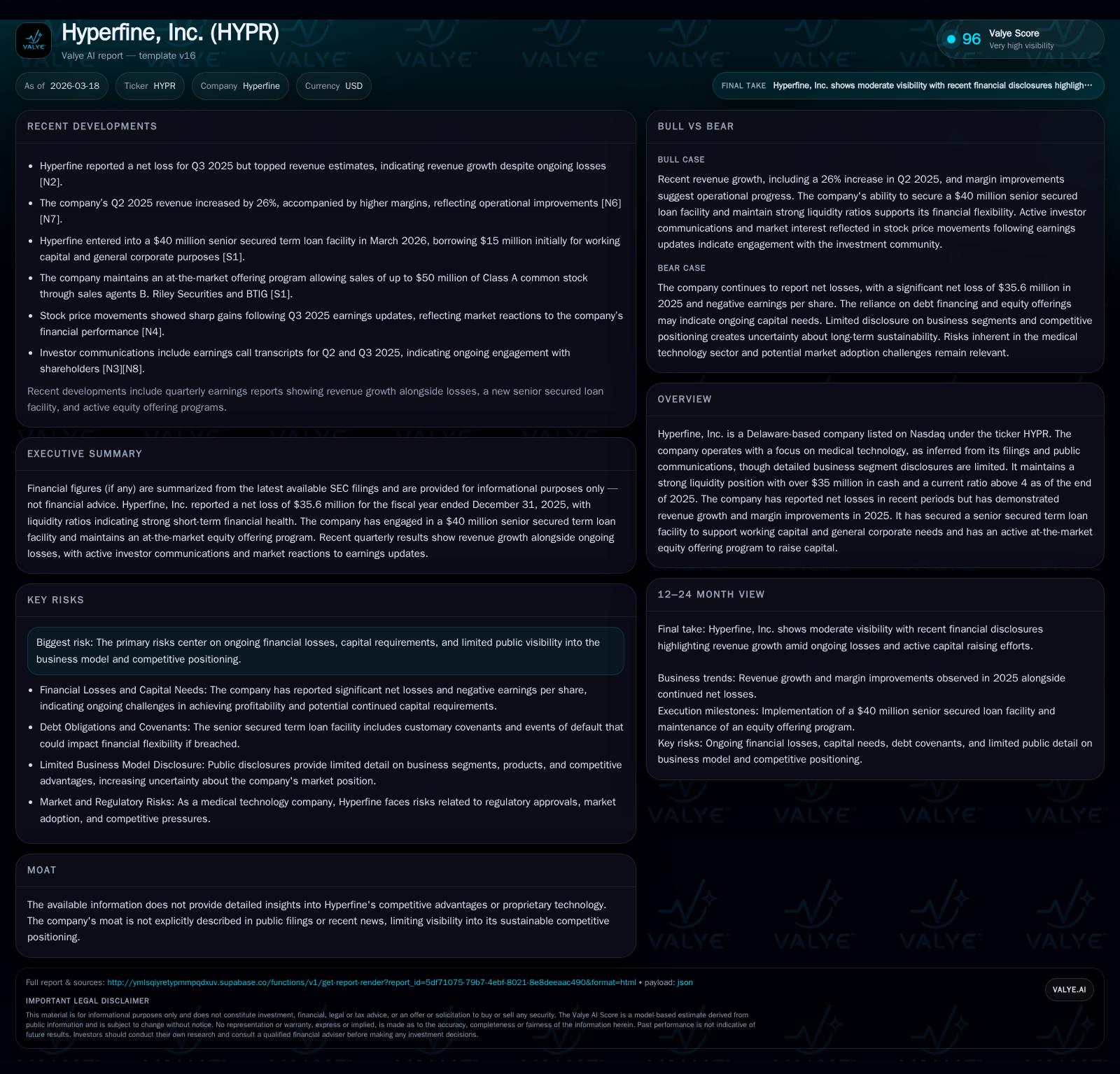
Hyperfine balances substantial net losses with growing revenue and strong liquidity, supported by recent debt and equity financing.
Hyperfine, Inc., a nascent player in medical technology, continues to operate at a net loss but has demonstrated incremental improvements in operating margins and revenue growth through 2025. The company maintains robust liquidity, bolstered by a $40 million senior secured term loan facility and an active at-the-market equity program. Regulatory challenges, including FDA cybersecurity compliance and state-level Determination of Need laws, constrain sales velocity but underscore the complexity of commercializing novel diagnostic tools. Capital allocation focuses on sustaining growth while managing burn, foregoing dividends or buybacks amid ongoing investments. Key uncertainties persist around market adoption scale and the company’s ability to achieve profitability given its limited historical operating track record.
Historical Financial Performance and Growth Drivers
Hyperfine's financial trajectory shows a steady reduction in operating losses alongside nascent revenue growth indicative of early commercialization efforts. Operating loss improved from approximately -$73.9 million in fiscal year (FY) 2022 to about -$37.1 million by FY 2025, a nearly 50% improvement over three years and a 14.2% improvement year-over-year from FY 2024 to FY 2025 [F1]. Net losses followed a similar pattern, decreasing from -$73.2 million in 2022 to -$35.6 million in 2025.
This progress aligns with Hyperfine’s initial launches of portable MRI technology targeting point-of-care diagnostics that seek to reduce costs relative to traditional MRI systems [S1]. Capital expenditure remained modest, rising from $0.59 million in 2022 to $1.19 million in 2025 [F1]. Operating cash flow deficits improved by nearly 28% year-over-year as the company optimized spending while scaling commercial activities.
Estimated revenue reached approximately $13.5 million for the full year ending December 31, 2025, signaling early-stage market adoption within a healthcare sector characterized by protracted sales cycles and regulatory complexities [N1][S1].
Product Development and Commercialization Efforts
Hyperfine’s flagship product is the Swoop® portable MRI system designed to expand neuroimaging access through affordability and ease of installation compared with conventional units. Compliance challenges have increased following FDA amendments requiring cybersecurity plans for connected medical devices—a critical factor given Hyperfine's device software interfaces with internet connectivity [S1].
Additionally, state-level Determination of Need (DoN) laws require healthcare facilities to undergo extensive review before capital acquisitions, slowing purchase decisions despite the system's lower cost point relative to legacy MRI devices. These regulatory factors introduce sales delays that complicate forecasting and growth acceleration.
The company must balance clinical validation efforts with buyer education on regulatory pathways and reimbursement feasibility—common hurdles for disruptive diagnostic technologies seeking broad market penetration.
Liquidity Position and Capital Structure
As of December 31, 2025, Hyperfine held approximately $35.1 million in cash and equivalents against current liabilities of about $11.7 million, yielding a strong current ratio exceeding 4x [F1], which supports near-term operational needs.
In March 2026, Hyperfine secured a senior secured term loan facility up to $40 million with Horizon Technology Finance Corporation, initially drawing $15 million at closing with an option for an additional $25 million subject to conditions through December 31, 2027 [S6][S7].
The loan carries interest at prime plus 4.25%, with a floor effectively setting minimum interest near or above 10.75%. Payments are monthly interest-only for four years post-closing with potential extension upon milestone achievement tied to operational metrics [S5][S6][S7]. Covenants restrict asset disposals, additional debt incurrence beyond limits, dividend payments, licensing arrangements, acquisitions, and related-party transactions to protect lender interests [S5][S8]. Accompanying warrants provide lenders potential equity upside linked to stock performance.
Revenue Growth Outlook Amid Regulatory Challenges
While explicit forward guidance is limited, recent commentary highlights ongoing commercial scale-up investments tempered by regulatory complexities including FDA cybersecurity mandates and DoN-related purchase delays [N1][S1]. Revenue growth is expected to be incremental as Hyperfine expands its sales force and pursues third-party reimbursement arrangements essential for hospital adoption.
Success hinges on overcoming regulatory barriers while demonstrating clear cost advantages versus traditional MRI systems.
Capital Allocation Strategy
Hyperfine manages its capital structure through an amended at-the-market (ATM) offering program allowing sales agents B. Riley Securities and BTIG to sell shares opportunistically up to $50 million aggregate value [S11][S13][S16]. This flexible equity approach supplements liquidity without fixed upfront proceeds.
The company has not declared dividends or initiated share repurchases amid continued net losses consistent with reinvestment priorities into product development and market expansion [F1][S13]. Free cash flow remains negative—approximately -$29.1 million in FY 2025—reflecting high burn rates typical of early commercialization stages.
This balanced use of debt facilities alongside controlled equity raises reflects prudent financial stewardship aimed at extending runway while supporting growth initiatives sustainably.
Risks from Operating Losses and Market Uncertainty
With accumulated deficits exceeding $330 million as of end-2025 alongside annual net losses near $36 million despite improvement trends, Hyperfine faces typical early-stage medtech execution risks related to achieving scale profitability within regulated healthcare markets [F1][S1].
Limited disclosure on intellectual property strength or durable competitive advantages adds uncertainty regarding long-term defensibility versus incumbent imaging providers or emerging alternatives [S4]. Failure to broaden clinical adoption or secure reimbursement could stall progress despite technological promise.
Compliance demands around evolving FDA cybersecurity rules pose ongoing operational challenges requiring resource allocation that may pressure financials if inadequately managed.
Key Developments to Monitor
- Utilization of remaining tranche under the term loan facility contingent on covenant satisfaction;
- Achievement of milestones enabling extension of interest-only payment period;
- Expansion of sales headcount correlating with order growth;
- Progress on third-party reimbursement facilitating hospital procurement;
- Resolution of regulatory bottlenecks like DoN approvals accelerating customer conversions;
- Clinical data reinforcing efficacy crucial for competitive positioning. Monitoring these will help assess if Hyperfine can translate innovation into scalable commercial success amid complex external factors.
Summary Table: Historical Financials (USD Millions)
Historical performance (annual)
| FY | Net ($mm) | CFO ($mm) | OpInc ($mm) | Capex ($) | Net YoY |
|---|---|---|---|---|---|
| 2025 | -36 | -28 | -37 | 1185000 | +12.6% |
| 2024 | -41 | -39 | -43 | 383000 | +8.0% |
| 2023 | -44 | -42 | -48 | 804000 | +39.5% |
| 2022 | -73 | -72 | -74 | 585000 |
Source: SEC companyfacts cache [F1].
Capital returns and efficiency (annual)
| FY | FCF ($mm) | ROE% |
|---|---|---|
| 2025 | -29 | -86.8 |
| 2024 | -39 | -83.0 |
| 2023 | -43 | -52.4 |
| 2022 | -73 | -59.1 |
Source: SEC companyfacts cache [F1]. Source: SEC filings as of March 18, 2026 [F1]
This report synthesizes publicly available SEC filings and recent earnings disclosures without speculative forecasts or investment recommendations.
Disclaimer: This is research-only, informational analysis and not investment advice. It may include AI-generated interpretation and general industry context. Always verify important details using primary sources.

Comments