
Dogwood Therapeutics’ Clinical Pipeline Progress Amidst Financial Pressures and Strategic Risks
Dogwood Therapeutics is advancing its novel pain and neuropathy therapies while facing mounting operational and financial challenges as it approaches clinical and commercial inflection points.
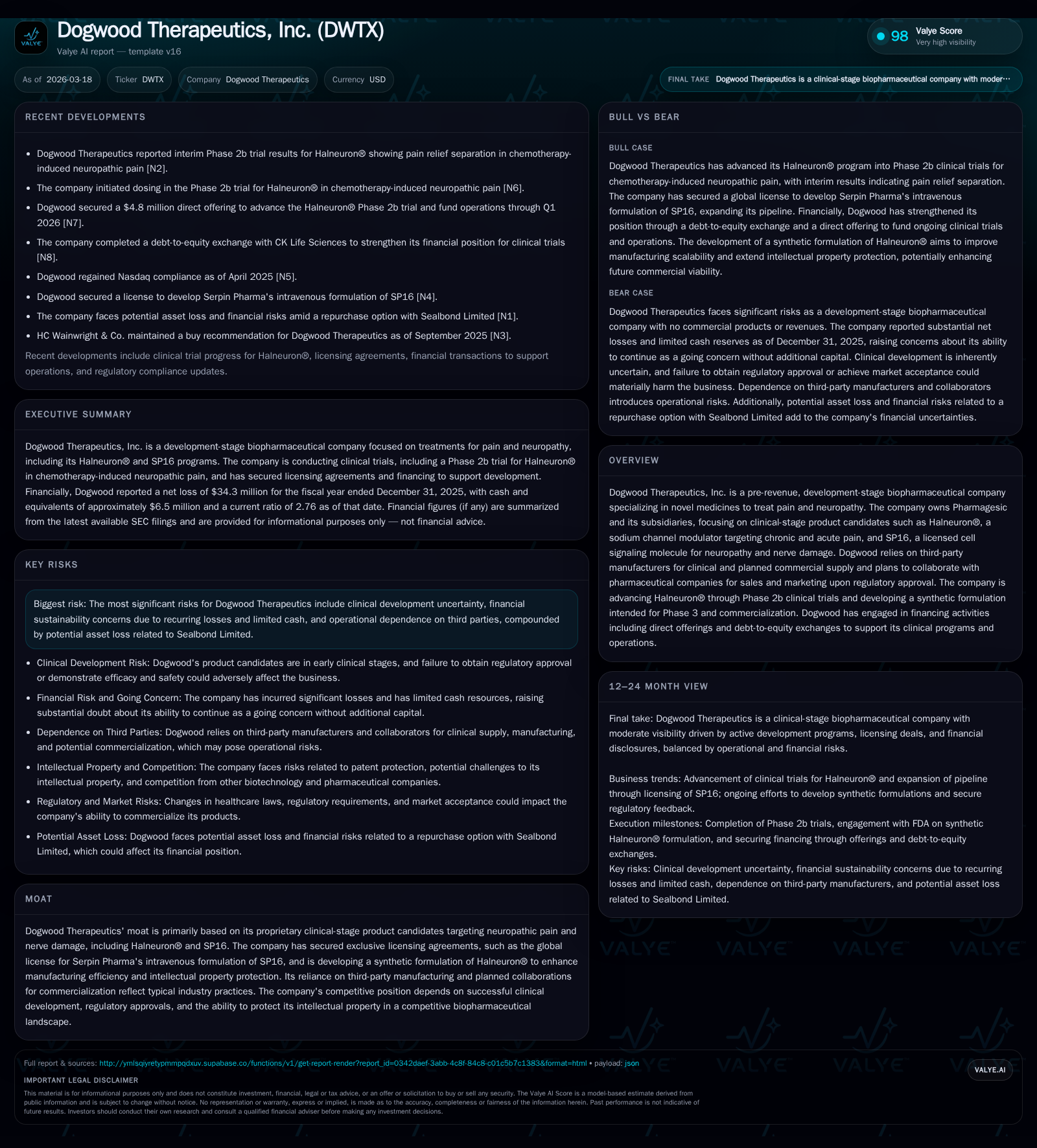
Dogwood Therapeutics, a development-stage biopharmaceutical company, is focusing on advancing proprietary product candidates Halneuron® and SP16 aimed at treating chronic and acute neuropathic pain. Despite progress entering Phase 2b clinical trials for Halneuron® and licensing SP16, the company remains pre-revenue with sustained operating losses and significant cash burn. Cash reserves at the end of 2025 stood near $6.5 million against operating losses exceeding $27 million for that year, intensifying pressure to secure additional funding or partnerships. Upcoming FDA interactions regarding a synthetic formulation of Halneuron® for Phase 3 will be critical milestones for commercialization readiness. The company also faces strategic risks including potential asset loss related to Sealbond Limited agreements and dependency on third-party manufacturing and clinical trial partners.
Clinical Progression: Advancing Proprietary Pain Therapies
Dogwood Therapeutics operates as a development-stage biopharmaceutical company focused exclusively on novel therapeutics addressing chronic pain and neuropathy disorders with significant unmet medical needs.[S1] Its leading candidate, Halneuron®, is a proprietary Nav1.7 voltage-gated sodium channel modulator designed as a non-opioid analgesic targeting chronic and acute pain syndromes.[N1][S1] This aligns with growing clinical validation of Nav1.7 as a critical pain pathway.
Halneuron® is currently in Phase 2b clinical trials to evaluate efficacy signals necessary before pivotal studies.[N1][S1] Concurrently, Dogwood is developing a synthetic formulation intended for Phase 3 development and commercialization to enhance manufacturing flexibility and intellectual property protection.[S6]
Another key pipeline asset is SP16, an anti-inflammatory peptide licensed exclusively from Serpin Pharma that aims to mitigate chemotherapy-induced peripheral neuropathy (CIPN).[N1][S24][S27] SP16 selectively activates LRP1 receptor pathways promoting neuronal survival without protease inhibition activity. It has entered early Phase 1 trials supported by National Cancer Institute funding targeting breast cancer patients undergoing neurotoxic chemotherapy regimens.[S27]
Dogwood relies on partnerships including Serpin Pharma for licensing,[S10] and contract manufacturing organizations (CMOs) for production — a common approach in biotech to minimize capital expenditures while leveraging specialized capabilities.[S24] Sales and marketing efforts are expected to be conducted via collaborations post regulatory approval given current lack of internal commercial infrastructure.[N1]
Financial Trajectory: Increasing Losses Amid Pipeline Advancement
Dogwood remains pre-revenue with no commercial products launched.[S1] Financial results over four fiscal years (2022–2025) show escalating losses reflecting increased research & development (R&D) investments aligned with clinical progression.[F1]
Historical performance (annual)
| FY | Net ($mm) | CFO ($mm) | OpInc ($mm) | Net YoY |
|---|---|---|---|---|
| 2025 | -34 | -16 | -28 | -177.4% |
| 2024 | -12 | -9 | -12 | -133.2% |
| 2023 | -5 | -5 | -5 | +56.8% |
| 2022 | -12 | -11 | -12 |
Source: SEC companyfacts cache [F1].
Capital returns and efficiency (annual)
| FY | ROE% |
|---|---|
| 2025 | -45.7 |
| 2024 | 122.0 |
| 2023 | -139.1 |
| 2022 | -167.2 |
Source: SEC companyfacts cache [F1].
Source: Dogwood Therapeutics annual reports [F1].
Operating income deteriorated significantly through FY2025 due to intensified R&D expenses supporting advanced clinical trials and synthetic chemistry development.[S18] Net losses likewise expanded reflecting absence of offsetting revenue streams.[F1]
Operating cash flow showed deepening negative outflows consistent with active investment phases culminating in nearly $15.6 million cash burn during FY2025.[F1]
At December 31, 2025 Dogwood held approximately $6.5 million in cash and equivalents with current assets exceeding liabilities by nearly threefold (current ratio ~2.76), indicating short-term liquidity but limited runway without new capital infusion.[F1] Equity improved markedly from negative $10.1 million at end-2024 to positive $74.9 million at end-2025 following financing activities including registered direct offerings.[F1][S22]
Capital Allocation: Financing Growth Amid Persistent Losses
As a pre-commercial entity Dogwood depends heavily on capital markets transactions to fund clinical programs and operations.[N1][S5] Recent filings document multiple financing events including direct offerings supporting costly trial phases.[N1][S22]
No dividends have been paid or declared given continuous net losses consistent with industry norms prioritizing reinvestment into R&D.[F1][S14] Share repurchases are absent; capital allocation focuses on sustaining pipeline advancement plus corporate governance compliance.
Preferred stock issuances alongside common shares contribute to equity fluctuations reflecting dilution associated with fundraising efforts aimed at mitigating insolvency risks flagged by auditors.[F1][S22]
Manufacturing & Licensing Partnerships: Operational Backbone
Dogwood's clinical assets benefit from exclusivity through licensing deals such as the September 2025 global license from Serpin Pharma covering intravenous SP16 formulations plus sublicensing rights jointly managed across entities.[S10][S24]
Manufacturing strategy leverages specialized CMOs—overseas suppliers provide active pharmaceutical ingredients like tetrodotoxin derivatives used in Halneuron®, while Canadian CMOs handle lyophilized fill-finish processes tailored for clinical sites.[N1][S24]
Developing a synthetic Halneuron® formulation aims not only at improving supply chain resilience but also scalability benefits lowering per-unit costs critical for commercial viability later.[S6] This approach also extends patent life cycles enhancing competitive positioning versus natural product extraction methods.
Such dependencies introduce execution risk; any CMO delays or quality issues could disrupt timelines or inflate costs complicating regulatory submissions and launch readiness common among biotech firms transitioning beyond early-stage trials.
Regulatory Pathway & Commercialization Outlook
Regulatory approval hinges on successful completion of planned Phase 3 studies for Halneuron®, contingent upon favorable Phase 2b outcomes.[N1][S6]
FDA engagements scheduled for late calendar year 2026 concerning the synthetic API formulation will shape pivotal trial design ahead of Investigational New Drug amendments required prior to late-stage human testing.[S6]
While explicit timelines are undisclosed,[N1] interim data readouts combined with regulatory input meetings will guide whether expedited pathways such as breakthrough therapy designation or orphan drug exclusivities might be pursued.
SP16’s initiation into mid-2026 human studies represents an important milestone; early Phase I primarily evaluates safety/tolerability while downstream efficacy signals remain vital for partnering or out-licensing prospects tied directly to this asset's clinical validation trajectory.[S27]
Commercialization readiness depends heavily on future alliances for sales force establishment targeting specialist prescribers given limited internal commercial capabilities currently.[N1]
Risk Factors: Asset Exposure & Third-Party Dependencies
Material strategic risk stems from potential adverse outcomes linked to agreements involving Sealbond Limited—which holds repurchase options over key assets—posing possible material impact if exercised unfavorably.[N1][S9]
Operational reliance on CMOs increases vulnerability; disruptions such as capacity constraints or quality control failures may delay regulatory milestones jeopardizing timelines important to investors.[S4]
Clinical development uncertainty remains high given inherent unpredictability translating early results into registrational success affecting valuation substantially.[S23]
Persistent recurring losses prompt going concern doubt disclosures by auditors contingent on raising additional funds highlighting precarious liquidity typical during advanced R&D phases without commercial revenue generation mechanisms.[S12]
Intellectual property protection faces challenges amid evolving legal scrutiny; robust patent defense is critical for sustaining competitive moats especially around novel synthetic formulations now under development underscoring importance of legal diligence alongside scientific efforts.[S17]
Investor Watchpoints: Milestones & Liquidity Monitoring into 2026
Key indicators include updates from FDA meetings regarding synthetic Halneuron® submission packages potentially guiding timing/scale decisions around Phase III study initiation framed by regulatory feedback reported publicly or via SEC filings.[S3][N1]
SP16’s Phase I enrollment progress funded through NCI grants will serve as a feasibility barometer influencing partner interest levels predicated upon safety profiles achieved per pipeline communications.[S27]
Cash flow statements reveal elevated burn rates indicating acute runway constraints requiring proactive capital raises or strategic collaborations necessary to maintain momentum driving longer-term value creation beyond near-term liquidity risks evidenced by late-2025 financials with about $6.5 million remaining cash balancing against multi-million dollar quarterly outflows recently [F1].[S5]
Monitoring announcements concerning licensing expansions or marketing collaboration contracts after potential approvals would signal transition into monetization phases essential for reversing historical loss trends focusing allocation towards scaled commercial launch resources rather than pure R&D spend dominance marking inflection points within equity markets evaluating biotech maturation globally.
Disclaimer: This report is prepared solely for informational purposes based on available public documents without offering investment advice or recommendations regarding securities mentioned herein.
Disclaimer: This is research-only, informational analysis and not investment advice. It may include AI-generated interpretation and general industry context. Always verify important details using primary sources.

Comments