
Avidbank Holdings’ Turnaround Challenges and Cash Reserve Strength
Examining Avidbank Holdings’ 2025 financial setbacks alongside its robust liquidity to assess strategic and shareholder implications.
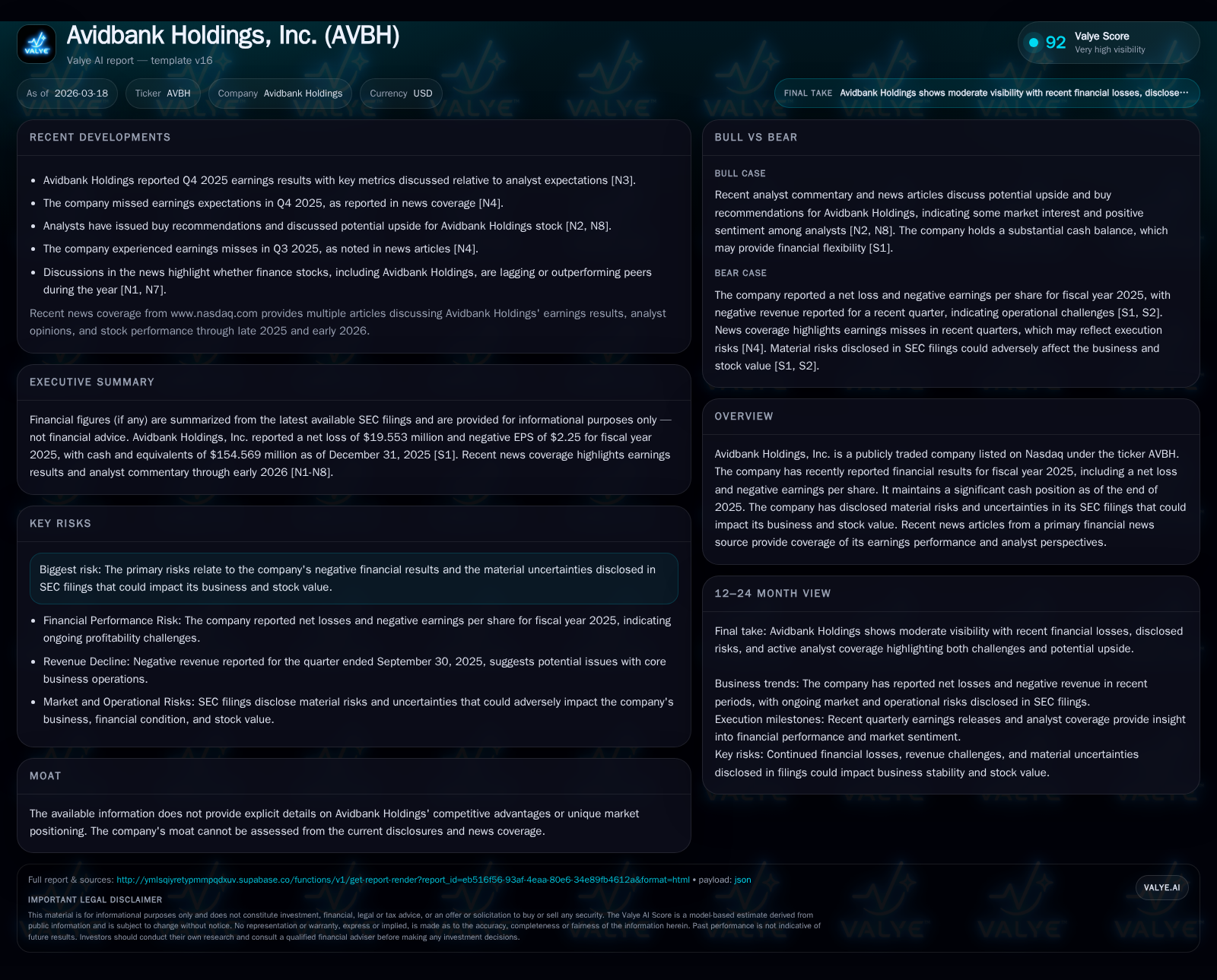
Avidbank Holdings reported a substantial net loss of $19.55 million in fiscal 2025 despite maintaining a sizable cash reserve exceeding $154 million. Revenue contracted to approximately $60.85 million through the first nine months of 2025, reflecting operational headwinds and absence of a clear competitive moat. The company’s free cash flow remained positive at roughly $38.9 million, underpinning liquidity but casting questions on sustainable profitability given a negative return on equity near -7%. Management disclosed material risks including credit, regulatory, and market uncertainties that complicate recovery prospects. Recent analyst commentary suggests improving earnings expectations, but firm milestones remain absent, warranting close monitoring of capital deployment and risk mitigation efforts.
2025 Financial Performance: Understanding the Net Loss and Revenue Trends
Avidbank Holdings experienced a challenging fiscal year in 2025, culminating in a net loss of approximately $19.55 million as disclosed in the year-end report [F1][S1]. This shortfall accompanies revenue recorded at roughly $60.85 million for the nine months ended September 30, 2025, marking a contraction reflective of headwinds possibly linked to lower lending volumes or compressed margins within its banking operations [F1][S2][S3]. The absence of an identifiable competitive moat implies pressure from both local competitors and broader market dynamics that constrain pricing power and growth opportunities.
Operational costs appear to have exerted additional strain, a common characteristic for regional banks amid tightening credit conditions and regulatory expenses. No explicit mention of goodwill impairment or exceptional charges was found in filings, suggesting losses principally stem from core operations.
Historical Financial Trends: Charting Growth and Operational Cashflows
The financial trajectory over recent years reveals volatility consistent with industry challenges faced by smaller depository institutions. Presented below is a summarized overview derived from available SEC data capturing revenue trends, net income, operating cash flow (CFO), capital expenditures (capex), and free cash flow (cash flow from operations less capex) metrics:
Historical performance (annual)
| FY |
|---|
| 2025 |
Source: SEC companyfacts cache [F1].
*Revenue figure represents partial-year data through September 30 as full FY revenue was not specifically stated.
Despite the negative bottom line, operating activities generated approximately $38.9 million in free cash flow in the latest reported period [F1], signaling effective working capital management or non-cash charges contributing positively to liquidity. However, return on equity remains subdued at around -7%, corroborating underlying profitability challenges given current equity bases.
Liquidity Profile: The Significance of a $154M Cash Cushion
Avidbank’s liquidity position stands notably strong with ending cash and equivalents totaling approximately $154.57 million as of December 31, 2025 [F1]. This healthy cash reserve provides an essential buffer—a liquidity runway—that can sustain company operations through periods of adverse earnings or fund strategic pivots without immediate reliance on external financing.
SEC filings detail stringent capital adequacy metrics typical for regulated banking entities alongside active liquidity management practices balancing asset-liability maturity profiles [S5][S7]. Given sector nuances such as managing net interest margin volatility and credit risk exposures amid a fluctuating economic environment, this cash cushion mitigates solvency risks while enabling flexibility in navigating regulatory capital thresholds.
Capital Allocation History: Dividends, Buybacks, and Shareholder Returns
In light of persistent operational losses and strategic repositioning needs, reported disclosures reveal restrained capital return policies with no recent dividends issued nor aggressive share repurchase programs executed [S20][F1]. This defensive posture aligns with prudential focus on preserving capital adequacy during turnaround phases.
The company's capital allocation thus prioritizes internal reinvestment and balance sheet fortification over direct shareholder distributions—a rational approach considering the negative ROE environment and ongoing risk management imperatives.
Managing Risks and Uncertainties Highlighted in Recent SEC Filings
Material risk factors outlined comprehensively in filings encompass credit risk concentrations inherent to loan portfolios with possible elevated non-performing assets; regulatory compliance complexities amplified by evolving legislation; potential litigation exposures; and market volatility influencing interest rate-sensitive operations [S4][S6][S12][S13].
This triad underpins valuation uncertainty for investors as realized risk events could materially impact asset quality metrics or elevate provisioning expenses further hampering profitability.
Profitability Outlook: Market Sentiment and Surging Earnings Estimates
Recent analyst commentary captured by Nasdaq sources highlights an uptick in forward earnings estimates prompting cautious optimism about Avidbank’s recovery trajectory [N1]. Such sentiment contrasts with slower performance trends among peer finance stocks noted concurrently [N2].
However, this optimism must be measured against fundamentals: subdued historical profitability compounded by operational risks leave considerable room for variance between expectations and outcomes. Valuation multiples hinged on price-to-book ratios may see adjustments contingent on tangible profits restoration.
Strategic Constraints and Growth Prospects from Management Disclosures
Management communications stress limiting factors such as loan portfolio concentration risk potentially restricting underwriting capacity or mandating tighter credit standards [N1][S3]. Additionally, operational leverage effects—where fixed costs pressure margins amid declining revenues—suggest growth prospects are tightly bound by efficiency improvements rather than expansive top-line gains at present.
Absent explicit forward guidance or milestone commitments from company disclosures means growth ambitions remain conditional upon broader market recoveries and internal remediation success.
Key Milestones Ahead: What Investors Should Monitor
Although not explicitly articulated within available filings or press materials, key upcoming events worth monitoring include quarterly earnings updates which will offer clearer visibility into trend reversals or persistent drags, regulatory reviews that may influence capital requirements or operational scope, and any shifts in capital allocation strategies — particularly any moves introducing dividends or repurchase programs indicating confidence restoration.
Furthermore, appointment changes at the board level such as addition of audit committee experts may signal heightened governance oversight intended to support financial discipline [S20].
Close observation of these factors will provide the clearest lenses through which investors can gauge Avidbank's trajectory post its challenging fiscal year.
This analysis aggregates publicly filed data including SEC submissions and recent news commentary without extrapolations beyond documented evidence. It does not constitute investment advice or forecasts but aims to furnish a factual basis for understanding Avidbank Holdings’ current financial positioning and associated operational context.
Disclaimer: This is research-only, informational analysis and not investment advice. It may include AI-generated interpretation and general industry context. Always verify important details using primary sources.

Comments