
SMX's Molecular Marking Technology: From Innovation to Market Challenges
SMX advances proprietary molecular marking for supply chain transparency while confronting early-stage financial headwinds.
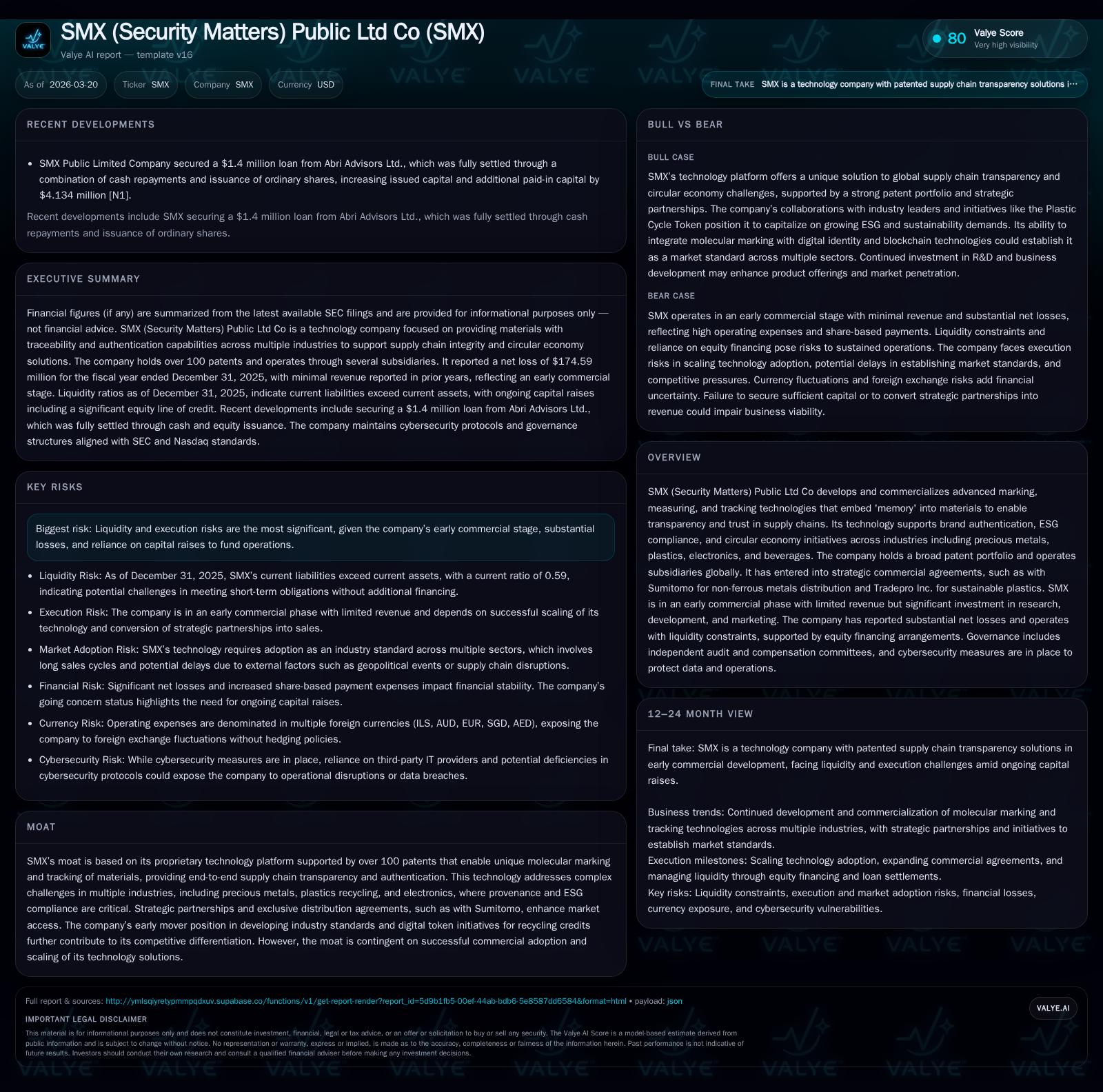
SMX (Security Matters) Public Ltd Co pioneers a unique sub-molecular marking technology embedded across diverse materials, aiming to revolutionize supply chain transparency, ESG compliance, and circular economy initiatives. Despite a rich patent portfolio and strategic partnerships, SMX remains in an early commercial phase characterized by limited revenue generation and escalating net losses. The company’s financial position demonstrates liquidity constraints and reliance on equity financings to sustain operations. Future growth depends heavily on successful technology commercialization and further financing to scale operations effectively.
Innovating Supply Chain Integrity: Technology and Patent Overview
SMX harnesses a cutting-edge molecular marking platform that embeds ‘‘memory’’ at the sub-molecular level within a wide range of materials—ranging from precious metals through plastics to electronics and beverages. This proprietary technology is distinct in its ability to uniquely mark solid, liquid, or gaseous substrates with permanent or removable markers that are chemically coded to resist duplication.
Critically, the company's patented reader technology utilizes advanced detection algorithms coupled with blockchain-based digital ledgers to capture and store marker information securely, ensuring provenance traceability crucial for brand authentication, ESG compliance mandates, and circular economy practices. Beyond authentication, this system provides measurable data points across a product’s lifecycle including the number of times a material was recycled or reused.
The breadth of SMX’s intellectual property includes over 100 patents covering both marking methods and corresponding detection algorithms forming a robust technological moat. This level of sophistication addresses complex industry demands where provenance verification is otherwise challenging—such as precious metal authenticity or plastic recycling verification [S1].
Notably, SMX announced the Plastic Cycle Token initiative in late 2023 intending to create an ethical digital credit platform for recyclable plastics, positioning it against traditional carbon credit systems aligned with European Union sustainability strategies. This innovation exemplifies how SMX’s tech extends beyond physical marking into new blockchain-enabled environmental assets [S1].
Historic Revenue Trends and Escalating Losses: A Financial Profile
Despite technological advancements, SMX’s commercial traction remains nascent. Revenues have been marginal with only $13,000 recorded as of fiscal year-end 2020, with no meaningful topline growth documented through latest filings [F1]. This reflects both the industry's lengthy sales cycle—targeting multinational market leaders—and ongoing investments in onboarding processes rather than direct product sales.
Financially, losses have accelerated sharply as commercialization efforts intensify. Net income deteriorated from -$6.18 million (FY22) to -$35.4 million (FY24) before widening drastically to -$174.6 million in FY25 — a staggering year-over-year decline of roughly 393% [F1]. Equity balances displayed dilution consequences with FY25 ending shareholders’ equity at $19.3 million down from $32.2 million in FY23.
Calculated return on equity (ROE) reached approximately -903%, underscoring extreme negative profitability inherent at this early stage absent revenue generation [F1]. Operating cash flow consumption likewise increased substantially with net cash used in operating activities rising to $17 million in FY25 compared to $11.3 million in FY24 reflecting higher non-cash share-based payments and increased deployment-related expenditures [F1][S14].
This profile clearly documents SMX’s transition from development-heavy spending towards scaling costs without yet achieving sustainable revenue inflows.
Historical performance (annual)
| FY | Net ($mm) | Net YoY |
|---|---|---|
| 2025 | -175 | -393.2% |
| 2024 | -35 | -68.7% |
| 2023 | -21 | -239.4% |
| 2022 | -6 |
Source: SEC companyfacts cache [F1].
Capital returns and efficiency (annual)
| FY | ROE% |
|---|---|
| 2025 | -903.4 |
| 2024 | -158.1 |
| 2023 | -65.1 |
| 2022 | -286.8 |
Source: SEC companyfacts cache [F1].
Table highlights accelerating losses amidst negligible revenue growth.
Commercial Strategy and Strategic Partnerships Shaping Growth Prospects
In spite of limited current revenues, SMX has strategically partnered with established channel distributors such as Sumitomo for non-ferrous metals—a sector particularly demanding precise traceability due to regulatory scrutiny and ESG concerns—and Tradepro Inc., which focuses on sustainable plastics trade [S1][N1]. These alliances provide crucial distribution pathways facilitating initial commercial deployments.
The company targets high-barrier industries where provenance offers competitive advantage or regulatory compliance benefit: precious metals authenticated for anti-counterfeiting; plastics integrated into circular economy frameworks via digital tokens; electronics protected against supply-chain tampering; beverage producers enforcing brand integrity. The multi-vertical approach aims for diversified application but inherently complicates scaling due to varying customer requirements.
While still early stage—with sales cycles lasting several quarters influenced by global supply chain dynamics such as geopolitical tensions or pandemic disruptions—SMX demonstrates tangible progress toward establishing its platform as an industry standard through pilot projects and proof-of-concept collaborations [S13].
The Plastic Cycle Token represents an innovative extension into digital asset markets potentially unlocking new revenue streams linked directly to verified recyclate volumes—a model resonant with evolving ESG investment priorities worldwide.
Capital Structure and Funding Dynamics Underpinning Near-Term Liquidity
SMX’s financial sustainability is heavily dependent on access to external capital given its early commercial maturity characteristically devoid of self-sustaining cash flow.
The company maintains multiple contemporaneous funding arrangements including convertible notes totaling over $20 million principal at year-end 2025 under agreements such as RBW December Notes; promissory notes including a $1.4 million loan from Abri Advisors Ltd., which involved original issue discounts and interest culminating in accelerated repayment clauses settled partly through equity issuance [S4][S6][S10][N1].
Post-2025 reporting period transactions included approximately $17.7 million equity raise under its Standby Equity Purchase Agreement (SEPA), which was amended to increase commitment from $100 million to $250 million allowing staged capital injections aligned with operational needs [S4][S9][S14]. However current liquidity ratios remain constrained—the current ratio stood at roughly 0.59 at the end of FY25—indicating short-term liabilities exceed current assets significantly [F1].
Repeated reverse stock splits also reflect shareholder base adjustments aimed at maintaining compliance with Nasdaq listing thresholds despite low share price movements.
This capital structure reflects typical startup phase debt-equity mix involving partial conversion of convertible notes into equity reducing debt burden but increasing dilution risk.
Operational Scaling Constraints and Risk Factors Affecting Execution
SMX faces execution risks stemming from prolonged sales cycles targeting large multinational conglomerates whose procurement processes are complex and sensitive to macro events beyond the company's control—including geopolitical tensions or COVID-19 ramifications that could stall contracts unexpectedly [S13].
Research & development expenses grew notably driven largely by non-cash share-based payment charges reflecting employee incentives aligned with deploying proprietary technology [S7]. The operational ramp-up requires balancing costly R&D stages against transitioning into scalable production timelines which remain uncertain.
Liquidity constraints increase scrutiny on capital management decisions; should fundraising falter or delay occur it may force scaling back commercialization efforts threatening broader market adoption trajectories [S5][S17]. A "going concern" explanatory paragraph is explicitly included within their financial statements signifying substantial doubt about continued operations without additional financing infusion [S5].
Furthermore, contractual obligations including lease commitments and outstanding convertible promissory notes place fixed payment requirements that reduce operational flexibility [S8][S11]. The company continually explores strategic partnerships not only for distribution but also potential co-investment opportunities that could alleviate near-term cash burn pressures but often come with unfavorable terms.
Key Milestones and Indicators to Watch in SMX’s Evolution
Looking ahead requires monitoring several interrelated milestones which will collectively signal whether SMX can overcome early-stage challenges:
- Completion and commercial rollout of Plastic Cycle Token platform fostering tangible ESG-linked credits uptake,
- Expansion or formalization of distribution agreements beyond current partners reflecting broader market acceptance,
- Demonstrated scalable deployments securing recurring revenues beyond proof-of-concept projects,
- Progression towards positive operating cash flow or materially reduced net loss trajectory,
- Further successful capital raises or refinancing transactions maintaining solvency without excessive dilution,
- Advancement toward establishing technology standardization within target industries enhancing competitive moat architecture [N1][S1].
Such indicators encapsulate both top-line adoption evidence and financial health vital for sustained viability.
Governance Landscape Enhancing Oversight Amid Growth Phase
Amid strategic development phases accompanied by escalating operational scale and financing complexity, SMX strengthened governance structures notably through appointing independent directors fulfilling SEC/Nasdaq criteria onto audit and compensation committees [S2].
Richard G. Hayes leads the audit committee ensuring rigorous oversight of financial controls including risks related to liquidity sufficiency disclosures consistent with applicable regulatory frameworks; concurrently compensation governance upgrades underpin appropriate alignment incentives critical during intense R&D commercialization push periods.
As a foreign private issuer incorporated under Irish law adopting home country governance practices enables focused board compositions without compromising independence standards ensuring transparency crucial for investor confidence during growth transitions [S2].
This report synthesizes publicly available information as of March 20th, 2026 regarding SMX (Security Matters) Public Ltd Co drawn principally from SEC filings dated March 20th alongside recent Nasdaq news releases. It is intended solely for informational purposes without offering investment advice or recommendations.
Disclaimer: This is research-only, informational analysis and not investment advice. It may include AI-generated interpretation and general industry context. Always verify important details using primary sources.

Comments