
Richmond Mutual Bancorporation’s 2025 Performance: Balancing Community Banking Strengths with Regulatory and Credit Challenges
An analysis of Richmond Mutual Bancorporation's financial progress, risk management adaptations, and strategic capital deployment within a competitive regional banking sector.
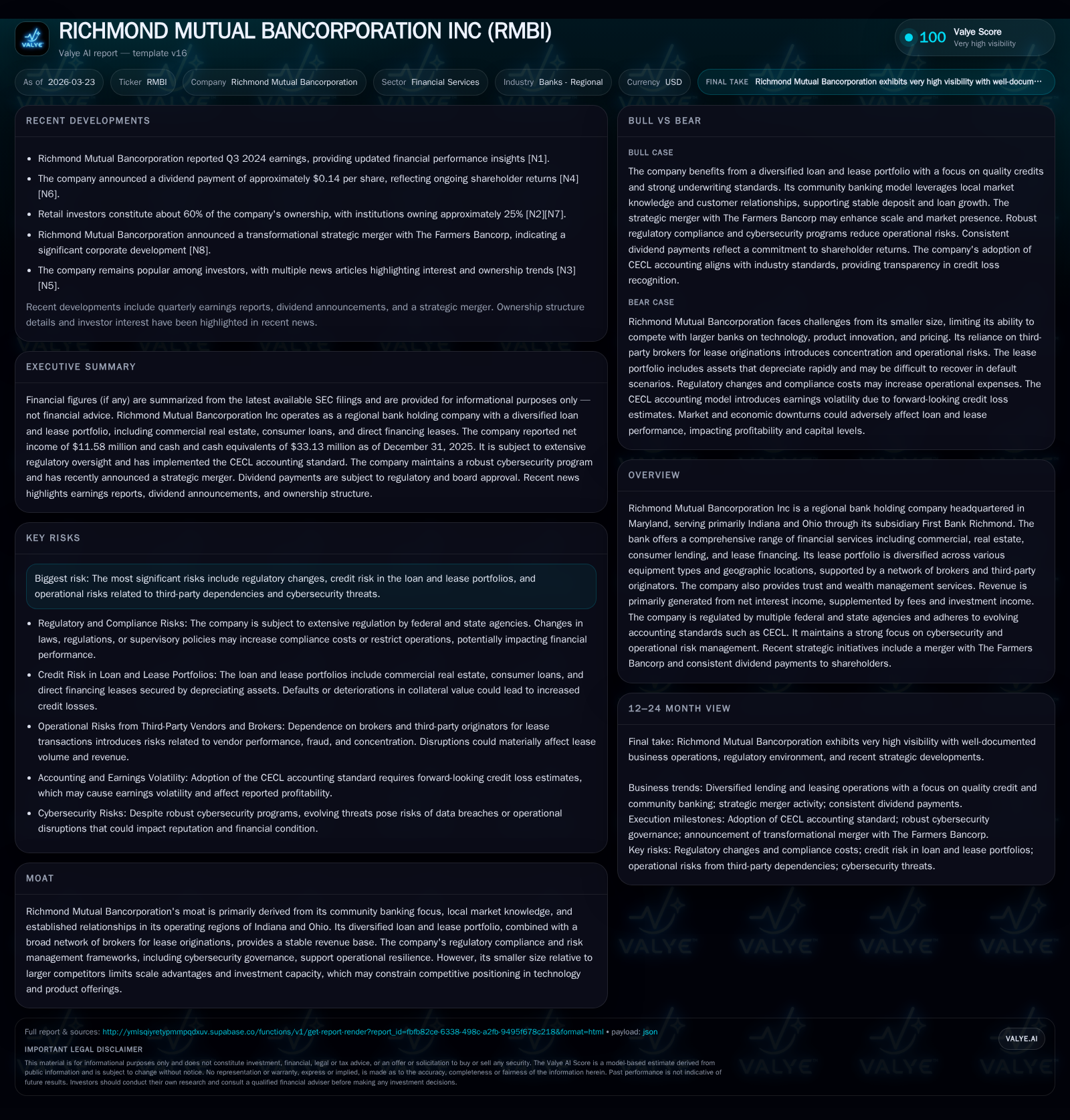
Richmond Mutual Bancorporation reported a 23.5% increase in net income for fiscal 2025, driven by solid net interest income and improved operating cash flow. The company's diversified loan and lease portfolio, supported by an extensive broker network, remains a key strength amid evolving accounting standards and regulatory pressures. Capital allocation reflects a balanced approach with steady dividends and share repurchases alongside increased investments in technology and cybersecurity. Key growth opportunities include a strategic merger and lease portfolio expansion, while ongoing risks stem from regulatory compliance costs and credit concentration in select states.
Historical Financial Performance Summary
Richmond Mutual Bancorporation delivered meaningful earnings growth in fiscal year 2025, achieving net income of $11.58 million—a 23.5% increase over $9.38 million reported in FY2024 [F1]. This marks a recovery from declines observed in prior years following peak earnings of $12.97 million in FY2022. Operating cash flow also increased by 8.2%, reaching approximately $15.97 million in FY2025 compared to $14.75 million the previous year, supporting liquidity for investments without imposing balance sheet strain [F1].
Capital expenditures surged to $1.36 million in FY2025 from $460 thousand in FY2024, reflecting an intensified focus on technology enhancements and cybersecurity infrastructure upgrades detailed within regulatory disclosures [F1],[S13]. Net interest income continues to be the principal revenue driver aligned with RMBI’s community banking model focusing on Indiana and Ohio markets [N1],. Fee-based income streams from trust services supplement earnings.
Historical performance (annual)
| FY | Net ($mm) | CFO ($mm) | Capex ($) | Net YoY |
|---|---|---|---|---|
| 2025 | 12 | 16 | 1361889 | +23.5% |
| 2024 | 9 | 15 | 460380 | -1.2% |
| 2023 | 9 | 12 | 619209 | -26.8% |
| 2022 | 13 | 18 | 385099 |
Source: SEC companyfacts cache [F1].
Capital returns and efficiency (annual)
| FY | Div ($mm) | Buybacks ($mm) | FCF ($mm) |
|---|---|---|---|
| 2025 | 6 | 6 | 15 |
| 2024 | 6 | 5 | 14 |
| 2023 | 6 | 6 | 11 |
| 2022 | 4 | 10 | 18 |
Source: SEC companyfacts cache [F1].
Table: Richmond Mutual Bancorporation Historical Financial Performance (FY2022-FY2025)
Loan Portfolio Composition and Risk Management
RMBI's lending activities center on commercial real estate loans secured primarily by owner-occupied properties along with commercial & industrial loans including equipment financing lines [S6],[S8]. The direct finance leasing portfolio totaled approximately $145.8 million at year-end FY25 representing about 12.2% of the total loan and lease portfolio [S18]. These leases span diverse equipment types including medical devices, computer systems, manufacturing machinery and construction equipment distributed nationally through a broker network exceeding one hundred originators ,[S11].
Underwriting emphasizes conservative credit profiles internally rated as "A" quality; nevertheless risks persist given challenges related to repossession or bankruptcy recoveries particularly for leased technology assets where contractual restrictions may limit collateral reuse [S18].
The adoption of the Current Expected Credit Losses (CECL) accounting standard effective January 1st, 2023 transitioned RMBI from an incurred loss model to a forward-looking lifetime loss estimation model incorporating macroeconomic inputs that influence allowance levels dynamically throughout reporting periods [S1],[S22]. This change introduces potential earnings volatility due to fluctuations in forecast assumptions but supports enhanced early recognition of credit deterioration.
Regulatory Environment Impacting Operations
RMBI operates under stringent regulatory supervision from the Federal Reserve Board (holding company oversight), Federal Deposit Insurance Corporation (FDIC), and state regulators including the Indiana Department of Financial Institutions [S1],[S5],[S17]. These bodies govern permissible activities including asset classification rules which directly affect capital adequacy calculations and loan loss reserve requirements.
CECL implementation also introduces retrospective adjustment considerations potentially affecting retained earnings levels temporarily [S22]. Additionally emerging federal cybersecurity regulations require rapid notification of critical incidents—typically within hours—mandating robust IT controls consistent with Gramm-Leach-Bliley Act privacy provisions among others [S17]. Compliance costs remain significant for RMBI given its smaller scale relative to larger peers constraining economies of scale benefits [S6],.
Growth Outlook: Strategic Initiatives and Market Positioning
The announced merger with The Farmers Bancor seeks to expand RMBI’s presence within the Indiana-Ohio corridor potentially increasing deposit volumes while leveraging complementary trust and wealth management capabilities present at both institutions [N1],.
Despite these growth prospects constraints arise from RMBI's comparatively smaller size limiting capacity for technology investments needed to rapidly innovate deposit products or enhance digital customer experiences amidst FinTech competition noted in filings [S6],[N1]. Talent acquisition challenges for specialized roles such as advanced risk modeling or AI integration are also relevant considerations flagged by management [S13].
Capital Allocation: Dividends and Share Repurchases
RMBI follows a capital allocation policy balancing shareholder returns with prudent capitalization objectives reflected in dividend payments totaling approximately $5.83 million in FY25 alongside share repurchases amounting to roughly $5.63 million during the same period [F1],[S20]. Return on equity stands near 7.9%, calculated as trailing net income over shareholders’ equity ($11.58 million / $145.78 million), indicating moderate capital efficiency aligned with community bank peers but below larger-scale competitors benefiting from scale leverage effects.
Elevated capex expenditure underscores strategic prioritization toward infrastructure modernization supporting cybersecurity governance enhancements while mitigating third-party vendor risks increasingly emphasized within risk disclosures [F1],[S13].
Technology Investments and Cybersecurity Focus
RMBI's increased capital spending highlights commitment to bolstering digital resilience through multi-layered cybersecurity defenses responsive to regulatory mandates on incident detection and reporting timelines introduced recently under federal guidance ,[S13],[S17]. Investments target advanced monitoring systems integration including anomaly detection automation with cautious consideration toward AI model risk governance described in risk factor sections ensuring robust human oversight [S13]. This approach aligns with industry recognition that constrained tech budgets may impair security postures exposing institutions to elevated ransomware threats.
Milestones Ahead: Merger Integration and Lease Portfolio Development
Key operational milestones include successful integration of The Farmers Bancor operations aiming for timely synergy realization as outlined during merger communications documented recently [N1]. Lease portfolio growth continues leveraging broad broker-originated deal flow enabling geographic diversification; however concentrated exposure across states such as California and New York—comprising nearly 38% of lease assets—requires vigilant monitoring against localized economic cyclicality impacting lessee payment performance .[ These developments will critically influence RMBI’s near-term trajectory particularly as merger complexity intersects evolving credit conditions amid tightening regulatory scrutiny.
Credit Risk Concentration Considerations
The CECL framework necessitates ongoing recalibration of allowance models incorporating volatile macroeconomic variables potentially causing earnings fluctuations when forecast assumptions shift materially quarter-to-quarter as acknowledged by management discussions within filings [S14],[F1].[ Lease portfolio concentration across four key states—California (16.6%), New York (8.6%), Florida (6.7%), Texas (5.9%)—represents notable exposure requiring active surveillance due to rapid depreciation characteristics typical of leased equipment collateral.
While no material loan concentrations breach regulatory lending limits currently noted certain construction loans face litigation risks presenting downside uncertainty warranting close watchfulness over future provisioning needs.
This analysis is based on publicly available SEC filings (10-Ks/Qs), Nasdaq news releases,and company disclosures through March 23rd ,2026 without providing investment advice or forecasts.
Disclaimer: This is research-only, informational analysis and not investment advice. It may include AI-generated interpretation and general industry context. Always verify important details using primary sources.

Comments