
EQUATOR Beverage’s Transition to Profitability Highlights Innovation and Capital Efficiency Constraints
A young beverage company riding organic, functional trends advances into profitability while facing competitive and operational challenges.
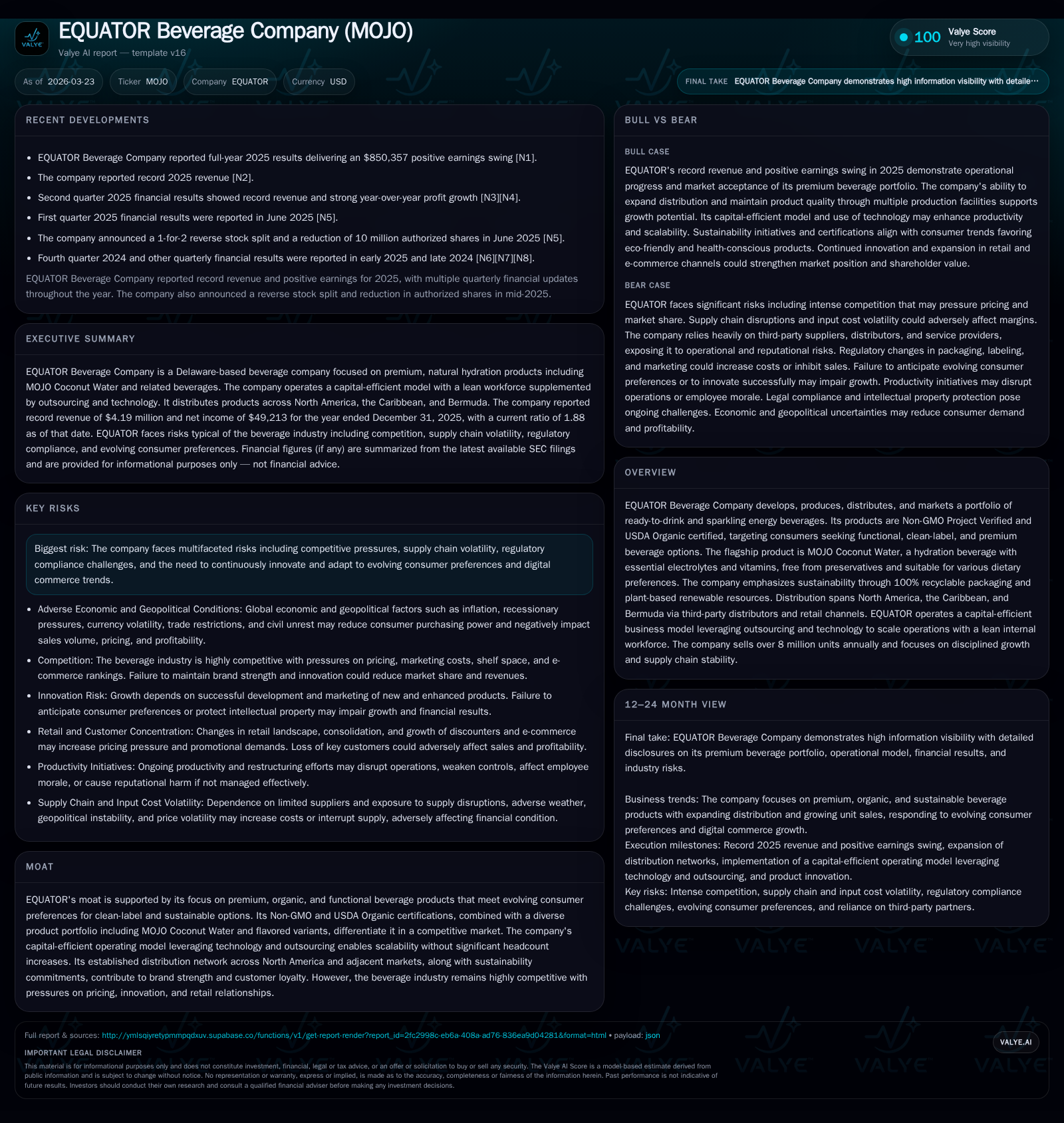
EQUATOR Beverage Company (MOJO) demonstrated strong revenue growth and a meaningful turnaround to positive net income in FY2025, supported by its portfolio of organic, Non-GMO certified ready-to-drink coconut water and sparkling energy beverages. The company’s asset-light model relying on outsourcing and technology enables capital-efficient scaling, reflected in improving operating margins and robust cash flow generation. Growth drivers include expanding geographic distribution in North America and adjacent markets, product innovation aligned with health-conscious consumer preferences, and digital commerce expansion. However, competitive pressures, supply chain volatility, evolving retail dynamics, and regulatory risks temper growth visibility. Monitoring management’s ability to sustain innovation momentum and manage input costs will be critical milestones.
Company Overview
EQUATOR Beverage Company (ticker MOJO) produces and markets ready-to-drink and sparkling energy beverages emphasizing organic, Non-GMO Project Verified products. Headquartered in Jersey City, New Jersey, EQUATOR has evolved since its beginnings in 2015 as MOJO Organics to establish a premium brand presence focused on health-conscious consumers seeking functional hydration alternatives with clean labels. Products include its flagship MOJO Coconut Water delivering essential electrolytes and vitamins without preservatives — appealing to vegan, kosher, paleo, keto diets — alongside flavored variants like coconut water with pineapple or mango juice and sparkling coconut water citrus blends.
Sustainability is core: packaging is fully recyclable using plant-based renewable materials. Distribution covers North America, the Caribbean, and Bermuda through third-party distributors plus retail grocery chains and expanding e-commerce channels [S1][S3][S8].
Historical Growth Performance
Financially, EQUATOR has experienced accelerated revenue growth alongside a strategic push for operational scale.
Historical performance (annual)
| FY | Rev ($mm) | Net ($) | CFO ($) | OpInc ($) | Rev YoY | Net YoY |
|---|---|---|---|---|---|---|
| 2025 | 4 | 49213 | 211658 | 83726 | +29.1% | +106.1% |
| 2024 | 3 | -801144 | 50460 | -781409 | +41.9% | -345.2% |
| 2023 | 2 | -179957 | 123415 | -163617 | +24.7% | |
| 2022 | -238836 | -93004 | -228199 |
Source: SEC companyfacts cache [F1].
Capital returns and efficiency (annual)
| FY | ROE% |
|---|---|
| 2025 | 8.9 |
| 2024 | -238.2 |
| 2023 | -66.4 |
| 2022 | -163.7 |
Source: SEC companyfacts cache [F1].
From FY2023 through FY2025 revenue nearly doubled from approximately $2.3 million to over $4.1 million (a compound annual growth rate exceeding 34%), powered by distribution expansion and new product introductions [F1]. In FY2025 the company swung into positive operating income of $83.7k from a negative base of over $780k the prior year — indicative of improving product mix and margin leverage though absolute profitability remains modest relative to scale [F1]. Net income also turned positive for the first time since inception.
Operating cash flow scaled more than fourfold to $211k in FY2025 as working capital normalized; capital expenditures remain minimal given outsourced manufacturing partners [F1][S6]. Equity nearly doubled during this period reflecting retained earnings accumulation supporting a stronger balance sheet.
Business Model & Competitive Positioning
EQUATOR operates an asset-light business model with lean internal staffing (two employees reported end-2025) while outsourcing production to multiple contract manufacturers aligned with demand forecasts [S3][S6]. This supports scalability without proportional fixed costs or headcount increases.
The company differentiates through USDA Organic certification and Non-GMO Project Verification combined with clean-label formulations meeting dietary niches such as vegan and keto diets [F1]. These attributes provide differentiation versus commoditized coconut water or mass-market energy drinks lacking ingredient transparency.
Sustainability efforts using plant-based renewable packaging align with rising consumer environmental awareness—an increasingly important market factor [S10].
Distribution is hybrid: third-party wholesale partnerships supply grocery retailers alongside targeted penetration into digital commerce platforms tapping growing online shopping habits for health-oriented products [S3][S15]. The geographic footprint includes North America plus Caribbean territories where tropical beverage flavors resonate culturally.
Competition is intense across segments—established beverage conglomerates have scale advantages in shelf space control while private label growth pressures prices [S18][S19]. Expansion of e-commerce increases price transparency potentially eroding margins without brand loyalty or innovation.
Future Growth Prospects
Growth catalysts include:
- Geographic Expansion: Developing distribution channels further within existing regions plus entry into new North American markets could increase sales volume.
- Product Innovation: Launching novel formulations or fortified blends aligned with functional wellness trends may broaden appeal beyond core organic consumers.
- Digital Commerce Scaling: Strengthening e-commerce capabilities is vital as consumer shopping migrates online; integration with mobile platforms or subscription models could enhance repeat purchases.
- Sustainability Leadership: Leveraging eco-friendly packaging as a marketing differentiator against competitors reliant on conventional plastics.
Growth limitations stem from:
- Pricing pressures amid retailer consolidation favoring discounters demanding promotional spend or price cuts [S16][S19].
- Supply chain risks tied to agricultural inputs such as coconut sourcing and volatile commodity prices for packaging materials potentially squeezing gross margins [S16].
- Regulatory uncertainties around labeling laws like California’s Proposition 65 that may require warnings deterring consumers [S4][S10].
- Need for continuous innovation amid evolving consumer tastes; intellectual property disputes could threaten proprietary formulations [S20][S22].
Financial Expectations & Milestones to Watch
While explicit medium-term guidance is absent ([N1],[S1]), key indicators include:
- Quarterly revenue maintaining low double-digit growth signaling sustained traction.
- Margin expansion via operational efficiencies including automation per management’s capital-efficient model [S6].
- New product launches gaining shelf placement in major grocery chains or e-commerce platforms demonstrating innovation pipeline success.
- Management’s strategies addressing input cost inflation impacting gross margin stability.
- Development of partnerships or broker networks deepening distribution coverage or supporting international expansion.
Returns & Capital Allocation
Recent financials indicate progress toward shareholder value creation:
- Approximate return on equity was about 8.9% for FY2025 calculated from net income over equity — an improvement from prior years’ losses [F1].
- Operating cash flows were solidly positive at $211k with negligible capex yielding free cash flow supporting liquidity [F1][S6].
- No dividends or share buybacks reported post-reverse stock split executed October 2025 aimed at enhancing per-share trading price for institutional appeal [S24]; reinvestment appears prioritized.
Risks Summary
EQUATOR faces risks including:
- Economic & Geopolitical: Inflationary pressures may reduce discretionary spending; geopolitical instability can disrupt commodity supplies affecting input costs [S1][S7].
- Competitive Dynamics: Intense rivalry may erode pricing power; private label growth threatens volume/margin mix [S18][S19].
- Regulatory & Legal: Product labeling requirements (e.g., Proposition 65), packaging mandates involving recycled content/PFAS restrictions add compliance costs possibly impeding sales [S4][S10][S13].
- Supply Chain & Outsourcing Dependence: Reliance on third-party manufacturers/distributors introduces operational risk; supplier failures can impact quality/delivery timelines [S16][S26].
- Consumer Preference Shifts: Rapid adoption of digital channels requires swift adaptation or risk loss of market share; failure in innovation undermines revenue potential [S9][S17].[N1]
- Intellectual Property: Protecting proprietary formulas is critical; infringement disputes could result in costly litigation altering competitiveness [S22].
Conclusion
EQUATOR Beverage Company has achieved an impressive fiscal turnaround through disciplined execution of a capital-light operating model leveraging outsourcing plus technology-driven scalability. Its growing portfolio centered on MOJO Coconut Water variants aligns well with wellness-oriented consumers prioritizing ingredient transparency and sustainability.
Ongoing challenges include fierce competition from large incumbents and private labels, regulatory uncertainties plus dynamic shifts toward digital purchasing complicating sustained growth momentum. Investors should monitor execution against geographic expansion plans, innovation cadence, supply chain risk management and cost inflation mitigation efforts.
Data provided herein is derived from public filings as of March 23rd, 2026 including EQUATOR Beverage Company’s SEC reports (10-K/10-Q) and verified financial disclosures without projections or investment recommendations.
Disclaimer: This is research-only, informational analysis and not investment advice. It may include AI-generated interpretation and general industry context. Always verify important details using primary sources.

Comments