
Capital Structure and Strategic Vision Drive Newbridge Acquisition's SPAC Trajectory
Newbridge Acquisition Ltd leverages its IPO proceeds and sector-focused strategy to pursue acquisitions in emerging markets while navigating early-stage financial and regulatory challenges.
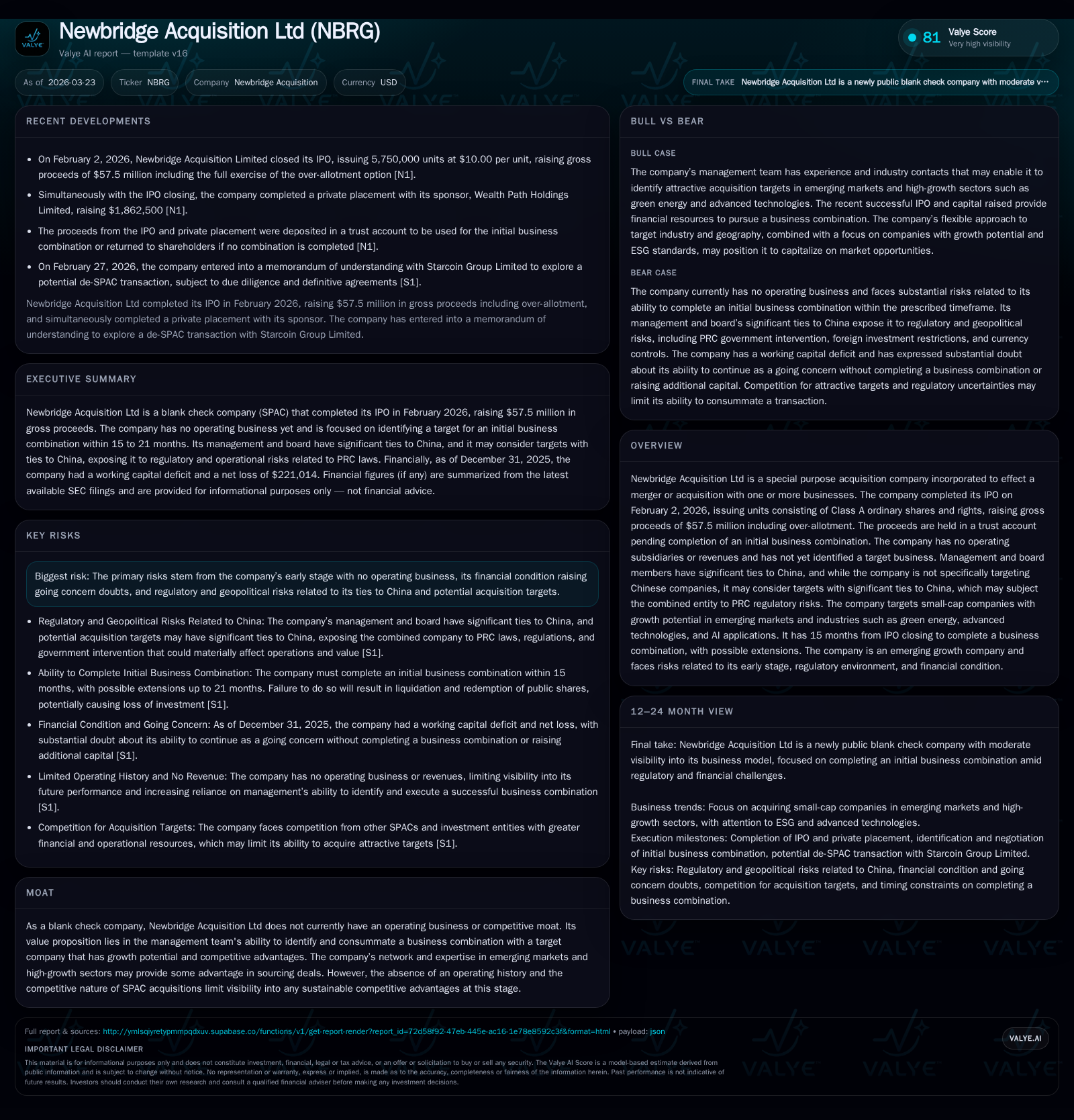
Newbridge Acquisition Ltd, a SPAC launched via a February 2026 IPO, raised $57.5 million held in trust pending an initial business combination targeting small-cap growth companies in emerging markets. Although devoid of operations and facing liquidity constraints reflected in a working capital deficit and auditor going concern doubts, the company’s management team leverages deep network ties and domain expertise in sectors including green energy and AI. Significant regulatory risks stem from the China-linked governance that shapes potential acquisition targets. Absent announced business combinations, investor attention will focus closely on target identification and the execution timeline within mandated windows.
IPO Completion and Initial Capital Structure
Newbridge Acquisition Ltd consummated its initial public offering on February 2, 2026, issuing 5 million units priced at $10 each. The units comprised one Class A ordinary share plus one right entitling holders to receive one-eighth of a Class A share upon consummation of an initial business combination [S1]. The IPO generated gross proceeds of $50 million. Underwriters exercised their overallotment option fully, adding $7.5 million more to proceeds. Concurrently, a private placement with the sponsor contributed approximately $1.86 million. Altogether approximately $57.5 million was deposited into a professionally managed trust account dedicated solely for funding the initial business combination or redeeming public shares if no deal closes [S1][S23]. The existence of this trust fund establishes the company's immediate capital base ready to finance upcoming acquisitions but leaves no operational cash flow.
Early Financial Snapshot and Going Concern Challenges
As a blank check company focused exclusively on identifying acquisition targets, Newbridge Acquisition has reported no operating revenues or subsidiaries [S1]. Financials as of December 31, 2025 reveal net income losses of $221 thousand alongside current assets totaling about $1.8 million against liabilities exceeding $5.4 million culminating in a current ratio near 0.34 [F1]. This highlights an acute liquidity mismatch indicative of typical pre-combination SPAC stage risks where public listing costs and administrative expenses outpace cash flows absent deal closure or external financing [S1]. Auditors have explicitly expressed substantial doubt regarding the company's ability to continue as a going concern given these constraints [S1]. Management notes ongoing expenses related to compliance with legal, accounting, regulatory filings plus prospecting for acquisition opportunities without revenue generation upfront [S1]. Therefore, while funded through the trust account earmarked for specific use, operating working capital remains fragile until a business combination materializes.
Historical performance (annual)
| FY |
|---|
| 2025 |
Source: SEC companyfacts cache [F1].
Reflects solely pre-combination financial snapshot given absence of operations.
Strategic Investment Focus and Target Criteria
The company's investment thesis centers on consummating an initial business combination with growth-oriented small-cap companies valued roughly between $650 million and $2 billion [S4][S7]. Primary industries under consideration include green energy initiatives aligned with sustainable development goals, artificial intelligence applications fostering industrial innovation, advanced equipment manufacturing modernizing traditional supply chains, as well as new materials that underpin technology-driven market transformation [S4][S7]. These sectors exhibit robust demand driven by industrial upgrading trends worldwide.
Geographically, though not exclusively bound by region, management prefers entities domiciled in North America, Europe or Asia-Pacific that possess international footprints particularly benefitting from rapidly growing emerging markets [S4][S10]. Selection criteria emphasize proven revenue growth coupled with scalability—businesses demonstrating platform-led models or closed loop systems enabled by technology adoption are prioritized for their path to resilient free cash flow generation [S7]. Companies displaying strong competitive moats via proprietary technologies, leading brands or exclusivity arrangements are preferred under a value investing philosophy aiming to reduce downside risk while unlocking upside via capital access on becoming public [S4][S7]. Additionally strong ESG adherence forms part of the qualitative filters ensuring alignment with contemporary sustainability mandates.
Operational Advantages in Emerging Markets and Sectors
Newbridge Acquisition’s management team brings hands-on experience operating emerging start-ups in targeted high-growth verticals complemented by an established global network instrumental for sourcing attractive bids efficiently [S4][S7]. Their strategic positioning enables evaluation not only based on financial metrics but also operational levers such as harnessing advanced manufacturing facilities, embedding ESG frameworks at portfolio level and driving cost efficiencies through innovative operational processes [S7]. Given increasing investor scrutiny on ESG norms alongside the shift toward greener industrial policies globally, this operational focus could confer secondary advantages during due diligence phases.
Their expertise also facilitates assessing companies with disruptive technologies capable of reshaping legacy market industry structures—this adds first-mover advantage elements that are critical in fast-evolving sectors like AI software integrations or novel materials commercialization [S7]. Ability to rapidly deploy growth capital post-combination is considered pivotal to capitalize on these dynamics.
Regulatory and Geopolitical Risks from China-Linked Governance
Despite no explicit mandate targeting Chinese-based companies for acquisition, Newbridge Acquisition’s sponsor and executive leadership maintain significant business ties with China [S1][S23]. The corporate domicile in Hong Kong further ties post-combination entities into potentially complex PRC regulatory regimes if acquisitions involve businesses with physical presence or major operations therein [S1][S10]. Such circumstances would expose the combined entity to evolving Chinese laws governing data privacy, national security reviews mandated by the China Securities Regulatory Commission (CSRC), restrictions on cross-border capital flows under SAFE regulations and possibly increased scrutiny on overseas listings evidenced recently among Chinese firms listed abroad [S20][S26].
These geopolitical uncertainties translate into heightened transaction risk profiles—deal approvals could face delays or prohibitions; repatriation of dividends from PRC subsidiaries might be constrained due to forex controls which limit offshore remittances; statutory reserve requirements diminish available distributable profits for dividends from PRC entities; moreover lawsuits or enforcement actions may be challenging due to lack of reciprocal judicial assistance agreements between US and China courts affecting dispute resolution [S12][S20][S26][S22]. This environment injects additional uncertainty into valuation assumptions and integration prospects post-business combination.
Capital Allocation Policies Surrounding Shares, Redemptions, and Buybacks
Public shareholders enjoy redemption rights allowing exit upon approval of an initial business combination at approximately $10 per share plus accrued interest from trust account deposits—providing downside protection inherent in SPAC structures [S6][S8]. Redemption may occur irrespective of shareholder vote choices concerning the combination itself. However large-scale attempts by affiliates or coordinated groups are limited by restrictions capping redemptions at no more than 20% of IPO shares to forestall manipulation via redemption blocking tactics [S21][S24].
Affiliated parties including sponsors, officers and directors may privately purchase shares from redeeming shareholders but only at prices not exceeding redemption values ensuring no undue premiums are paid outside open mechanisms [S9][S14]. Furthermore such purchases must comply with SEC rules including Regulation M designed against market manipulation signals such as illegal stock price inflation through strategic buys ahead of significant events [S6][S9]. Any acquisitions made by insiders would not carry voting rights favoring combination approvals mitigating conflicts of interest concerns. Disclosures detailing purchase quantities, prices paid and seller identities would be filed promptly ahead of shareholder meetings approving transactions providing transparency into activity affecting float composition [S14].
There are currently no declared dividend policies nor share repurchase programs prior to consummation of any acquisition reflecting standard SPAC practices focusing all capital deployment toward securing a viable target business first [S6][S12].
What to Watch: Initial Business Combination Milestones and Potential Targets
As typical within SPAC frameworks governed by Nasdaq rules and contractual articles governing Newbridge Acquisition Ltd., the deadline to consummate an initial business combination stands initially at 15 months following IPO close but can be extended twice by three-month increments subject to board discretion but without requirement for shareholder approval — extending the window up to total maximum duration of roughly 21 months post-IPO [S25][S26][S28]. Failure to complete an acquisition within this timeframe mandates redemption of public shares from trust funds followed by company liquidation barring novel extensions.
Currently there is no public disclosure indicating substantive discussions or engagement with potential candidates nor agents retained specifically for deal sourcing suggesting early-stage search status [S7][S25]. Market participants should closely monitor regulatory filings for announcements regarding definitive agreements as well as proxy statements which will detail target valuations compared against trust account balance thresholds (minimum fair market value approx. 80% of trust amount) required for transaction viability under Nasdaq listing standards [S27][S28], alongside proposed governance arrangements post-closing.
Investors should also watch for disclosures relating to geopolitical risk management especially regarding businesses with China exposure given regulatory hurdles identified above which could influence transaction timing or structuring decisions dramatically.
This report summarizes Newbridge Acquisition Ltd’s foundational corporate trajectory from IPO through initial steps toward developing a business combination strategy emphasizing emerging market growth sectors. The absence of operating revenues combined with pronounced liquidity pressures underscores typical challenges blank check companies face pre-combination. Simultaneously management’s sectoral expertise aligned with disciplined target selection criteria presents clear axes along which future value creation ambitions hinge. Nonetheless extensive China-related regulatory exposure introduces material risk vectors necessitating vigilant oversight by stakeholders evaluating upcoming milestones.
This analysis intends purely informational purposes leveraging publicly available SEC filings without expressing investment opinions or recommendations.
Disclaimer: This is research-only, informational analysis and not investment advice. It may include AI-generated interpretation and general industry context. Always verify important details using primary sources.

Comments