
Vendome Acquisition Corp I’s SPAC Journey from IPO to Initial Business Combination
Vendome Acquisition Corp I leverages its SPAC structure and management prowess to pursue a transformative business combination in the consumer sector.
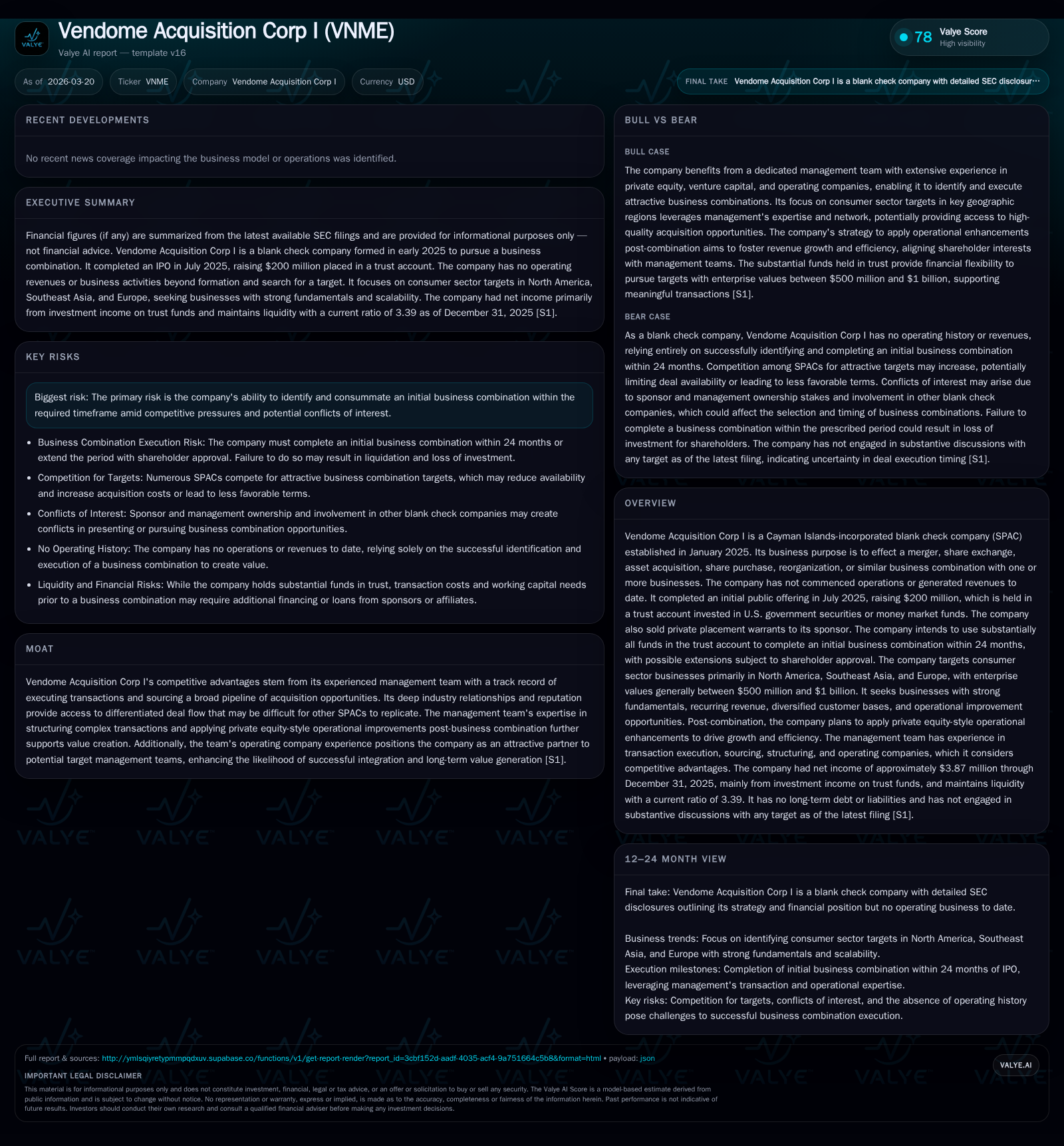
Incepted in early 2025, Vendome Acquisition Corp I promptly completed its IPO mid-2025, raising $200 million primarily earmarked for a strategic merger or acquisition. The company, a Cayman Islands blank check entity, currently holds capital securely in a trust account invested conservatively with the objective to finalize its initial business combination within two years. Operationally inactive, its value hinges on management’s seasoned expertise in sourcing and negotiating complex transactions, particularly targeting consumer businesses across North America, Europe, and Southeast Asia. Investors face typical SPAC risks including the finite timeline for deal execution amidst competitive pressures, sponsor-related structural nuances, and regulatory oversight.
Foundation Laid: IPO Capital Raise and Trust Account Structure
Vendome Acquisition Corp I ("the Company"), incorporated in the Cayman Islands in January 2025 as a special purpose acquisition company (SPAC), swiftly conducted its initial public offering on July 3, 2025. The offering consisted of 20 million units priced at $10 each, generating gross proceeds of $200 million [S1]. Concurrently, a private placement of approximately 2.65 million warrants was completed with the Sponsor at $1 per warrant, accruing an additional $2.65 million [S1].
All net proceeds from the IPO—totaling $200 million after underwriting discounts and fees—were placed into a trust account administered by Odyssey Transfer and Trust Company [S1]. Per industry norms for SPACs, these funds are conservatively invested solely in U.S. government securities with maturities under 185 days or qualifying money market funds [S1]. This approach safeguards investor capital until deployment upon completing an initial business combination.
The trust funds earmarked for acquisition are restricted from release except under specific circumstances: completion of the initial business combination, redemption of public shares in conjunction with shareholder votes altering redemption rights, or if no transaction is consummated within the prescribed timeframe—currently set at 24 months post-IPO—and the Company is liquidated [S1]. Interest accrued on these trust assets may be withdrawn by the Company to meet taxes or franchise fees but is otherwise retained within the trust account [S1]. This structural design aligns with best practices observed across blank check companies to ensure capital preservation.
Management Expertise and Deal Sourcing Differentiation
The Company's competitive advantages reside largely in its experienced management team which boasts substantial expertise in sourcing complex transactions and driving private equity-style value creation initiatives post-deal [S18][S19]. Unlike many SPACs that rely solely on financial engineering or generalist leadership, Vendome's sponsors possess operating company backgrounds complemented by extensive networks within private equity and venture capital sectors.
This depth enables access to proprietary deal flow opportunities predominantly within consumer industry verticals where they maintain established relationships across North America, Southeast Asia, and Europe—regions targeted for acquisition activity [S19]. Their skillset extends beyond mere transaction execution: it encompasses operational restructuring capabilities designed to unlock growth potential following integration. This dual focus reflects a commitment not only to closing deals but enhancing sustainable enterprise value through disciplined operational improvements—an often overlooked facet in typical SPAC strategies.
Additionally, the team's reputation mitigates common transaction frictions encountered during negotiations of structurally complex mergers or asset acquisitions. Such complexity necessitates creativity coupled with rigorous due diligence processes—a competency underscored by Vendome's sponsorship pedigree [S18]. Sector insiders will recognize that this approach positions Vendome favorably against peers competing for quality consumer businesses that exhibit scalability and robust fundamentals.
Financial Overview: No Operating History but Strong Statement of Funds
Reflecting its SPAC status, Vendome has yet to commence commercial operations or generate revenue since inception through December 31, 2025 [S1][F1]. Its net income during this period accrues primarily from interest earned on funds held within the trust account—recorded at approximately $4.03 million—which offsets modest formation and operating expenses totaling nearly $163 thousand [F1][S17]. Consequently, net income stood at roughly $2.05 million for fiscal year 2025 [F1].
Liquidity remains robust with current assets approximating $574 thousand against current liabilities near $169 thousand as of December 31, 2025 [F1], yielding a healthy current ratio around 3.39—a standard expectation given minimal operational activity. Total shareholders' equity was low due to the nature of SPAC accounting but yielded an ROE of approximately 506.5% driven mainly by small equity base and non-operating income gains rather than conventional profitability metrics [F1].
Investors should note that such elevated ROE figures are common in newly formed blank check entities where earnings derive from investment income on trust-held cash rather than recurring operations. This nuance complicates direct comparisons against traditional operating companies but remains standard within SPAC reporting conventions.
Historical performance (annual)
| FY |
|---|
| 2025 |
Source: SEC companyfacts cache [F1].
Table: Vendome Acquisition Corp I annual financial summary for fiscal year ending December 31, 2025[F1].
SPAC Lifecycle Milestones and Timelines to Watch
Critical timing considerations dictate that Vendome must consummate its initial business combination within two years of the IPO date—or else liquidate trust funds back to shareholders excluding specific permitted expenses unless shareholders approve an extension [S1][S10]. Extensions beyond this period require affirmative shareholder consent.
Redemption rights afford public shareholders the option to redeem their shares for cash prior to any business combination if dissatisfied with proposed deals or terms. Warrants attached to units have exercise prices subject to stock price adjustments triggered by trading volume weighted average prices falling below thresholds post-combination [S4].
Warrants issued via private placement hold transfer restrictions until at least 30 days following successful completion of the initial combination—standard lock-up provisions ensuring sponsor alignment during critical early stages [S4]. Additionally, sponsors may provide Working Capital Loans convertible into warrants to finance pre-combination activities if needed; however as of December 31, 2025 no such advances were outstanding [S15][S16][S26].
Given intense competition among SPACs targeting attractive consumer industry targets coupled with rising general market volatility impacting valuations, these time constraints place natural pressure on management teams to execute efficiently without compromising diligence quality—a balancing act intrinsic to blank check investing strategies.
Target Industry Focus: Consumer Businesses Across Key Regions
While Vendome remains open to various industries for their initial acquisition(s), their stated intent centers on consumer sector enterprises exhibiting favorable long-term growth prospects backed by secular tailwinds and fragmented competitive landscapes ripe for consolidation opportunities [S19].
Geographically, they prioritize markets where their leadership holds differentiated expertise: North America provides broad base demand dynamics; Southeast Asia offers emerging middle-class expansion prospects; while Europe contributes stable regulatory environments paired with diverse market characteristics supportive of operational improvements via scale economies [S19].
Ideal targets typically feature significant recurring revenue streams and diversified customer bases alongside solid margin profiles conducive to applying private equity operational playbooks post-combination [S19][S28]. This tri-regional focus combined with sector specificity represents strategic differentiation relative to more generalized SPAC mandates actively present in today's transactional environment.
Risks and Regulatory Considerations in the Hunt for a Business Combination
The preeminent risk hinges on successfully identifying a target meeting stringent valuation criteria while consummating a deal before expiration deadlines amidst heightened competition from other acquisitive entities including rival SPACs and traditional private equity firms [S3][S10]. Failure triggers mandatory liquidation yielding redemptions equal roughly to IPO price minus costs which could substantially limit shareholder returns.
Potential conflicts arise given Sponsor ownership stakes via founder shares and private placement warrants creating alignment concerns especially under stressed timelines where sponsorship incentives may diverge from public shareholders' best interests if pressure mounts toward hastened deal closures or relaxed diligence standards [S3].
Regulatory scrutiny specific to blank check companies requires transparent disclosures around related party transactions including working capital funding arrangements accompanied by rigorous adherence to SEC rules governing shareholder rights during redemption events post-public listing [S10]. Compliance expense burdens also contribute ongoing costs absent direct operating revenues prior to combination success.
No material litigation challenges confront management presently; however evolving regulatory interpretations continue warrant monitoring given heightened SEC focus on SPAC governance standards underscoring reputational risks intrinsic to this vehicle class [S3].
Capital Structure Nuances: Warrants, Founder Shares, and Sponsor Stakes
Post-IPO capital structure divides between Public Units comprising one Class A ordinary share plus half a redeemable public warrant exercisable at $11.50 subject to adjustments—and Private Placement Warrants sold exclusively to Sponsors bearing exercise rights with transfer limitations binding until after completion of an initial business combination [S1][S4].
Founder shares initially issued at nominal cost ($0.003-$0.005 per share effective price after forfeitures) represent approximately five million shares held by Sponsors with planned lockups extending six months post-merger or until specified share price hurdles are achieved assuring alignment before liquidity events occur [S1][S8][S26]. Such founder equity underpins sponsor economic interest but is subject to forfeiture clauses tied explicitly to underwriter over-allotment options which were not exercised fully—the execution variance affecting ultimate share counts post-issuance adjustments [S8].
Warrant overhang presents dilution risk typical in SPACs whereby exercise during future liquidity events may increase share counts diluting public holders unless managed prudently via anti-dilution mechanisms embedded within prospectus provisions adjusting strike prices upon certain down rounds or financing repricings [S4]. Registration rights attached specifically enable Sponsor-held warrants and converted founder shares resale flexibility after liquidity horizons evolve establishing normal market trading liquidity dynamics post-business combination.
Expected Shareholder Returns and Capital Allocation Strategies
Currently devoid of operational revenues or dividends distributions—and constrained from buyback programs—the Company's capital allocation posture prioritizes preserving all IPO proceeds within trust accounts pending deployment toward acquisition consideration(s) meeting strategic investment criteria outlined by management guidance [F1][S1].
Interest income supports limited corporate overhead related payments including franchise taxes but does not substantively impact broader returns profiles which remain predicated entirely on successful consummation of the business combination hypothesized value generation resulting from transaction synergies coupled with active operational stewardship led by experienced sponsors post-close [F1].
Investors should anticipate valuation volatility inherent during target search phases combined with final transaction pricing outcomes shaping realized returns as well as dilution impacts from warrant exercises sensitivity requiring careful ongoing monitoring ahead of merger announcements or proxy solicitations.
This analysis synthesizes information extracted exclusively from filed regulatory disclosures as of March 20, 2026 ([F1],[S#]). It acknowledges inherent uncertainties surrounding early-stage blank check companies whose prospective success depends greatly on execution capabilities and external market conditions beyond currently reported financial measures. Readers should consider these factors carefully when evaluating the company's progress toward its first substantive merger transaction.
Disclaimer: This is research-only, informational analysis and not investment advice. It may include AI-generated interpretation and general industry context. Always verify important details using primary sources.

Comments