
TEN Holdings Faces Revenue Decline and Intensified Losses Amid Concentration and Regulatory Challenges
TEN Holdings reported declining revenues, widening losses, and high customer concentration while navigating regulatory probes and capital pressures.
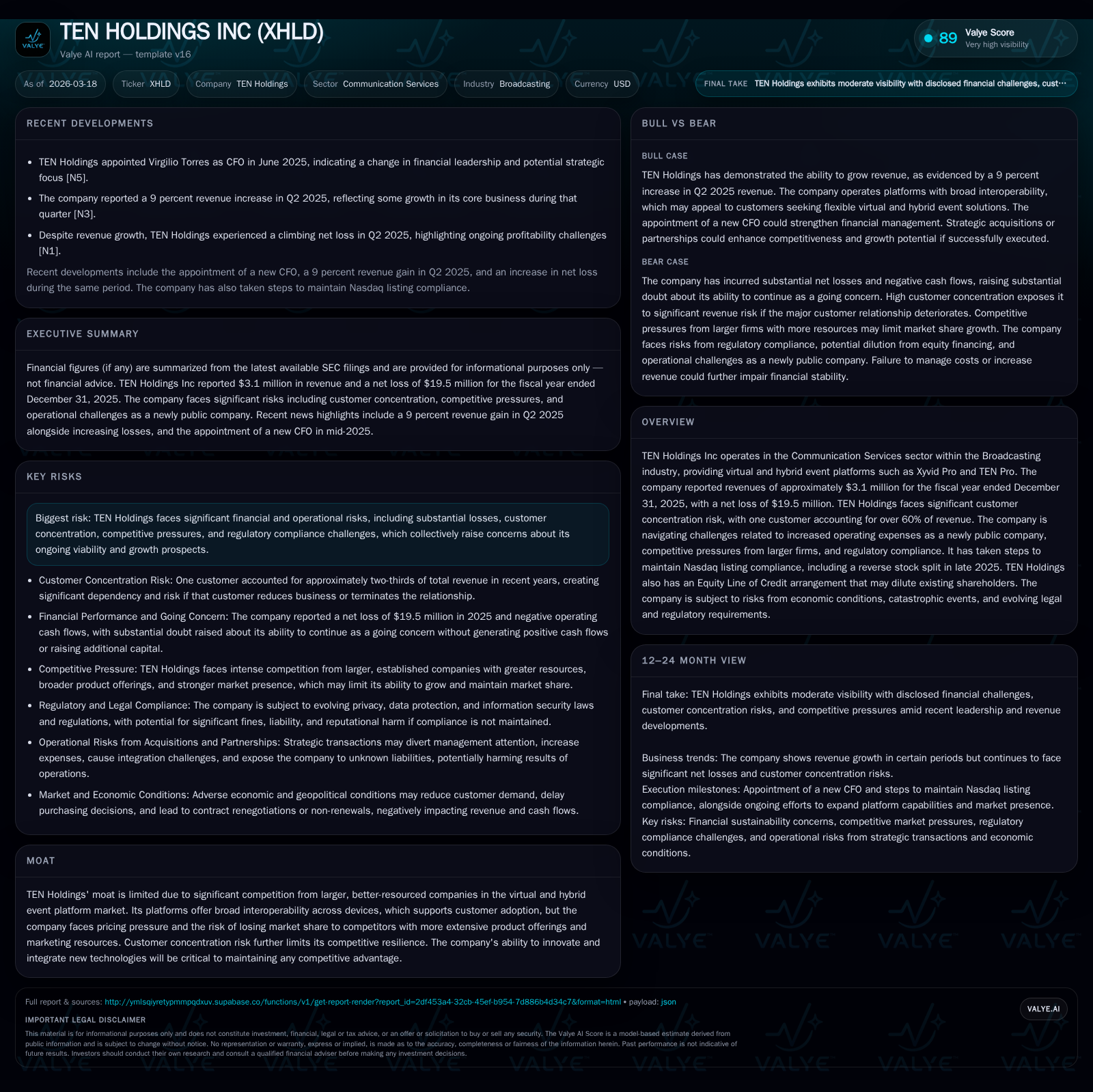
In fiscal year 2025, TEN Holdings Inc saw revenues decrease 11.4% to $3.1 million, with net losses expanding markedly to $19.5 million. The company remains heavily dependent on a single customer accounting for approximately two-thirds of total revenue. Operating cash flow stayed deeply negative at $10.1 million. Efforts to maintain Nasdaq listing included a reverse stock split, while equity financing arrangements offer capital but risk dilution. Regulatory investigations related to the IPO process persist, and operational challenges amid competition and cost pressures cloud near-term outlook.
Historical Financial Performance
TEN Holdings reported a decline in revenue for fiscal year 2025, dropping approximately 11.4% from $3.5 million in 2024 to about $3.1 million in 2025 [F1]. This contraction coincided with a substantial increase in operating losses, which expanded from roughly $2.7 million in 2024 to approximately $13.4 million in 2025, reflecting heightened cost pressures during scaling public company operations [F1]. Net losses increased significantly as well, reaching $19.5 million compared to $3.0 million in the prior year [F1]. Operating cash flow continued its negative trajectory, deteriorating to a loss of about $10.1 million during the fiscal year [F1]. Capital expenditures remained steady at around $38,000 annually.
Historical performance (annual)
| FY | Rev ($mm) | Net ($mm) | CFO ($mm) | OpInc ($mm) | Rev YoY | Net YoY |
|---|---|---|---|---|---|---|
| 2025 | 3 | -20 | -10 | -13 | -11.4% | -557.3% |
| 2024 | 4 | -3 | -2 | -3 |
Source: SEC companyfacts cache [F1].
Capital returns and efficiency (annual)
| FY | FCF ($mm) | ROE% |
|---|---|---|
| 2025 | -10 | -455.9 |
| 2024 | -3 | 185.5 |
Source: SEC companyfacts cache [F1].
The company's equity position improved from a deficit of approximately -$1.6 million in 2024 to a positive $4.3 million by the end of 2025, supported partly by recent equity issuances [F1]. Despite this improvement, the balance sheet remains constrained with a current ratio of about 1.43 indicating limited liquidity headroom [F1].
Customer Concentration and Operational Risks
TEN Holdings continues to rely heavily on a single customer that accounted for approximately 66.7% of total revenue in 2025—up slightly from about 64.6% in the previous year [S4][S6]. This concentration presents material risks; any reduction or loss of this customer relationship could materially impact revenues and cash flows.
The company notes that challenges such as customer dissatisfaction or competitive offerings could lead to contract non-renewals or reduced service engagement levels [S4]. It also faces strong competition in the virtual and hybrid event platform space from larger players with broader resources and offerings which may exert pricing pressure and margin erosion [S6].
Regulatory and Legal Challenges
TEN Holdings is subject to ongoing investigations by federal authorities related to its initial public offering process: grand jury subpoenas were issued by the U.S. Attorney’s Office for the Southern District of New York alongside document requests by the SEC [S5][S11]. These inquiries remain unresolved and could result in unforeseen liabilities or reputational harm.
Additionally, the company operates under evolving regulatory frameworks involving data privacy and security laws, intellectual property protections, anti-corruption statutes including the Foreign Corrupt Practices Act (FCPA), as well as accessibility requirements such as those mandated by the Americans with Disabilities Act (ADA) [S7][S8][S12][S15][S17][S21]. Compliance with these laws adds complexity and potential costs as TEN expands its operations.
Capital Structure and Nasdaq Compliance Efforts
To address Nasdaq listing deficiencies related to minimum bid price requirements due to sustained low share prices, TEN Holdings implemented a reverse stock split at roughly a 1-for-15 ratio near the end of calendar year 2025 [S2][S23]. Failure to maintain compliance through December 1, 2026 would lead to immediate delisting without further grace periods [S18][S23], representing significant liquidity risk.
The company has also entered into an Equity Line of Credit (ELOC) agreement with Lincoln Park Capital Fund allowing issuance of up to $20 million in common stock over a two-year period subject to certain conditions [S2][S14]. While this arrangement provides potential capital inflows critical for operations and growth initiatives, it carries dilution risk for existing shareholders.
Growth Prospects and Strategic Considerations
TEN Holdings’ ability to improve its outlook depends largely on diversifying its customer base beyond its largest client through new client acquisition and retention efforts under renewed contracts [S1][S19]. The firm plans investments in expanding sales and marketing capabilities including digital marketing spend and salesforce growth; however these initiatives require substantial funding without guaranteed returns given competitive dynamics.
Technological innovation remains important as TEN’s platform emphasizes interoperability across devices which supports adoption; nevertheless evolving client demands may require ongoing development resource commitments.
Macroeconomic factors such as inflationary pressures or economic slowdowns could reduce discretionary spending by business clients on virtual event services further constraining growth potential [S19][S21].
Returns and Capital Allocation
Historical financial results show no profitability; return on equity is deeply negative at approximately -456%, mirroring cumulative net losses relative to equity base as of fiscal year-end 2025 [F1]. The company does not pay dividends or conduct share repurchases given its financial condition.
Capital expenditures are minimal relative to operating scale (~$38K annually), consistent with software platform maintenance rather than asset-heavy investments [F1]. Operating cash flows remain substantially negative reflecting ongoing high fixed costs against limited revenue generation capacity [F1].
Current capital allocation prioritizes sustaining operations through equity financing mechanisms rather than shareholder distributions—a typical stance for an early-stage public company facing financial headwinds.
Disclaimer: This analysis is based exclusively on publicly available SEC filings cited herein without offering investment advice or recommendations regarding TEN Holdings Inc securities.
Disclaimer: This is research-only, informational analysis and not investment advice. It may include AI-generated interpretation and general industry context. Always verify important details using primary sources.

Comments