
Grayscale Ethereum Classic Trust’s Financial Volatility Amid Market and Regulatory Challenges
ETC Trust’s performance reflects Ethereum Classic price swings, sponsor fee impacts, and evolving regulatory and structural conditions.
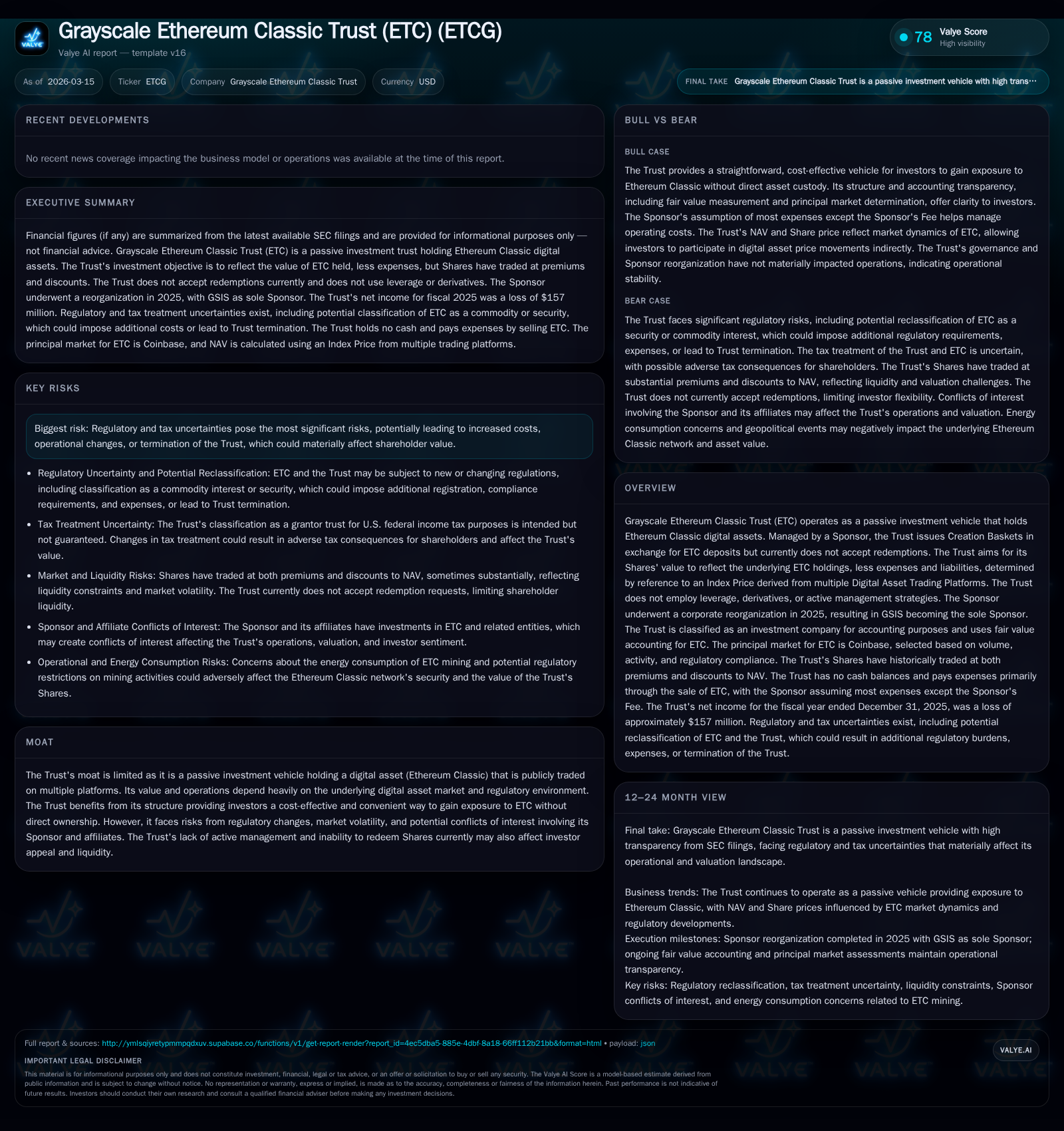
Grayscale Ethereum Classic Trust (ETCG) passively holds Ethereum Classic (ETC) tokens, with financial results closely tied to ETC price fluctuations. The Trust reported net income of $66.6 million in 2023 before declining to a $157 million loss in 2025, driven by ETC depreciation and sponsor fees paid in ETC tokens. A 2025 sponsor reorganization consolidated sponsorship under GSIS without operational disruption. Regulatory uncertainty around digital asset classification and mining restrictions adds risk. The absence of share redemptions contributes to significant premiums and discounts relative to NAV, complicating liquidity. Capital allocation consists mainly of ETC transfers for sponsor fees, with no dividends or buybacks. Legal disputes involving affiliated entities add further uncertainty.
Historical Performance: ETC Price Volatility and Sponsor Fees Impact
Grayscale Ethereum Classic Trust (ETCG) operates as a passive vehicle holding only Ethereum Classic (ETC) tokens. Its financial results are directly correlated with ETC market price movements.
The Trust reported net income of approximately $66.6 million in fiscal year 2023, benefiting from ETC appreciation during that period [F1]. In 2024, net income declined to $29.1 million before swinging to a net loss of $157 million by the end of 2025 [F1], reflecting significant declines in ETC prices.
Quarterly and semiannual reports highlight ETC price drops from $23.56 per token as of June 30, 2024, to $16.77 by June 30, 2025 [S7], contributing to reductions in net asset value (NAV). Concurrently, Sponsor fees are paid quarterly through transfers of ETC tokens from the Trust’s holdings rather than cash payments, further reducing ETC balances and impacting NAV directly [S3,S5,S7,S9]. These fees ranged from approximately 69,000 to over 200,000 ETC tokens per quarter during mid-2024 through late-2025 periods.
Historical performance (annual)
| FY | Net ($mm) | Net YoY |
|---|---|---|
| 2025 | -157 | -639.7% |
| 2024 | 29 | -56.3% |
| 2023 | 67 |
Source: SEC companyfacts cache [F1].
Sponsor fees settled via ETC token transfers reduce underlying assets; Share prices have traded at substantial premiums or discounts relative to NAV due to structural factors [F1,S7].
Sponsor Reorganization: Consolidation under GSIS
In early 2025, an internal corporate reorganization merged GSI into GSO effective January 1, with GSIS admitted as an additional Sponsor immediately thereafter [S2,S15]. On May 3, 2025, GSIS became the sole Sponsor following GSO’s voluntary withdrawal pursuant to the Trust Agreement [S2,S15].
This consolidation did not materially affect day-to-day management or contractual obligations related to the Sponsor role but streamlined control within Grayscale’s affiliate structure.
Ethereum Classic Network Dynamics: Mining Activity and Regulatory Scrutiny
As of December 31, 2025, the Ethereum Classic network maintained a hash rate exceeding 186 tera hashes per second—a measure of proof-of-work mining activity critical for network security [S1,S8]. However, concerns over energy consumption have led various states including New York to impose moratoriums on new proof-of-work mining permits since November 2022 [S8].
Such regulatory actions may reduce mining activity levels and pose risks to network security against threats like majority hash rate attacks (51% attacks), which could adversely affect token value and Trust operations.
Regulatory Risks: Classification Uncertainty and Compliance Burdens
Regulatory uncertainty remains a major risk factor for the Trust:
- ETC could be classified as a "security" by the SEC or as a "commodity interest" under CFTC jurisdiction following legislative developments such as the CLARITY Act [S12,S14].
- Such classifications would impose new compliance requirements on the Sponsor and potentially Authorized Participants servicing creation orders.
- Failure or unwillingness to comply might lead to extraordinary expenses or require termination of the Trust at disadvantageous times for shareholders [S12].
- Foreign regulatory conflicts further complicate acceptance and trading globally.
- Legal proceedings involving affiliates—such as Genesis Global Capital's bankruptcy litigation alleging preferential transfers—pose reputational and operational uncertainties despite no direct expected impact on the Trust currently [S6].
Liquidity Constraints: Absence of Redemptions and Pricing Dislocations
The Trust does not currently accept redemption requests from shareholders but periodically issues Creation Baskets upon deposits of ETC by Authorized Participants [S1,S2]. This absence of redemptions removes a key arbitrage mechanism that typically keeps Share prices aligned with NAV.
Consequently:
- Shares frequently trade at substantial premiums or discounts relative to NAV depending on market demand and supply dynamics [S16,S25].
- Non-concurrent trading hours between OTCQX (where Shares trade) and Digital Asset Trading Platforms (referenced for underlying asset pricing) exacerbate valuation disconnects [S25].
- The sole Authorized Participant is an affiliate-controlled entity limiting arm's-length transactions and potentially liquidity depth [S22].
Capital Allocation: Fee Payments Without Distributions or Buybacks
Capital flows within the Trust predominantly relate to covering Sponsor fees:
- Fees are exclusively paid via transfers of ETC tokens from Trust holdings rather than cash payments, systematically diminishing token assets over time [F1,S10].
- No dividends or share repurchases have been declared or executed; shareholder returns rely entirely on underlying asset appreciation minus expenses and fees.
- Operating cash flows remain negative or near zero given these mechanical token transfers without active income generation beyond asset appreciation potential [S3,S5,S7].
Investor Considerations: Premium/Discount Volatility and Redemption Limitations
Investors should note:
- Shares have historically exhibited wide deviations from NAV per Share reflecting market sentiment swings.
- Lack of redemption rights restricts direct liquidation at NAV levels.
- Creation basket issuance through affiliated Authorized Participants reduces transparency on Share issuance timing affecting premium/discount dynamics.
Understanding these factors is essential when assessing liquidity profiles alongside desired exposure levels.
Outlook: Key Developments to Monitor
Looking forward without extrapolating beyond disclosed facts:
- Regulatory clarifications on digital asset classifications will be critical; outcomes may necessitate registration filings or trigger extraordinary compliance costs.
- Changes in mining regulations affecting energy use could influence network security profiles and long-term value trajectories for ETC.
- Potential introduction of redemption programs would improve liquidity but require sponsor consent under current agreements.
- Continued monitoring of legal proceedings involving affiliates remains important for risk assessment.
- Broader digital asset ecosystem competition continues to influence market dynamics.
This analysis is based exclusively on company disclosures through March 15, 2026.
Disclaimer: This is research-only, informational analysis and not investment advice. It may include AI-generated interpretation and general industry context. Always verify important details using primary sources.

Comments