
Cue Biopharma Struggles with Clinical and Market Challenges Despite Proprietary Immuno-STAT Platform
The clinical-stage biopharma leverages a novel T-cell targeting platform but faces financial losses and regulatory hurdles.
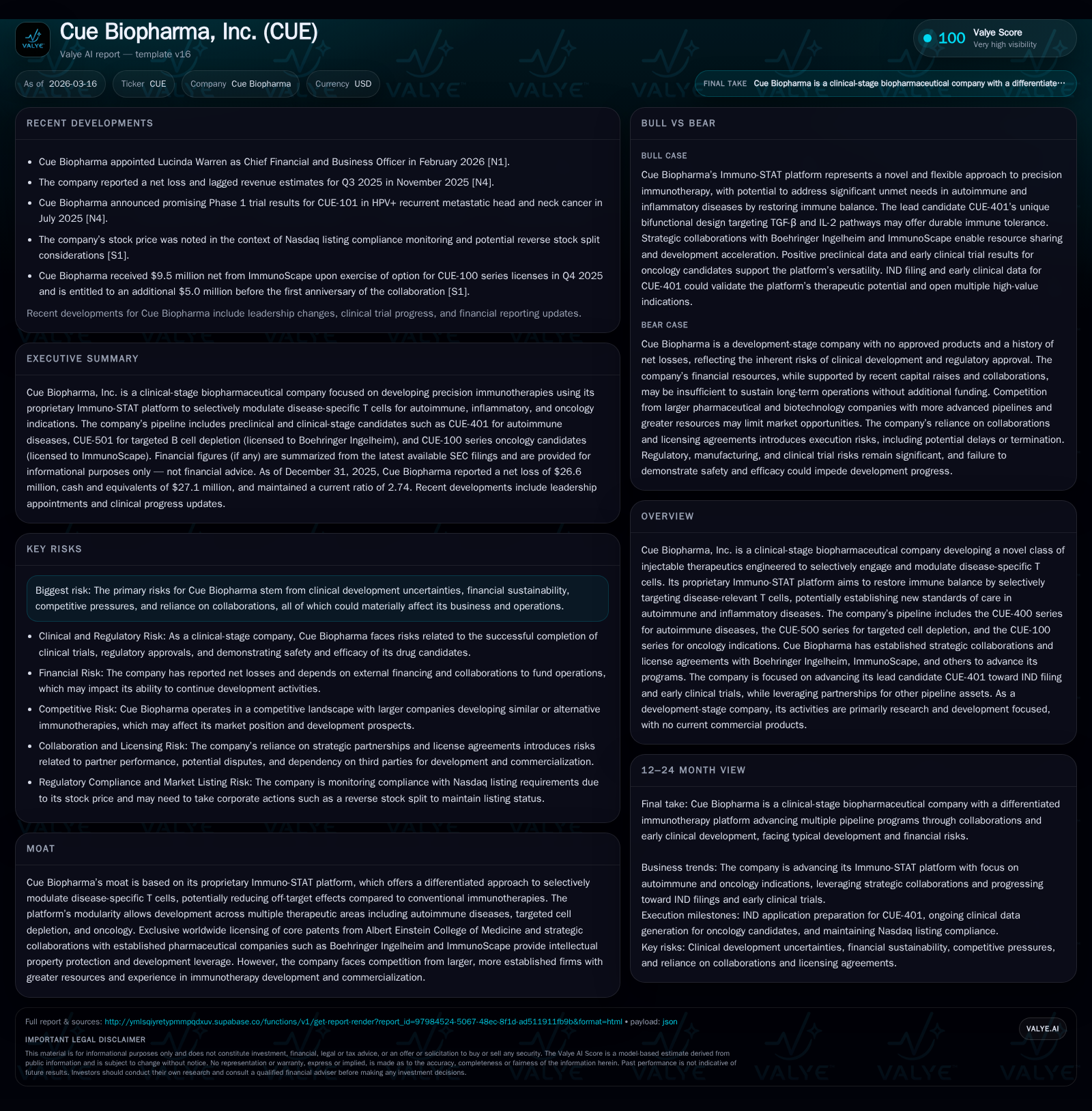
Cue Biopharma, Inc. is developing a unique class of biologics aimed at disease-specific T cell modulation via its Immuno-STAT platform targeting autoimmune, inflammatory, and oncology indications. Its lead candidate, CUE-401, is advancing toward IND filing in Q2 2026, supported by strategic partnerships including Boehringer Ingelheim. Despite these advances, the company continues to report substantial operating losses and negative cash flows, constraining financial sustainability. Regulatory compliance challenges, competitive pressures, and Nasdaq listing risks add material uncertainty to its growth trajectory.
Company Overview and Business Model
Cue Biopharma, Inc., a clinical-stage biopharmaceutical entity, specializes in innovative injectable therapeutics engineered to selectively engage disease-specific T cells. Its proprietary Immuno-STAT® platform underpins product candidates across therapeutic areas: autoimmune (CUE-400 series), targeted cell depletion (CUE-500 series), and oncology (CUE-100 series). The platform’s modular design harnesses engineered cytokines like IL-2 and TGF-β to induce immune tolerance or activate tumor-specific immune responses, distinguishing it from conventional immunotherapies that broadly activate the immune system [S1].
Strategic partnerships bolster Cue’s development pipeline: Boehringer Ingelheim holds rights for the CUE-501 B cell depletion program, while ImmunoScape oversees oncology asset development. This collaborative model accelerates innovation yet imposes operational dependencies typical in biotech alliances [S1][S18].
Historical Performance (2019–2025)
While detailed financials prior to 2022 are unavailable here, recent annual performance offers insight into Cue’s trajectory amid R&D-intensive phases:
Historical performance (annual)
| FY | Net ($mm) | CFO ($mm) | OpInc ($mm) | Capex ($) | Net YoY |
|---|---|---|---|---|---|
| 2025 | -27 | -22 | -27 | 177000 | +34.6% |
| 2024 | -41 | -36 | -41 | 66000 | +19.8% |
| 2023 | -51 | -40 | -52 | 0 | +4.3% |
| 2022 | -53 | -42 | -53 | 170746 |
Source: SEC companyfacts cache [F1].
Capital returns and efficiency (annual)
| FY | Buybacks ($) | FCF ($mm) | ROE% |
|---|---|---|---|
| 2025 | -22 | -100.6 | |
| 2024 | -36 | -232.4 | |
| 2023 | 0 | -40 | -136.8 |
| 2022 | 199873 | -42 | -80.7 |
Source: SEC companyfacts cache [F1].
Note: Revenue data not reported; Cue Biopharma remains pre-revenue as a development-stage company focused on advancing its pipeline [F1].
Operating losses have steadily decreased from approximately $53 million in 2022 to $26.5 million in 2025—a notable improvement but still significant in scale reflecting ongoing R&D expenditures and administrative costs in early clinical stages. Correspondingly net losses exhibit similar trends.
Cash flows from operations show partial improvement but remain negative by over $21 million in fiscal year 2025. Capital expenditures are nominal relative to operating expenses given the company's focus on biologics development rather than heavy asset investments.
Equity contracted sharply from $66 million at end-2022 to roughly $26 million at end-2025, evidencing capital consumption perhaps offset partially by financing events not detailed here [F1].
Future Growth Prospects
Cue is concentrating efforts on advancing its lead candidate CUE-401 toward an Investigational New Drug (IND) application expected mid-2026 [S18]. This bifunctional fusion protein aims to reset immune tolerance through induction of regulatory T cells derived from effector T cells—a novel mechanism potentially addressing autoimmune diseases such as rheumatoid arthritis or multiple sclerosis.
Other pipeline elements like CUE-501 licensed to Boehringer Ingelheim provide additional growth vectors leveraging external resources for commercialization while expanding the therapeutic scope.
The Immuno-STAT platform’s adaptability creates potential for broad application across distinct immunological maladies with modular design enabling pivoting between immune activation or suppression paradigms.
Despite these scientific advantages and collaborations fueling development momentum:
- The timing of clinical milestones remains uncertain absent explicit guidance beyond the IND target [N1][S18].
- Achieving favorable clinical outcomes without unexpected safety issues will be pivotal given mechanistic novelty.
- Competitive pressures from larger immunotherapy firms could constrain market penetration if comparable or more mature therapies reach commercialization first.
- Pricing pressures linked to legislative reforms (e.g., U.S. Inflation Reduction Act) may limit commercial returns even if approval occurs [S25][S26].
Regulatory Environment and Risk Factors
Regulatory pathways remain challenging: product candidates must satisfy stringent FDA biological product licensure standards while navigating parallel requirements abroad including the European Medicines Agency's Clinical Trials Regulation and Medical Device Regulations related to companion diagnostics [S4][S10][S19].
Extensive U.S. healthcare laws encompassing anti-kickback statutes and privacy acts impose complex compliance burdens which can lead to costly enforcement actions if breached [S6][S8][S11]. Additionally:
- Price negotiation dynamics may evolve unfavorably with global health authorities increasingly emphasizing cost containment [S5][S12].
- Data privacy regulations including GDPR-like rules in California present operational compliance complexities [S9][S24][S28].
Moreover the firm currently confronts Nasdaq listing risks due to sustained share price below minimum requirements triggering a deficiency notice as of May 2025 with a subsequent extended cure period through May 2026. The Board approved a potential reverse stock split between ratios of 1-for-30 to 1-for-50 pending shareholder approval at April’s Annual Meeting as a strategic measure to restore compliance and preserve liquidity [S1][S15].
Capital Allocation and Financial Returns
Given pre-commercial stage status Cue has no revenue streams generating operating profit or positive cash flow. It reported net losses approaching $27 million in fiscal year ending December 31st, 2025 which nevertheless represent improvement versus prior years [F1]. Free cash flow was approximately negative $21.9 million after minimal capital investments.
No dividends have been distributed by Cue Biopharma historically; share repurchase programs ceased post FY2022 with no activity reported since then reflecting prudent capital preservation during pipeline maturation phases [F1][S15].
Return on equity is negative exceeding -100%, consistent with high research/development expense structure typical among early-stage specialty biotechs lacking product sales [F1].
Liquidity position appears adequate near-term with cash and equivalents around $27 million against current liabilities under $14 million yielding a current ratio above 2.7x—although ongoing operating cash burn necessitates additional financing before commercialization horizons are reached [F1].
Sector Contextual Analysis
The immunotherapy space is intensely competitive with well-capitalized incumbents pursuing similar immunomodulatory pathways often leveraging checkpoint inhibitors or CAR-T approaches targeting different immune axes. Cue’s emphasis on engineered cytokine fusion proteins represents a niche innovation aiming for enhanced selectivity of regulatory T-cell engagement—a complex biological challenge where dose tuning and safety profiles will be critical determinants of success.
Collaborative licensing strategies align with trends favoring risk-sharing models between emerging biotech firms specializing in platform discovery versus global pharma companies experienced in late-stage trials and commercial infrastructure deployment.
Pharmaceutical pricing reforms especially within Medicare frameworks introduce uncertainties about long-term revenues across all developers targeting chronic autoimmune indications. Furthermore evolving data protection laws could impact patient recruitment capabilities for trials entailing cross-border data transfers.
Monitoring Points for Upcoming Milestones — Analysis Perspective Only
While official guidance is limited beyond the announced IND filing intent for CUE-401 in Q2 2026:
- Watch closely progress updates concerning Phase I/II trial initiations post IND acceptance.
- Evaluate any disclosures around clinical trial results for safety or biomarker efficacy signals shaping further investment priorities.
- Track developments in regulatory correspondence or approvals related to partner programs like CUE-501 that might influence pipeline valuation.
- Observe stock price behavior around April Annual Meeting decisions regarding reverse split which could materially affect shareholder structure.
- Monitor disclosures on new licensing collaborations or amendments impacting capital runway or strategic positioning.
Conclusion
Cue Biopharma stands as an inventive clinical-stage contender leveraging a scientifically sophisticated platform promising selective immune modulation with applications spanning autoimmune disorders to cancer. Significant operational improvements in loss reduction were recorded but the company remains unprofitable with substantial cash burn amid nascent clinical validation stages. Regulatory complexities coupled with marketplace competitive dynamics amplify execution risks alongside pressures arising from public market listing non-compliance requiring corporate action interventions.
Multiple factors including clinical data generation pace; successful advancement through regulatory milestones; partnership scalability; pricing environment adaptation; and resolution of Nasdaq listing concerns will significantly influence future sustainability and market opportunity capture potential.
Disclaimer: This analysis is intended solely for informational purposes based on publicly available filings and news reports as of March 16, 2026. It does not constitute investment advice or recommendations regarding Cue Biopharma securities or products.
Disclaimer: This is research-only, informational analysis and not investment advice. It may include AI-generated interpretation and general industry context. Always verify important details using primary sources.

Comments