
Art Technology Acquisition Corp’s $253 Million Trust Account: Position Before First Business Combination
Art Technology Acquisition Corp recently completed its IPO, securing $253 million in a trust account while preparing to identify an initial business combination target.
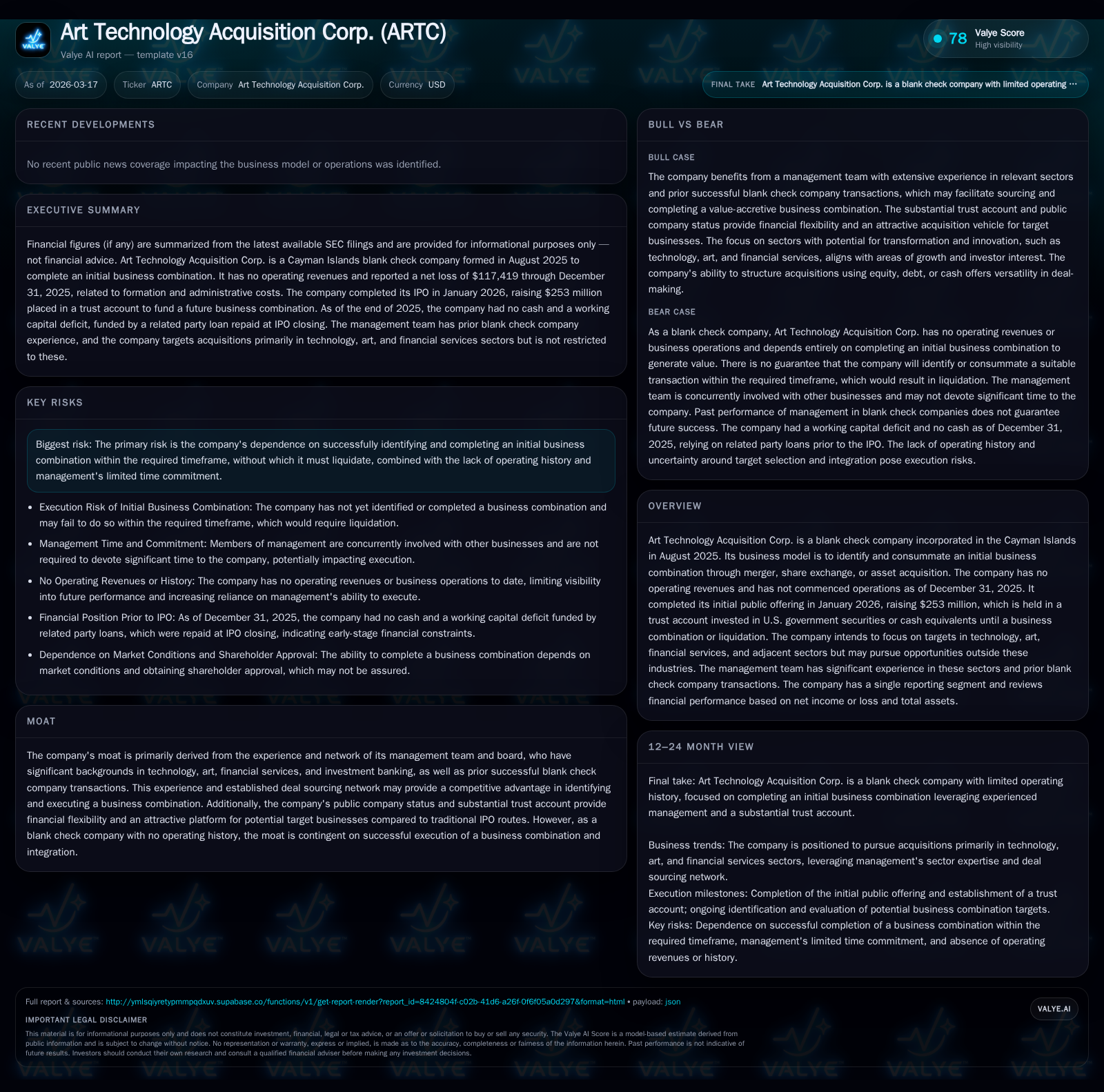
Art Technology Acquisition Corp (ARTC), incorporated in August 2025 as a Cayman Islands blank check company, raised gross proceeds of $253 million through its January 2026 IPO and underwriters’ option exercise. These funds are held in a trust account invested in short-duration U.S. government securities or cash equivalents pending the identification and consummation of a business combination primarily focused on technology, art, and financial services sectors. The company has no operating revenues to date and reported a net loss of $117,419 from formation expenses through December 31, 2025. Management’s sector expertise supports the firm’s strategic focus, while key risks include completing a business combination within the mandated timeframe and limited management time commitment.
Formation and Initial Financial Performance: From Inception to IPO
Art Technology Acquisition Corp was incorporated on August 22, 2025, in the Cayman Islands as a blank check company formed to pursue one or more qualifying business combinations. Prior to its January 2026 IPO, the company's activities were limited to organizational tasks and preparation for going public. It generated no operating revenues during this period; any income was non-operating such as interest on funds held.
From inception through December 31, 2025, ARTC reported a net loss of $117,419 primarily due to formation costs and general administrative expenses [F1][S1][S4]. At year-end, current assets totaled $35,440 against current liabilities of $387,318 resulting in a current ratio of approximately 0.09 — indicative of its early stage without operational cash inflows [F1]. This working capital deficit was financed via Sponsor loans which were repaid at the IPO closing [S5][S17].
Historical performance (annual)
| FY |
|---|
| 2025 |
Source: SEC companyfacts cache [F1].
Capital Raised and Trust Account Structure: Ensuring Stability Pre-Combination
On January 7, 2026, ARTC completed its Initial Public Offering issuing 22 million units at $10 each for gross proceeds of $220 million. Concurrently, it sold 825,000 Private Placement Units to the Sponsor and Clear Street for $8.25 million. The underwriters fully exercised their over-allotment option on January 26, selling an additional 3.3 million units for $33 million. Total gross proceeds aggregated to $253 million [S1][S5][S6].
These proceeds were placed into a trust account invested exclusively in U.S. government securities with maturities not exceeding 185 days or money market funds investing solely in direct government obligations plus uninvested cash held at federally chartered banks [S1][S6][S16]. This trust structure safeguards public investors’ capital by limiting risk exposure until consummation of the initial business combination.
Management Experience and Sector Focus: Core Competitive Advantage
ARTC’s management team brings combined expertise from prior SPAC transactions and backgrounds rooted in technology innovation, art markets, financial services, and investment banking disciplines. Their experience provides access to proprietary deal flow opportunities across these sectors that could accelerate value creation post-business combination [S1][S24].
The team’s network and operational knowledge serve as ARTC’s primary competitive advantage given the absence of ongoing operations.
Target Search Strategy and Industry Scope
The company intends to target acquisitions primarily within technology; art; financial services; and adjacent sectors promoting transformation and innovation. While focused on these industries to leverage expertise synergies, ARTC remains open to opportunities outside these sectors if compelling [S1].
It plans to pursue both domestic and global businesses but excludes speculative models or highly leveraged companies [S1].
Risks Related to Execution Timeline and Operational Absence
As a blank check company without operational history or revenues prior to IPO, ARTC faces risks related chiefly to completing an initial business combination within the prescribed "completion window" mandated by its governing documents [S1]. Failure to do so will result in liquidation with return of capital based on trust account valuation.
Management officers’ concurrent commitments may limit dedicated time for ARTC activities potentially impacting transaction sourcing speed [S1].
Financial Resources and Liquidity Management Post-IPO
Following IPO completion including over-allotment exercise on January 26, 2026, ARTC reported approximately $3.1 million unrestricted cash outside the Trust Account alongside working capital improving significantly to about $2.9 million after depositing $220 million into the Trust Account [S5][S6][S9].
Sponsor extended unsecured promissory notes pre-IPO totaling up to $300,000 for early working capital needs; these were fully repaid at IPO close [S5][S17]. To fund working capital deficiencies or transaction costs before closing any business combination—such as due diligence expenses—the Sponsor may provide additional "Working Capital Loans" up to $2.5 million convertible into Private Placement Units upon consummation at IPO price terms [S5][S8][S21].
This arrangement preserves trust account assets exclusively for acquisition consideration.
Capital Allocation Priorities: Costs and Transaction Funding
ARTC allocates resources primarily toward organizational expenses including underwriting fees totaling approximately $15.7 million consisting of cash fees plus deferred commissions [S1][S14][S16][S25][S27][S29]. No dividends or share repurchases have been declared or planned given absence of operating cash flow.
The company's conservative liquidity management reflects disciplined stewardship until successful merger execution.
Key Milestones: Business Combination Timeline and Candidate Evaluation
ARTC's charter imposes a finite period—typically two years—to identify and close an initial business combination before mandatory liquidation is triggered [S1]. Investors should monitor disclosures regarding target identification progress including SEC filings signaling advanced negotiations.
Progress updates on due diligence efforts and any regulatory developments will be critical indicators of deal viability within timing constraints.
Failure to meet these milestones will result in liquidation with return of capital less permitted dissolution costs.
Disclaimer: This report is based solely on information disclosed by Art Technology Acquisition Corp in SEC filings as of March 17, 2026. It does not constitute investment advice or an offer regarding securities.
Disclaimer: This is research-only, informational analysis and not investment advice. It may include AI-generated interpretation and general industry context. Always verify important details using primary sources.

Comments