
WW International's Turnaround: Subscription Model and Strategic Partnerships Pivot Weight Management
WW International emerges from Chapter 11 restructuring, refocusing on integrated subscription offerings and clinical partnerships to reshape its competitive footing in weight management.
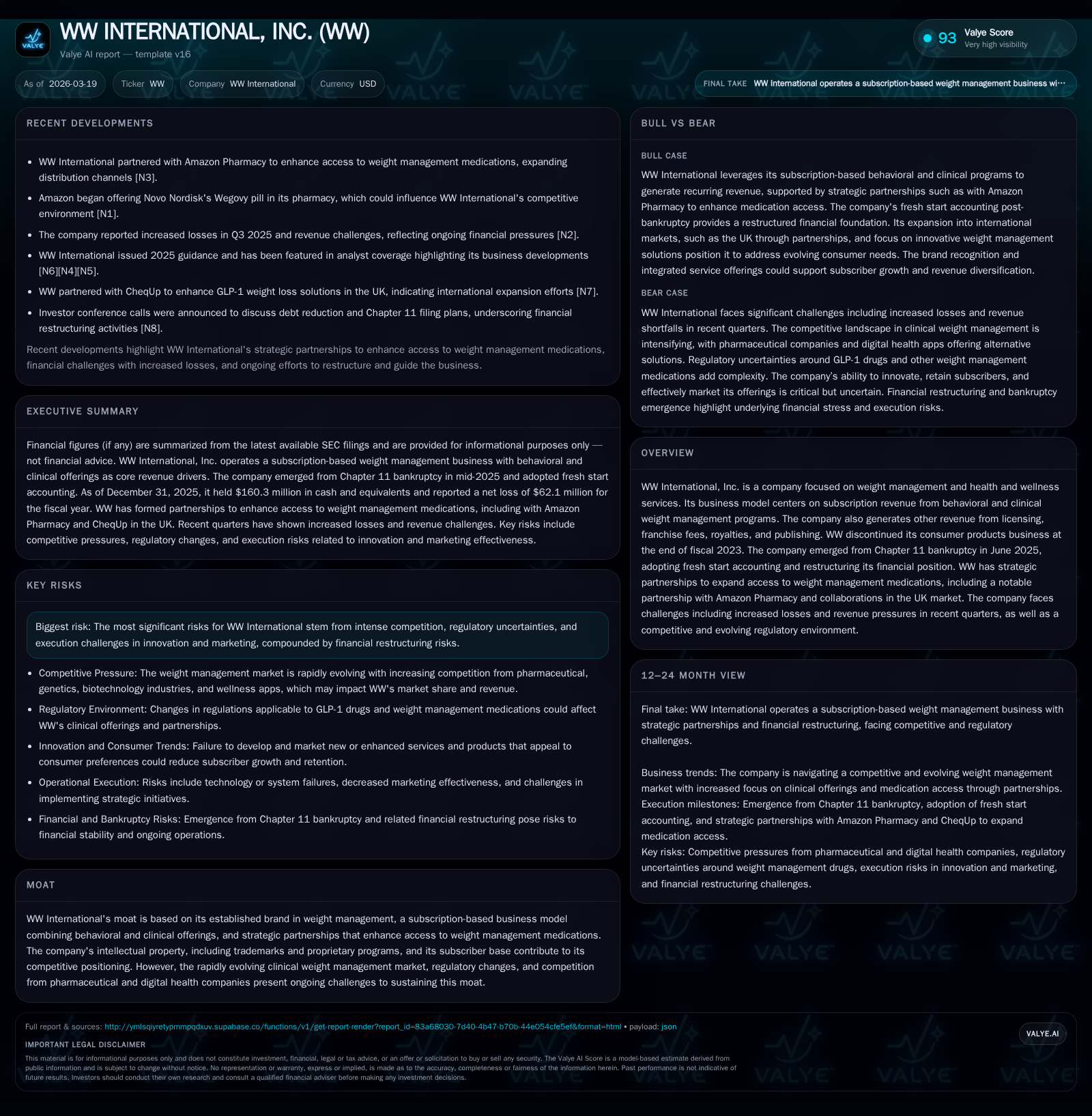
WW International’s path reflects a significant transformation from a legacy weight loss brand to an integrated weight health platform combining behavioral and clinical subscription services. The company’s emergence from bankruptcy and adoption of fresh start accounting reset its capital structure, enabling strategic investment in clinical partnerships, notably with Amazon Pharmacy for GLP-1 medication access. Despite recent losses and top-line pressures, WW is pivoting toward growth via its hybrid digital-clinical model amid intensifying competition and regulatory uncertainty. The firm’s improved cash flow and reduced leverage highlight cautious financial resilience while key milestones will focus on subscriber dynamics and marketplace adaptation.
Legacy Brand Evolution to Integrated Weight Health Platform
WW International traces its heritage to over six decades as a pioneering community-based weight management program under the Weight Watchers brand. Traditionally rooted in group behavioral coaching and nutrition guidance, the firm has pivoted towards embedding its established community ethos within a broader weight health offering tailored for the GLP-1 era. This strategic evolution reflects integration of personalized nutrition, behavioral science insights, digital innovations, targeted coaching, and compassion in its programs [S1].
Central to this transformation is the addition of licensed healthcare professionals within the WW Network capable of prescribing pharmaceutical treatments such as both oral and injectable GLP-1 receptor agonists — a significant departure from its historical purely behavioral focus [S1]. This hybrid behavioral-clinical model aligns with current obesity medicine trends where medication-assisted therapy complements lifestyle interventions.
Subscription Revenue as Core Growth Engine: Performance and Shifts
Following the discontinuation of all consumer product sales by end of fiscal 2023, WW International's revenue composition has shifted decisively toward subscription revenue streams. These are classified explicitly into Behavioral subscriptions—mainly digital access with optional workshop components—and Clinical subscriptions which bundle digital offerings with clinical services via Weight Watchers Clinic [S1].
Financial data reveal that while aggregate revenue has been pressured due to competitive dynamics and market disruption by pharmaceutical entrants in weight management therapies, subscription revenues represent the growing core. WW's FY2025 revenue was lower than peak years but historical data shows around $312 million in 2017 [F1]. This year-over-year transition evidences a renewed focus on scalable recurring revenues despite top-line declines.
Historical performance (annual)
| FY | Net ($mm) | CFO ($mm) | OpInc ($mm) | Capex ($mm) | Net YoY |
|---|---|---|---|---|---|
| 2025 | -62 | 6 | -2 | 0 | +82.0% |
| 2024 | -346 | -17 | -236 | 1 | -292.2% |
| 2023 | -88 | 7 | -6 | 2 | +64.9% |
| 2022 | -251 | 77 | -283 | 2 |
Source: SEC companyfacts cache [F1].
Capital returns and efficiency (annual)
| FY | FCF ($mm) | ROE% |
|---|---|---|
| 2025 | 5 | -19.5 |
| 2024 | -18 | 31.0 |
| 2023 | 4 | 11.6 |
| 2022 | 75 | 36.8 |
Source: SEC companyfacts cache [F1].
Note: Revenue YoY calculated where data permits; operating losses have notably narrowed post bankruptcy.
Restructuring Impact and Fresh Start Accounting on Financial Health
WW International filed for voluntary Chapter 11 bankruptcy protection in early 2025 due to recurring net losses exacerbated by rising competition and regulatory uncertainties in the evolving obesity medicine market [S1]. Emergence occurred June 24, 2025.
The company applied ASC Topic 852 "Reorganizations" during bankruptcy proceedings through emergence date disclosures [S1]. Upon emergence they adopted fresh start accounting per ASC Topic 852 requirements because voting shares of pre-petition equity holders were diluted below meaningful control thresholds, and reorganization value was less than liabilities [S1].
Fresh start accounting involved fair value allocations under ASC Topic 805 guidelines for assets including goodwill ($529 million intangible assets identified), trade names valued via relief-from-royalty methods (~6% royalty rate), developed technology intangibles (royalty rates ~4-5%), databases cost approach valuations, customer relationships through multi-period excess earnings method [S1].
This reset reflected material write-downs impacting FY25 balance sheet comparatives but provided a cleaner capital base moving forward at new fair-value-adjusted equity of around $318 million by December 31, 2025 [F1]. However, substantial goodwill impairment risk remains if market or operating performance deteriorates further [S1].
Strategic Partnerships Expanding Clinical Medication Access
Central to WW’s post-emergence strategy is expanding clinical medication access through partnerships leveraging their digital platform’s scale. Notably, collaboration with Amazon Pharmacy now enables distribution of Novo Nordisk's oral GLP-1 pill Wegovy® alongside injectables within the U.S., improving formulary reach critical for patient uptake [N1][S1].
UK partnerships mirror this approach adapting to regional obesity regulations and payer environments. These alliances aim to facilitate patients’ access to prescription options integrated seamlessly with WW’s behavioral coaching [S1]. This behavioral-clinical hybrid model differentiates WW versus pure pharma or digital health competitors alone.
However, these collaborations operate amid competitive friction from dominant pharmaceutical manufacturers aggressively marketing proprietary drugs directly to providers and consumers [S2]. The ability of WW’s network clinicians to prescribe comprehensive formularies offers an evolving advantage pending regulatory approval shifts.
Competitive Positioning amid Regulatory and Market Challenges
WW faces stiff competition from pharmaceutical entrants rapidly growing their share in the weight management space via GLP-1 medications such as Wegovy® and Mounjaro®. These drug manufacturers benefit from direct-to-consumer advertising budgets and formulary placements that challenge traditional provider-led programs like WW [S2][N1].
Additionally, digital health startups offer app-based behavior modification solutions unbundled from clinical prescriptions creating fragmented market pressure.
Regulatory risks loom large with evolving FDA guidance on prescription therapies for obesity including indications expansion or restriction potentially reshaping coverage policies affecting reimbursement levels critical for payor acceptance [S2]. Consumer appetite also shifts as patients seek faster pharmacologic results tempered by adherence concerns requiring integrated behavioral support.
Management acknowledges these challenges while endeavoring to carve out defensible positioning rooted in lasting brand equity combined with clinical capability expansion through licensing clinicians specifically trained in obesity medicine [S1][S2].
Operational Cash Flows, Cost Control, and Capital Allocation Dynamics
After emergence from Chapter 11 restructuring, WW International demonstrated a notable turnaround in operating cash flow generation producing positive CFO of $5.5 million for FY2025 compared to negative $16.8 million prior year outflows demonstrating early signs of operational leverage via cost discipline [F1][S15].
Capital expenditures dropped precipitously following cessation of consumer product lines—from over $2 million annually toward modest software development investments (~$87k in H1 FY2025) reflecting leaner operation focused on digital platform enhancements rather than physical inventory [F1][S29].
No dividends or share repurchase activity occurred post-reorg due both to Board conservative stance amid rebuilding phase and credit agreement covenants restricting distributions [S8][S17]. Cash reserves strengthened considerably with holding cash & equivalents over $160 million by year end fostering liquidity stability [F1][S4].
Although FY2025 reported an operating loss narrowly below $2.3 million (improved sharply from hundreds of millions prior), net losses persisted at approximately $62 million reflecting continued investments plus prior period impairments without immediate profit realization [F1][S1].
Balance Sheet Renewal: Debt Refinancing and Liquidity Management
Emergence extinguished approximately $1.6 billion of pre-petition indebtedness comprising term loans ($945 million), secured notes ($500 million), revolving credit facility drawdowns ($171 million) among other liabilities releasing lien burdens [S23][S24]. In substitution WW entered a Senior Secured Credit Agreement dated June 24, 2025 establishing a New Term Loan Facility totaling $465 million maturing June 2030.
Interest bears variable rates based on interest benchmarks plus spreads summing about ~10.91% effective annual rate inclusive of debt premiums amortized costs—significantly higher than pre-petition averages but reflective of restructuring risk profile [S12][S13]. Covenants impose mandatory prepayment requirements annually for unrestricted cash above $100 million threshold facilitating deleveraging alongside prepayment premiums applicable during initial three years post-emergence termed "prepayment premium" schedules [S4][S13][S14].
As December 31, 2025 successor statements show total current assets exceed current liabilities yielding stable current ratio ~1.69 underpinning liquidity cushion essential for operational flexibility going forward despite legacy working capital deficits excluding cash [F1][S24]. Letters of credit issuance remains minimal preserving borrowing capacity for contingencies.
Investor Watchpoints: Milestones and Forward-Looking Risks
Key metrics for investor attention encompass subscriber count trajectories particularly distinguishing Behavioral versus Clinical segment growth given the latter’s role integrating pharmacotherapy access which could underpin future margin improvement if adoption scales [N1][S1]. Shift towards higher-value clinical subscribers balancing behavioral attrition will be pivotal.
Market share evolution versus pharmaceutical heavyweights advancing obesity medicines remains uncertain amidst pricing pressures and payer dynamics—a prime area of strategic sensitivity influencing topline recovery pace [S2][N1]. Monitoring regulatory shifts especially FDA labeling changes or insurance reimbursement policy updates across U.S./UK realms offers crucial forward information.
Potential goodwill or intangible asset impairment triggers linked to operating performance fluctuations should be anticipated given prior write-down history despite fresh start accounting resetting bases last year—changes here could materially affect earnings going forward [S21]. Finally measuring innovation execution effectiveness via new product feature rollouts or marketing campaigns adding subscriber engagement will illuminate management’s ability to sustain competitive advantage.
Disclaimer: This analysis is based solely on publicly available information as referenced without any speculative projections or investment recommendations regarding WW International, Inc.'s securities or prospects.
Disclaimer: This is research-only, informational analysis and not investment advice. It may include AI-generated interpretation and general industry context. Always verify important details using primary sources.

Comments