
Marker Therapeutics’ MAR-T Cell Therapy Advances: Balancing Innovation with Financial Headwinds
Marker Therapeutics leverages its proprietary MAR-T platform to target diverse tumor antigens while managing sustained development-stage financial pressures and regulatory risks.
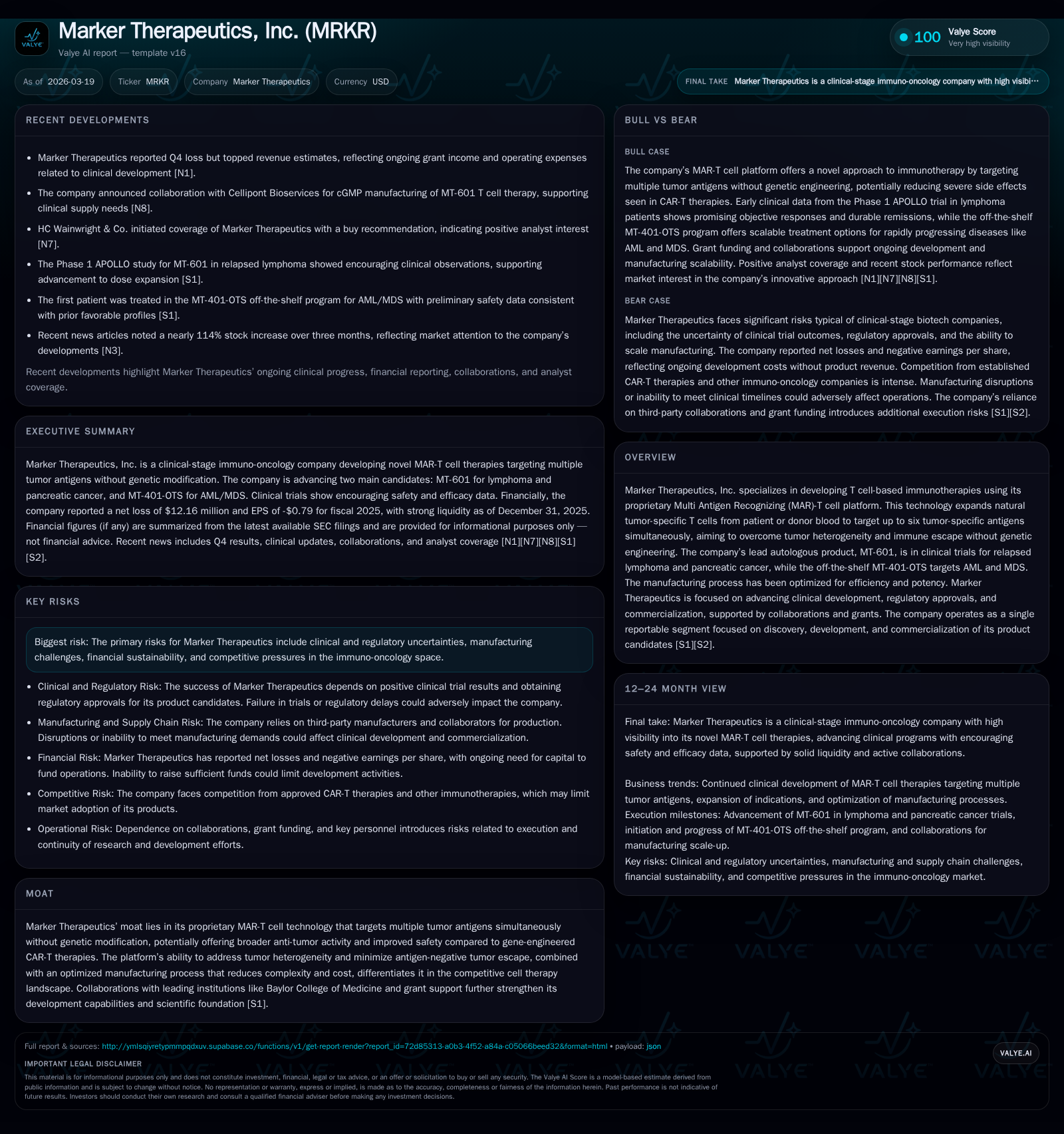
Marker Therapeutics, Inc. is a clinical-stage immunotherapy developer pioneering Multi Antigen Recognizing T cell (MAR-T) technology designed to address tumor heterogeneity without genetic engineering. Its lead autologous product MT-601 and off-the-shelf MT-401-OTS are advancing clinical trials targeting lymphoma, pancreatic cancer, AML, and MDS. Despite promising clinical differentiation and manufacturing efficiencies, the company continues to generate operating losses with no revenue since 2021 while maintaining a modest cash runway. Regulatory complexities, capital needs, and competitive dynamics in cell therapy remain key challenges as Marker anticipates critical trial milestones and funding decisions ahead.
From Concept to Clinic: Tracing Marker Therapeutics’ Growth Trajectory
Since licensing the underlying Multi Antigen Recognizing T cell (MAR-T) technology from Baylor College of Medicine (BCM) in 2018, Marker Therapeutics has charted a path from academic innovation toward clinical development within adoptive T cell immunotherapy [S1]. BCM's prior exploratory trials treated over 150 patients with various cancers—including lymphoma, myeloma, leukemias, pancreatic cancer, breast cancer, and sarcomas—showing early signals of safety and potential efficacy that Marker seeks to expand.
Financially, Marker remains firmly in the development stage characterized by zero product revenue reported from FY2021 through FY2025 as reflected in its SEC filings [F1]. Historical revenues were nominal prior to that point ($213K in FY2019). Operating losses persist driven by research and development investments advancing clinical programs. Operating income improved moderately from a loss of approximately $11.1 million in FY2024 to about $12.9 million negative in FY2025—a roughly 16% decline year-over-year though still indicative of substantial burn [F1]. Net income trends are consistent.
The company's steady progress into multiple clinical trials for MT-601 (autologous therapy) targeting relapsed lymphoma and pancreatic cancer, alongside off-the-shelf candidate MT-401 addressing AML and MDS indications, underpins this investment phase [S1]. Manufacturing optimization efforts accompany these advancements aimed at improving scalability.
Distinctive MAR-T Technology: Addressing Tumor Heterogeneity Without Genetic Engineering
Marker’s MAR-T platform expands naturally occurring tumor-specific T cells capable of recognizing up to six tumor-associated antigens simultaneously via native T cell receptors (TCRs). Unlike conventional CAR-T therapies that genetically engineer receptor specificity through chimeric antigen receptors, MAR-T avoids gene modification altogether. This strategy reduces risks such as mutagenesis inherent to engineered constructs while leveraging polyclonal antigen recognition to mitigate tumor immune escape mechanisms like antigen loss or downregulation.
Clinical safety profiles validated in BCM studies demonstrate minimal treatment-related adverse effects notably absent immune effector cell-associated neurotoxicity syndrome (ICANS), a complication seen with many CAR-T therapies [S1]. The ability to recognize hundreds of epitopes across multiple TAAs enhances tumoricidal breadth critical for heterogeneous solid tumors as well as hematologic malignancies.
From a manufacturing perspective, MAR-T's non-genetic process facilitates reduced complexity compared to viral vector-based CAR-T production. This can translate into lower costs and higher consistency—a crucial advantage given the therapeutic domain’s notorious manufacturing bottlenecks [S1]. Still, reliance on selective expansion demands rigorous quality controls.
Clinical Pipeline Progress and Future Indications Under Evaluation
Marker’s lead autologous candidate MT-601 is engaged in clinical trials addressing difficult-to-treat relapsed lymphoma and pancreatic cancer populations. Concurrently, the off-the-shelf product candidate MT-401 targets acute myeloid leukemia (AML) and myelodysplastic syndromes (MDS), both indications with significant unmet medical need [N1][S1].
Pipeline advancement is facilitated by collaborations including continued academic support from BCM alongside grant awards underscoring scientific validation. Recent reports indicate positive Q4 operational updates focusing on trial execution milestones; however, explicit data readouts or regulatory submission timelines remain pending publicly [N1][S3].
Given current regulatory pathways for cellular therapies commonly span multiple years—from phase trials through approvals—patient enrollment rates, responder durability assessment, and safety monitoring will be pivotal near-term indicators. Expansion into additional indications or combinational approaches may arise based on ongoing scientific evaluation but are not detailed within available disclosures.
Financial Performance Snapshot: Continuing Losses Amid Operational Efficiency Gains
A historical review of Marker Therapeutics' annual financial results reveals persistent losses offset slightly by some improvement in operational scale efficiencies. Revenue ceased practically since FY2021 reflecting absence of marketed products [F1]. Operating income posted a loss of $29.9 million in FY2022 which narrowed progressively by about 57% over three years reaching approximately $12.9 million loss in FY2025—a sign of improved expense management as programs mature.
Net income trends mirror operating cash flow which remains negative but similarly trending less severely year-over-year than earlier periods. Capital expenditures fluctuate with increases linked likely to manufacturing capability investments (notably rising over 150% since FY2019) aligning with process optimization efforts.
Historical performance (annual)
| FY | Net ($mm) | CFO ($mm) | OpInc ($mm) | Net YoY |
|---|---|---|---|---|
| 2025 | -12 | -12 | -13 | -13.3% |
| 2024 | -11 | -11 | -11 | -30.3% |
| 2023 | -8 | -16 | -15 | +72.5% |
| 2022 | -30 | -27 | -30 |
Source: SEC companyfacts cache [F1].
Capital returns and efficiency (annual)
| FY | ROE% |
|---|---|
| 2025 | -72.4 |
| 2024 | -57.8 |
| 2023 | -58.6 |
| 2022 | -152.7 |
Source: SEC companyfacts cache [F1].
Thus far Marker has not generated top-line sales but demonstrates steady enhancement in cost control amid expansion of technical capabilities.
Capital Structure, Cash Flow Dynamics, and Capital Allocation Strategy
At year-end 2025 Marker held cash and equivalents totaling roughly $16.1 million against current liabilities around $2.3 million—reflecting a strong current ratio exceeding 8x indicating liquidity adequacy within short term horizons [F1][S23]. However persistent negative free cash flow—computed as operating cash flow minus capex—is approximately negative $12.4 million annually signaling ongoing funding needs to maintain operations.
No dividends have been declared or paid historically; similarly no share repurchases are evident reflecting prioritization of capital conservation towards R&D activities rather than shareholder returns at this stage [F1][S19]. The company’s financing model relies heavily on equity raises under effective ATM programs executed recently along with governmental grants related to oncology research spanning lymphoma and pancreatic cancer projects [S10][S14][N1].
Management acknowledges going concern considerations reliant upon raising additional capital beyond mid-2026 absent significant changes in burn rate or revenue generation forecasts [S10]. Dilution risks implicit from new share issuances remain an investor consideration given anticipated equity financing requirements through pivotal trial phases.
Regulatory Hurdles and Risk Factors Shaping Development and Commercialization Outlook
Marker operates within a highly regulated environment subjecting its novel biologics candidates to extensive FDA oversight encompassing preclinical testing standards cGMP-compliant manufacturing controls through post-marketing surveillance mandates should approval be gained [S4–S9][S15]. The FDA’s unfamiliarity with MAR-T therapy modality might extend review cycles adversely impacting timelines compared with more established CAR-T approvals.
Additional risks stem from product liability exposure inherent in first-in-class therapies despite positive safety data preliminarily observed. Market access complexities include third-party reimbursement uncertainties given evolving U.S.-centric healthcare price reforms like IRA legislation affecting biologic drug pricing strategies [S16][S7]. Compliance with anti-kickback statutes alongside data privacy laws such as HIPAA add layers of operational burden increasing indirect costs potentially reducing flexibility particularly during scaling [S6][S18][S19]. Furthermore patent landscape contestations may require robust intellectual property defense mechanisms amidst competitive innovation targeting similar platforms [S21][S24].
Investor Considerations: Milestones to Monitor and Potential Catalysts
While explicit forward guidance remains limited outside corporate filings indicating planned progress toward commercialization readiness milestones [N1][S3], investors should monitor key near-term events including:
- Clinical data releases from ongoing MT-601 trials focused on lymphoma/pancreatic cancer efficacy/safety endpoints,
- Advancement status updates on MT-401 off-the-shelf AML/MDS program,
- Submissions or interactions with regulatory agencies indicating potential initiation dates for pivotal trials or marketing application filings,
- Strategic collaborations or additional grant awards enhancing financial runway,
- Changes in cash burn aligned with scale-up measures or potential outlicensing deals.
Success at these milestones could validate the technological approach while mitigating some investment risks associated with clinical failure or prolonged delay. Conversely sustained capital consumption without clear data progression exacerbates going concern issues putting emphasis on timely funding solutions.
This analysis aggregates publicly available financials and regulatory disclosures related to Marker Therapeutics’ innovative immunotherapy pipeline while refraining from speculative commentary beyond documented facts. The company’s distinctive MAR-T platform reflects a scientifically compelling yet commercially nascent asset base subject to standard developmental risks common across cellular immunotherapy firms navigating highly regulated biotechnology domains.
Disclaimer: This is research-only, informational analysis and not investment advice. It may include AI-generated interpretation and general industry context. Always verify important details using primary sources.

Comments