
Chain Bridge Bancorp’s Conservative Balance Sheet and Political Client Focus Shape Growth and Risk Profile
Chain Bridge Bancorp leverages a technology-driven, branchless banking model with a niche in political organizations, balancing growth with conservative asset management and liquidity.
Chain Bridge Bancorp, operating primarily through Chain Bridge Bank, N.A., has consistently emphasized a conservative balance sheet strategy, prioritizing liquidity and asset quality. Its historical growth reflects steady net income generation driven by its specialized services to political organizations and clients with complex transactional needs. The company faces deposit concentration risks due to its client base's seasonality and geographic focus on the Washington, D.C. area. Future growth is likely to be influenced by its ability to expand digital banking solutions nationwide while managing regulatory constraints and capital allocation prudently. The bank’s financial health is underpinned by solid equity levels, stable cash flows, and a low loan-to-deposit ratio.
Company Overview
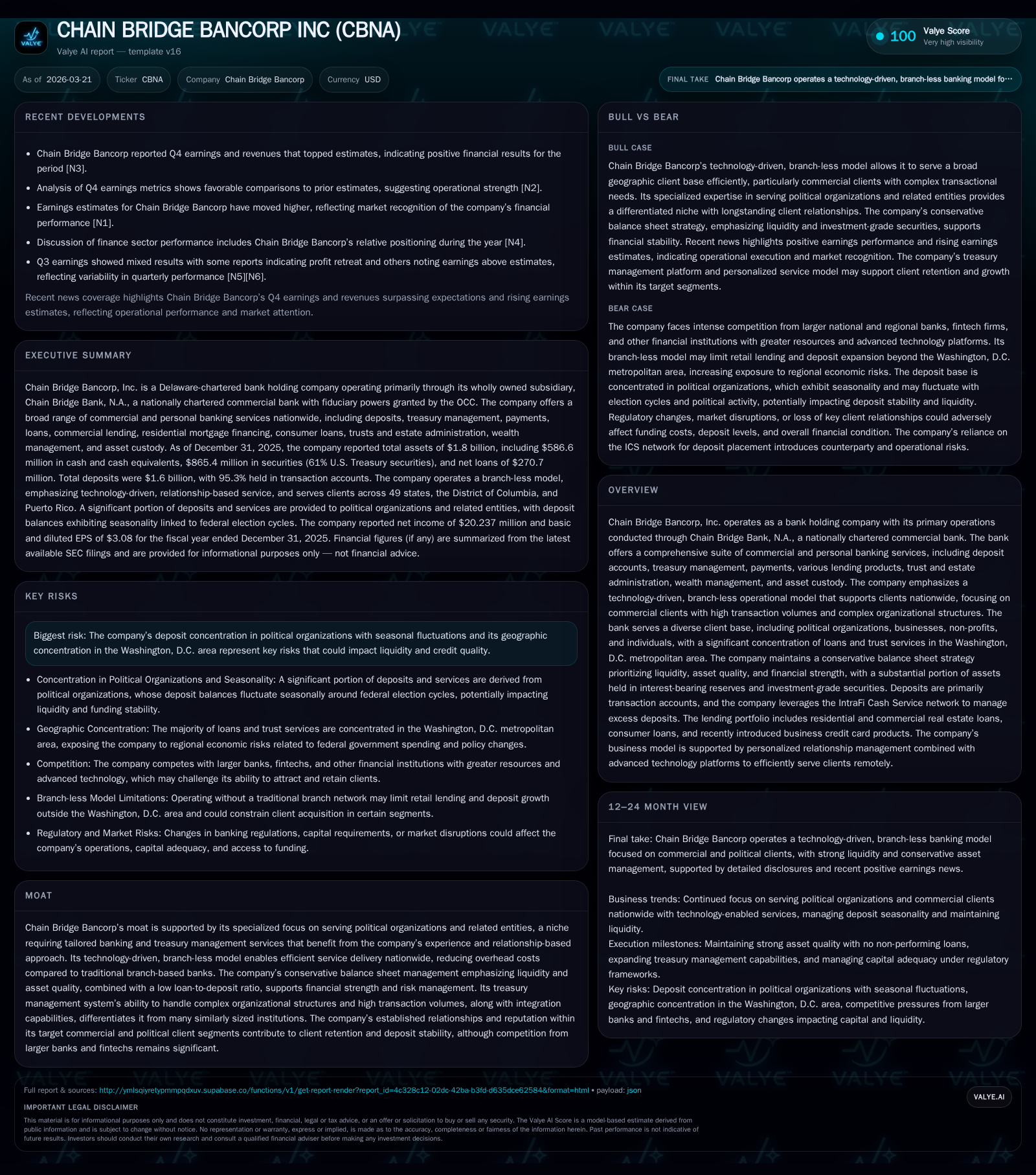
Chain Bridge Bancorp, Inc., incorporated in Delaware in 2006, operates exclusively through its wholly owned subsidiary Chain Bridge Bank, N.A., a nationally chartered commercial bank with fiduciary powers granted by the OCC. By March 2026, the company has solidified its presence as a technology-driven, branchless institution providing commercial and personal banking services nationwide but with concentrated operational roots in the Washington, D.C. metropolitan area [S1][S20].
Its core offerings encompass deposit accounts—mainly transaction deposits—treasury management tailored for high-volume commercial clients, lending products focusing on residential jumbo mortgages and commercial real estate loans primarily local to D.C., trust and estate administration, as well as wealth management services [S20].
Historical Financial Performance
The bank maintains a conservative balance sheet strategy that prioritizes liquidity and asset quality over aggressive credit expansion. This is reflected in its reported financials for fiscal years ending December 31, 2024 and 2025:
Historical performance (annual)
| FY | Net ($mm) | CFO ($mm) | Capex ($mm) | Net YoY |
|---|---|---|---|---|
| 2025 | 20 | 16 | 4 | -3.4% |
| 2024 | 21 | 22 | 0 |
Source: SEC companyfacts cache [F1].
Capital returns and efficiency (annual)
| FY | FCF ($mm) | ROE% |
|---|---|---|
| 2025 | 11 | 12.0 |
| 2024 | 22 | 14.5 |
Source: SEC companyfacts cache [F1].
Net income showed minor fluctuation with a slight decline indicating steady profitability despite cautious lending activity or potential margin pressures [F1]. Operating cash flows decreased notably year-over-year but remained sufficient to generate free cash flow around $11.5 million after accounting for materially higher capital expenditures related primarily to technology investments enhancing their digital servicing platform [F1], consistent with their branchless operational philosophy.
Business Model & Niche Focus
Chain Bridge Bancorp distinguishes itself by serving political organizations—a client segment demanding specialized treasury management—and entities requiring complex organizational banking solutions. The firm estimates that a majority of deposit balances periodically come from political entities affiliated predominantly with the U.S. Republican Party; this client base brings both durable relationship advantages as well as inherent seasonality tied to election cycles impacting liquidity fluctuations [S1][S10].
Their approach eschews traditional brick-and-mortar expansion: leveraging dedicated relationship officers reachable remotely combined with high-efficiency technology platforms supports broad geographic reach while keeping overhead comparatively low versus branch-heavy competitors [S10][S16]. This contributes to low funding costs (0.32%) despite competitive pressures from large national banks and agile fintech alternatives entering treasury management space [S15][S25].
Asset Composition and Credit Quality
By year-end 2025 assets totaled approximately $1.8 billion comprising significant holdings in cash ($586 million) largely as interest-bearing reserves at the Federal Reserve ($580 million) alongside a securities portfolio dominated by investment-grade debt (notably U.S. Treasury securities representing about 61%), combined with net loans held for investment of roughly $271 million—reflecting a conservative loan-to-deposit ratio near 17.5% that minimizes credit risk exposure while emphasizing liquidity preservation [F1][S20][S6][S7].
Loan portfolio composition centers on residential real estate loans (over 73%), including sizable non-conforming jumbo mortgage holdings targeted at sophisticated borrowers often with diverse financial profiles—a niche underserved by larger retail lenders—plus commercial real estate loans (around 18%) mostly concentrated regionally within Washington D.C., supplemented by consumer and commercial loans segments displaying cautious underwriting standards evidenced by no reported non-performing assets since mid-2012 or loan charge-offs since Q3-2017 [S6][S18][F1].
Capital Structure & Liquidity Management
Equity capital increased significantly from roughly $144 million at end-2024 to $169 million at end-2025 contributing to an approximate return on equity near 12% based on trailing net income figures—indicating efficient capital management within regulatory constraints [F1].
Liquidity is principally maintained via substantial Federal Reserve reserve balances alongside available-for-sale investment securities easily monetizable if needed. Clients’ deposits constituting most funding sources reached $1.6 billion predominantly held in transaction accounts (95+%) supporting revenue stability albeit accompanied by concentration risks tied to political organization clients whose fundraising activities exhibit seasonal spikes [S4][S22][S7]. The bank participates in IntraFi Cash Service® network deposits allowing deposit placement across participating banks below FDIC insurance limits mitigating some single-institution exposure risk though introducing counterparty considerations [S7].
Debt usage is minimal; the company eliminated prior credit lines post-IPO repayment but initiated a new unsecured revolving credit facility for $15 million at holding company level early in 2026 adding contingent liquidity but subject to typical debt covenants limiting flexibility until maturity potentially in February 2027 unless extended by compliance status [S9][S4]. No preferred stock or subordinated debt issued increases reliance on equity and deposit funding.
Capital Allocation & Returns
The company does not anticipate paying dividends on common stock for the foreseeable future due to regulatory restrictions aiming to preserve capital adequacy buffers within Basel III frameworks enforced by OCC and supervisors[footnote](Chain Bridge Bank must comply with minimum Tier 1 leverage ratios and capital conservation buffers constraining discretionary distributions).[S5][S21]
Likewise, share repurchases are limited under Federal Reserve policy which discourages large buybacks if they would undermine the bank’s capacity as a source of strength during periods of economic stress or volatile funding conditions.
Historically strong free cash flow generation supports internal reinvestments primarily into technology infrastructure improvements evidenced by ramping capex spend from nominal levels pre-2025 while maintaining prudent financial discipline ensuring core capital robustness ahead of potential growth opportunities or regulatory changes.
Industry Context & Competitive Positioning
Chain Bridge Bancorp operates within an increasingly challenging environment where traditional banks face competition from large national institutions offering vast treasury product suites as well as nimble fintech disruptors advancing digital banking capabilities beyond conventional deposit-lending frameworks. Their differentiated factor lies in catering specifically to political organizations requiring compliance-sensitive treasury management services unavailable generically elsewhere—a moat reinforced by deep experience navigating campaign finance laws and regulatory complexities coupled with personalized service delivery through relationship managers accessible digitally nationwide. This specialized niche also concentrates risk as political deposits are susceptible to volatility driven by election cycles raising liquidity management challenges uncommon among peer regional banks. Besides direct competitors include other regional banks servicing affluent residential mortgage clientele or community-based borrowers primarily located within their brick-and-mortar footprint areas.
Risks & Challenges
Key risks include:
- Deposit concentration risk heightened by sizeable proportion of funds deposited by politically affiliated organizations whose seasonal fluctuations could materially impact liquidity availability outside predictable cycles [S1][S26];
- Geographic concentration risk as majority lending operations reside within Washington D.C., making credit metrics sensitive to local economic shifts or real estate market conditions;
- Regulatory compliance burden increasing operational costs particularly due to Basel III enhancements plus evolving consumer protection rules such as those recently proposed around payment account data access impacting future systems adaptability [S25][S26];
- Competitive threat from highly capitalized fintech entrants possibly eroding transaction account bases requiring further innovation investments;
- Restriction on dividends or share repurchases linked directly to maintenance of adequate capital buffers limiting shareholder returns even during profitable seasons;
- Need for additional capital raises if deposit growth or asset size expands beyond current leverage capacity although such raises carry dilution or increased leverage risks depending on instruments used[footnote](Issuing new equity may dilute shareholders; issuing debt adds interest obligations.).
Growth Prospects & What To Watch
Growth drivers may include:
- Expanding adoption of their remote onboarding technology enabling broader national market penetration beyond traditional D.C.-centric base;
- Cross-selling opportunities between deposits/mortgages/trust services raising per-client wallet share particularly among political-related entities;
- Product innovation aligned with lending solutions closely tied to existing customer relationships enhancing stickiness. Nevertheless growth could be capped or episodic given client base nuances plus intentional conservative balance sheet posture avoiding excessive credit risk exposure. Important milestones would encompass monitoring quarterly deposit compositions especially seasonal changes among political clients alongside loan portfolio diversification efforts beyond residential mortgages into higher yielding commercial credits without sacrificing asset quality. Equally crucial will be regulatory developments affecting capital requirements or consumer data rules potentially influencing strategic priorities. Liquidity enhancements through effective utilization or extension of new revolving credit lines could provide flexibility accommodating opportunistic balance sheet expansions amid fluctuating deposit trends.
Conclusion
Chain Bridge Bancorp exemplifies a specialized regional banking franchise focused on combining technological efficiency with relationship-based service tailored toward distinct sectors notably political organizations demanding stringent treasury management solutions. Their conservative approach manifests in robust capitalization, substantial liquidity reserves concentrated in safe government-backed securities paired with selective credit risk exposure yielding stable profitability albeit modest recent declines. Ongoing investments into digital capabilities align well with broadening national footprint ambitions presenting measurable growth paths though tempered prudence strongly governs capital returns amid stringent regulatory landscapes. Risks linked mainly to concentrated deposit sources and competitive intensity warrant constant vigilance but overall position Chain Bridge Bancorp as a niche player balancing opportunity against manageable risk profiles effectively entering mid-decade.
This analysis reflects publicly available information as of March 21, 2026 without providing investment recommendations or forecasts beyond reported data sources.
Disclaimer: This is research-only, informational analysis and not investment advice. It may include AI-generated interpretation and general industry context. Always verify important details using primary sources.

Comments