
Palisade Bio’s Targeted PDE4 Inhibition Strategy and Clinical Advances in IBD
Palisade Bio pursues a localized oral PDE4 prodrug aimed at improving treatment outcomes in inflammatory bowel disease through targeted delivery and biomarker-guided patient selection.
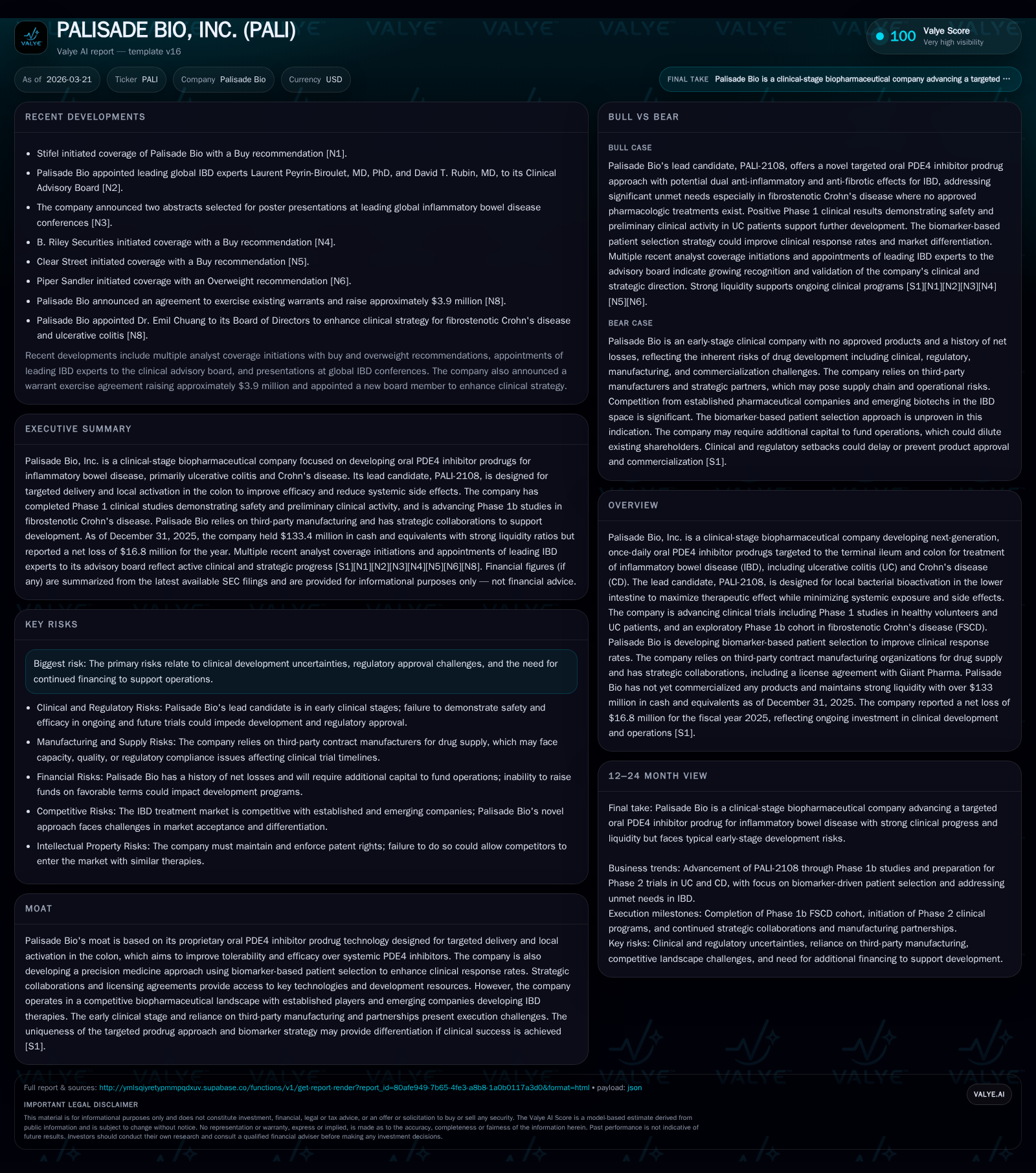
Palisade Bio, a clinical-stage biopharmaceutical company, focuses on developing PALI-2108, a once-daily oral PDE4 inhibitor prodrug tailored for localized activation in the terminal ileum and colon to treat ulcerative colitis and Crohn’s disease. The company has progressed through multiple Phase 1 clinical studies including healthy volunteers and patient cohorts, alongside efforts to integrate biomarker-based patient stratification designed to enhance therapeutic response. Despite operating losses consistent with early-stage biotech development and reliance on third-party manufacturing, Palisade maintains a strong cash position providing runway for upcoming Phase 2 studies targeting remission endpoints. Key risks remain embedded in clinical, regulatory, and reimbursement challenges characteristic of the sector.
Historical Performance and Development Milestones
Palisade Bio is a clinical-stage biopharmaceutical company focused on developing treatments for inflammatory bowel disease (IBD). Its financial profile reflects typical early-stage biotech characteristics with no approved products or significant revenues. Historical revenue has been minimal, recording $260,000 as of FY2017 compared to nominal amounts in prior years [F1]. This underscores the company's developmental stage with no commercial sales.
Operating losses have increased alongside intensified research and development activities. Operating income declined from approximately -$13 million in FY2023 to -$18 million by FY2025 [F1], driven primarily by expanded clinical trial expenditures including initiation of Phase 1 studies for PALI-2108 starting November 2024 [S1].
Operating cash flows have remained negative annually between -$10.8 million and -$13.3 million since FY2022 [F1], reflecting ongoing investment without offsetting revenues. Capital expenditures have been negligible relative to operational costs, denoting a lean infrastructure reliant on outsourcing.
Historical performance (annual)
| FY | Net ($mm) | CFO ($mm) | OpInc ($mm) | Capex ($) | Net YoY |
|---|---|---|---|---|---|
| 2025 | -17 | -11 | -18 | -16.2% | |
| 2024 | -14 | -12 | -15 | 0 | -17.4% |
| 2023 | -12 | -11 | -13 | 4000 | +13.7% |
| 2022 | -14 | -13 | -16 | 10000 |
Source: SEC companyfacts cache [F1].
Capital returns and efficiency (annual)
| FY | FCF ($mm) | ROE% |
|---|---|---|
| 2025 | -13.0 | |
| 2024 | -12 | -192.7 |
| 2023 | -11 | -108.7 |
| 2022 | -13 | -114.3 |
Source: SEC companyfacts cache [F1].
Note: Revenue growth compares FY2025 against FY2017 due to limited revenue history.
PALI-2108: Mechanism of Action and Clinical Progression
PALI-2108 is Palisade Bio's lead clinical candidate — an oral phosphodiesterase-4 (PDE4) inhibitor prodrug engineered for site-specific delivery to the terminal ileum and colon via bacterial enzymatic bioactivation [S1]. The prodrug remains pharmacologically inactive during transit through the upper gastrointestinal tract until converted by local microbiota enzymes at sites of intestinal inflammation.
This targeted activation is intended to confine therapeutic exposure predominantly within diseased tissue microenvironments while minimizing systemic absorption that often leads to adverse events such as nausea or headache associated with systemic PDE4 inhibitors. This mechanism aims to improve tolerability and therapeutic index crucial for chronic IBD management.
The once-daily dosing regimen leverages sustained local exposure enabled by controlled-release formulations designed for patient convenience and adherence [S1]. PALI-2108 thus differentiates itself from existing systemic PDE4 inhibitors that typically exhibit broader distribution profiles with increased dose-limiting toxicities.
Precision Medicine Approach via Biomarker Development
Palisade Bio is advancing a biomarker-driven patient selection strategy aimed at identifying individuals more likely to respond favorably to PALI-2108 treatment [S1]. Utilizing multiomics data from large patient populations correlated with PDE4 pathway activity and IBD severity markers,
the company is developing companion diagnostic assays intended for regulatory approval alongside its therapeutic candidate. This approach targets enrichment of responder populations during clinical trials,
enabling improved efficacy signals relative to heterogeneous untreated populations common in IBD studies.
Such precision medicine strategies address a key challenge in IBD therapeutics — variable patient responsiveness — potentially improving clinical trial success probabilities.
Clinical Trial Outlook and Milestones
Palisade's current clinical program includes Phase 1 trials encompassing healthy volunteers as well as ulcerative colitis patients. An exploratory Phase 1b cohort evaluates activity in fibrostenotic Crohn's disease—a subtype marked by intestinal fibrosis complicating inflammation [S1]. These studies aim to establish safety profiles and pharmacodynamic markers critical for dose selection.
The company plans progression into Phase 2 trials focused on induction and maintenance of remission over a 12-week period measuring both clinical endpoints aligned with regulatory guidance and biomarker responses derived from companion diagnostics [N1]. Success at this stage will be pivotal for advancing toward registration-enabling studies.
Capital Position and Financial Sustainability
As of December 31st, 2025 filings indicate Palisade Bio held approximately $133.3 million in cash and equivalents supported by current assets near $134.2 million against current liabilities around $4.6 million—yielding a strong liquidity position with a current ratio near 29 [F1]. This robust cash reserve supports ongoing R&D investments despite operating losses exceeding $18 million in FY2025.
Free cash flow remains negative at approximately -$10.8 million due primarily to trial-related expenditures without offsetting product revenues [F1]. Return on equity stands negative at about -13%, reflecting sustained net losses relative to equity base accumulated through financing activities rather than operational profitability [F1].
Given absence of marketed products or royalties typical at this stage, the company's near-term capital requirements will revolve around funding upcoming pivotal trials or securing strategic partnerships/licensing arrangements as outlined in their business model [S1][S2].
Regulatory Compliance and Manufacturing Partnerships
Palisade relies on contract manufacturing organizations (CMOs) compliant with current Good Manufacturing Practices (cGMP) subject to regulatory oversight including facility inspections [S3]. Maintaining quality standards is essential; any disruptions could materially impact development timelines.
Commercial success will depend heavily on securing reimbursement across diverse payor landscapes notably government programs such as Medicare/Medicaid facing pricing scrutiny pressures [S3][S6]. Ongoing healthcare reform initiatives targeting cost containment present uncertainties regarding coverage levels that could affect future revenue potential.
Compliance extends beyond manufacturing into complex healthcare regulations including anti-kickback statutes, data privacy laws like HIPAA/CCPA, and stringent promotional conduct rules limiting off-label communications — all requiring rigorous adherence to mitigate legal risks [S9][S12][S19][S23].
Analyst Coverage and Market Sentiment
Stifel Research initiated coverage on February 25th, 2026 with a Buy recommendation highlighting confidence in Palisade's scientific platform and pipeline progression [N1]. This endorsement reflects recognition of the company's innovative targeted approach combined with advancing clinical data trajectories.
Market sentiment appears cautiously optimistic given the technical complexity of Palisade's strategy addressing validated biological pathways central to IBD pathology coupled with emerging personalized medicine methodologies.
Key Risks: Clinical Development & Commercialization Challenges
Material risks inherent to Palisade’s profile include:
- Clinical attrition risk given early-phase status of PALI-2108 without definitive efficacy/safety data beyond initial cohorts;
- Dependence on intellectual property licensed from Giiant Pharma Inc., where termination or breach could disrupt exclusivity critical for commercialization;
- Regulatory uncertainties related to acceptance of foreign trial data plus evolving FDA guidance possibly affecting approval timing;
- Continued requirement for substantial external capital injections driven by costly late-phase trials absent product revenue streams;
- Pricing negotiation challenges amidst tightening reimbursement environments limiting commercial margins;
- Reliance on third-party manufacturing exposing supply chain vulnerabilities impacting scale-up capacity. These factors underscore the importance of disciplined execution across scientific development, funding strategies, and regulatory navigation.
This analysis synthesizes publicly available SEC filings and news coverage without offering investment advice. Palisade Bio operates within a dynamic biopharmaceutical environment where promising science intersects operational complexities requiring ongoing reassessment as new data emerge.
Disclaimer: This is research-only, informational analysis and not investment advice. It may include AI-generated interpretation and general industry context. Always verify important details using primary sources.

Comments