
Armada Acquisition Corp. III: Building a FinTech and AI SPAC with a $248M War Chest
Armada Acquisition Corp. III launched with significant IPO proceeds positioning it to target high-potential fintech, SaaS, and AI businesses.
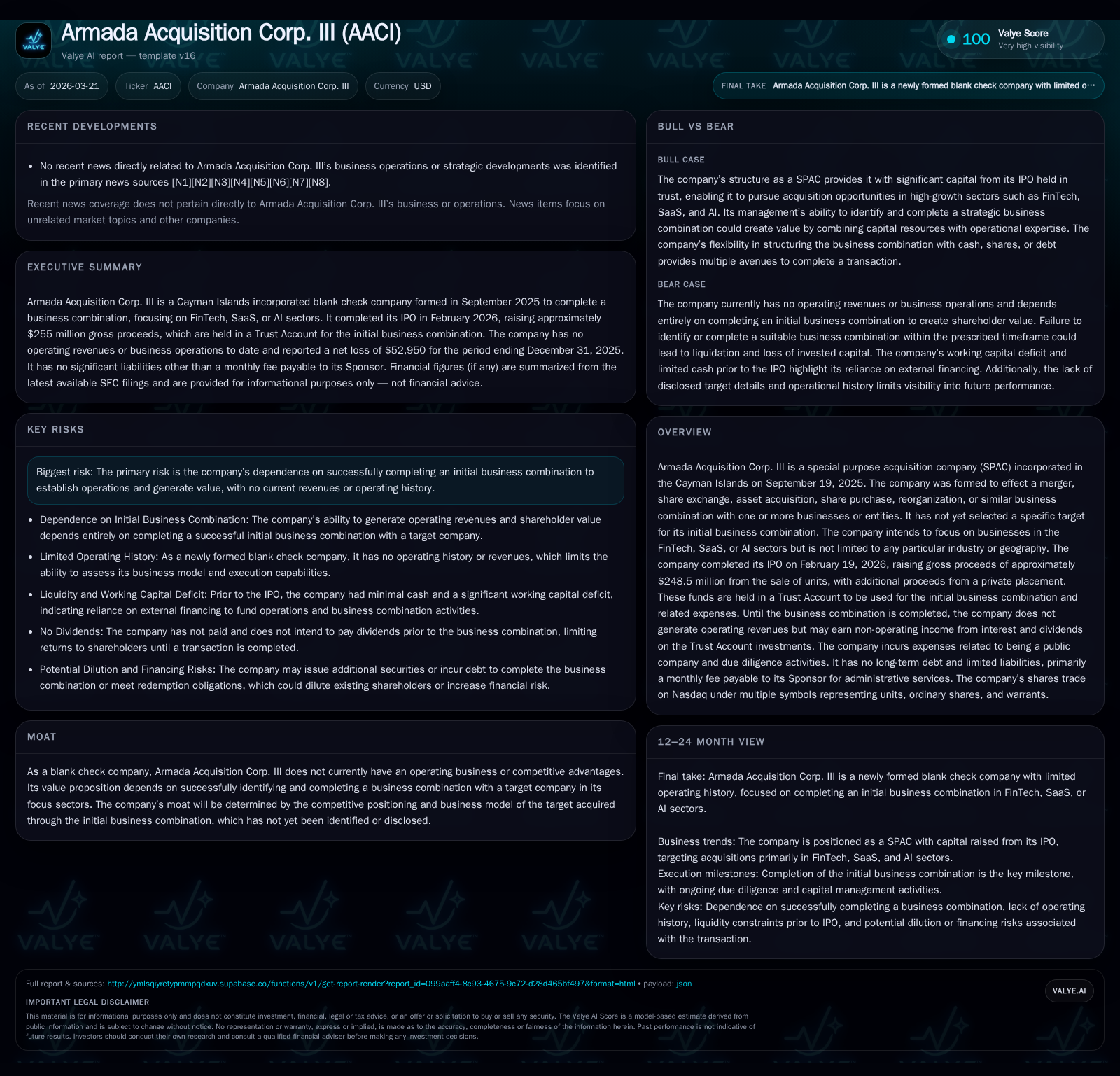
Armada Acquisition Corp. III is a Cayman Islands-based SPAC that completed its IPO in February 2026, raising approximately $248.5 million. The company aims to leverage this substantial capital base to identify and merge with promising companies primarily in the fintech, SaaS, and AI sectors, although it retains geographic and industry flexibility. Given its pre-combination status, Armada's growth hinges on successfully closing a business combination within the 18-month timeframe. Capital allocation and governance structures are designed to align sponsor incentives with shareholder interests while managing risks inherent in SPACs.
IPO Completion and Capital Structure Setup
Armada Acquisition Corp. III consummated its initial public offering on February 19, 2026, selling 24.85 million Units at $10 each, generating gross proceeds of roughly $248.5 million [S3][S4][S9]. A partial exercise of the underwriters’ over-allotment option added 2.35 million Units; the remainder was forfeited leading to adjustments in sponsor founder share forfeitures [S4]. Each Unit consists of one Class A ordinary share and half a redeemable warrant exercisable at $11.50 per share beginning twelve months after the IPO and after the business combination completion [S9]. Warrants expire five years following the initial business combination or earlier if redeemed per terms specified.
Alongside the IPO, Armada sold approximately 672,000 Private Placement Units at $10 apiece raising around $6.7 million from the Sponsor and underwriters; some proceeds were placed in the Trust Account [S9][S16][S23]. Proceeds not invested directly in the Trust Account fund working capital needs such as due diligence and transaction expenses [S16][S23]. This Trust Account structure is standard among SPACs to ensure funds allocated for target acquisitions remain secure.
The Sponsor purchased just over 8.25 million Class B founder shares subject to partial forfeiture mechanisms linked to underwriter over-allotment exercises; some shares were transferred to board directors as compensation for their service with staggered vesting schedules [S4][S25][S26][S28]. This dual-class share structure is typical SPAC architecture providing controlling interest while aligning incentives through vesting.
Historical Performance Snapshot: From Inception to IPO
Since its inception on September 19, 2025 through December 31, 2025, Armada Acquisition Corp. III operated without generating revenue as expected for a blank check company at this stage [F1][S16]. The net loss reported was $52,950 driven by administrative and organizational expenses [F1]. Cash on hand was minimal ($4,347), while current liabilities stood at about $360,000 resulting in a very low current ratio of roughly 0.01—a reflection of early-stage liquidity prior to IPO funding [F1].
Notably, reported return on equity (ROE) showed an anomalous figure near 189% due mainly to nominal equity base during formation; this is an accounting artifact rather than an indicator of operating performance [F1]. Post-IPO capital injection resolves pre-IPO liquidity constraints enabling operational scope expansion.
Historical performance (annual)
| FY |
|---|
| 2025 |
Source: SEC companyfacts cache [F1].
All data as of December 31, 2025 per latest filing
Target Sector Focus: FinTech, SaaS, and AI Specialization
While Armada Acquisition Corp. III has no operating business currently, its strategic orientation centers on identifying targets in fintech, SaaS (Software-as-a-Service), or AI-related businesses [N3][N14]. These sectors have demonstrated robust growth dynamics supported by trends such as increased AI investment traction highlighted by Nasdaq coverage indicating multiple-fold valuation potential [N3].
This thematic focus leverages technological innovation as a value driver but Armada retains discretion to pursue combinations outside these verticals or outside geographic constraints—common among SPACs wanting strategic flexibility [S16].
Challenges and Constraints Facing a Pre-Combination SPAC
Armada faces challenges common to all blank check companies including absence of operational history or revenues prior to consummating a business combination [S1]. The company has an enforced completion window of 18 months post-IPO by which it must close its initial business combination or commence liquidation proceedings redeeming public shareholders at Trust Account value less fees [S5][S13].
Operational costs incurred in target identification and diligence processes could stretch available working capital allocated outside the Trust Account raising liquidity pressure before merger closure [S6][S7]. The Sponsor may extend working capital loans up to $1.5 million convertible into post-combination private placement units if needed but this support is discretionary [S6][S7]. Furthermore, investor redemptions during shareholder votes on deals can reduce merger funding complicating deal structuring.
Capital Allocation Framework and Sponsor Arrangements
The bulk of proceeds ($248.5 million plus portion of Private Placement Units' proceeds) reside in the Trust Account pooled in short-duration U.S.-government treasury securities or qualifying money market funds until released for acquisition purposes or redemptions [S9][S23]. Funds held outside are allocated toward expenses including legal fees, due diligence travel costs, corporate overheads as well as preparation-related expenses ahead of any merger consummation [S16][S23].
Underwriting fees total about $15.5 million combining cash discounts payable at offering closing plus deferred fees released upon business combination completion [S9][S23]. Additionally, deferred underwriting commissions are contingent payouts maintained from funds remaining post-redemptions.
Sponsor founder shares totaling approximately 8.25 million include forfeiture provisions linked proportionally to underwriter over-allotment exercises affecting sponsor ownership percentage dynamically [S4][S25]. Sponsor purchased 400k Private Placement Units agreeing that portion goes into Trust Account ensuring aligned interests during pre-combination phase [S16][S26].
Governance and Sponsor Share Structure Impact
Ownership control resides principally with the Sponsor holding Class B ordinary shares where roughly 8.25 million founder shares remain outstanding after forfeitures related to partial over-allotment non-exercise by underwriters [S4][S25]. Some founder shares were assigned as stock-based compensation for director services with vesting spread across quarterly intervals concluding at either IPO close or initial business combination completion [S4][S25][S26][S28].
This issuance anchors governance stability while providing incentive alignment essential for navigating complexities during target search and negotiation phases typical within SPAC lifecycle frameworks.
Key Milestones Ahead: What To Watch Before Business Combination
The critical timeline event looming is the requirement to complete an initial business combination within eighteen months following February's IPO closing date or initiate dissolution steps including redemption of public shareholders’ pro rata Trust Account funds less permitted expenses [S3][S13].
Warrant exercisability will start twelve months after IPO but only once an initial combination has closed rendering those securities active components affecting future capital structure decisions post-merger completion [S9].
Investors should monitor announcements relating to prospective target identifications since that will drive shareholder votes accompanied by redemption windows materially impacting deal valuation mechanics and available merger financing capacity.
The absence of identified targets thus far means near-term catalysts remain event-driven surrounding announcement timing rather than operational results milestones.
Potential Market Risks Tied To Macro And IPO Dependence
Macroeconomic factors such as geopolitical tensions reflecting stock market volatility around escalated conflicts ([N4]) can compound difficulty assessing fair values for acquisition candidates amid uncertain credit environments spotlighted by warnings in private credit markets ([N5]).
These external headwinds add complexity beyond typical SPAC risk profiles centered on deal closure uncertainty embedded in contractual timeframes. Failure to merge within mandated period triggers mandatory liquidation extinguishing potential upside leaving only principal return less offering costs borne by early investors.
Given structural dependencies on shareholder votes and redemption rights consequential from valuation considerations underscores how sensitive Armada’s eventual success remains subject both internal execution discipline and prevailing external market conditions.
Disclaimer: This analysis provides information grounded solely in public filings and verified news sources without recommendation regarding participation or investment in Armada Acquisition Corp. III securities.
Disclaimer: This is research-only, informational analysis and not investment advice. It may include AI-generated interpretation and general industry context. Always verify important details using primary sources.

Comments