
Affinity Bancshares' Earnings Surge and Portfolio Strategy Reshape Growth Path
Robust earnings growth linked to diversified lending and disciplined risk management, alongside strategic recalibration after acquisition deal termination.
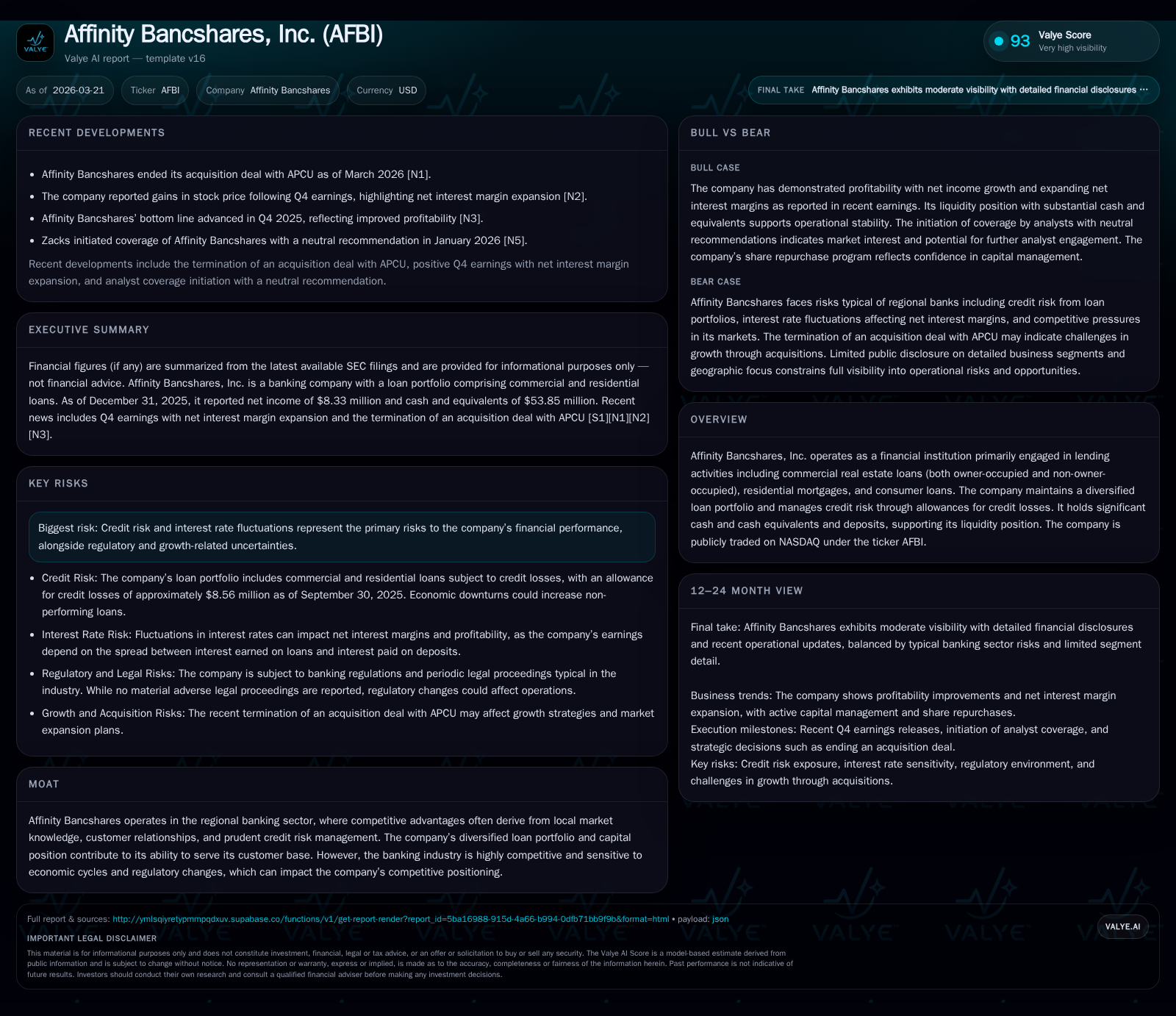
Affinity Bancshares demonstrated a compelling 53.1% year-over-year net income increase through prudent expansion across commercial real estate, residential mortgages, and consumer loans. Enhanced operating cash flows (+71.4%) reflect operational efficiency gains amidst a dynamic regional banking environment. The recent termination of the APCU acquisition signals a strategic pivot, underscoring focus on organic growth and capital return balance. Capital deployment includes consistent share buybacks alongside dividend payments while maintaining strong equity levels.
Growth Trajectory in Lending: Key Drivers Behind Earnings Power
Affinity Bancshares recorded a significant net income increase of 53.1% in fiscal year 2025 compared to the prior year, rising from $5.44 million to $8.33 million [F1]. This surge is primarily attributable to targeted expansion across its diversified lending segments—owner-occupied commercial real estate (CRE), non-owner-occupied commercial RE loans, residential mortgages, and consumer installment loans—with total loan balances increasing moderately over the same period [S2]. Operating cash flow outpaced net income growth with a robust 71.4% increase to $11.64 million, signaling enhanced underlying operational efficiency and improved cash generation capabilities [F1]. This was achieved despite steady capital expenditures held constant at approximately $422,000, reflecting effective resource allocation without increased investment burden [F1].
Historical performance (annual)
| FY | Net ($mm) | CFO ($mm) | Capex ($) | Net YoY |
|---|---|---|---|---|
| 2025 | 8 | 12 | 422000 | +53.1% |
| 2024 | 5 | 7 | 422000 | -15.6% |
| 2023 | 6 | 8 | 527000 | -9.6% |
| 2022 | 7 | 8 | 1394000 |
Source: SEC companyfacts cache [F1].
Capital returns and efficiency (annual)
| FY | Buybacks ($mm) | FCF ($mm) | ROE% |
|---|---|---|---|
| 2025 | 6 | 11 | 6.6 |
| 2024 | 3 | 6 | 4.2 |
| 2023 | 3 | 7 | 5.3 |
| 2022 | 6 | 6 | 6.1 |
Source: SEC companyfacts cache [F1].
The bank's approach to managing credit risk through adequate allowances for credit losses aligned with seasoning effects in CRE portfolios has helped support incremental income gains amidst competitive pressures typical in regional banking sectors [S2]. The CRE segment notably balances owner-occupied loans at around $164 million with near-equal exposure to non-owner-occupied loans at approximately $164 million, cementing a well-seasoned, pass-rated loan mix that mitigates concentration risks [S13],[S26]. Consumer loans expanded steadily alongside construction and development financing, diversifying sources of yield.
Comprehensive Portfolio Composition: Shifts and Risk Mitigation
At September 30, 2025 detailed disclosures show owner-occupied commercial real estate loans stood at approximately $163.8 million while non-owner-occupied CRE loans were close to $164 million; residential mortgage exposure declined slightly to about $48.5 million; consumer installment loans increased to roughly $130 million from prior periods [S13],[S26]. Allowance for credit losses remained appropriately provisioned at about $8.54 million against total loans of $731 million supporting sound coverage ratios reflective of portfolio seasoning and low impaired assets incidence [S13],[S26].
Investment securities comprise mostly U.S. government-sponsored enterprise (GSE) bonds including mortgage-backed securities with explicit or implied federal guarantees valued at about $50.7 million as of mid-2025 [S7],[S17]. These holdings contribute liquidity buffers and low credit risk profile instrumental for regulatory capital comfort.
The loan portfolio also encompasses specialized lending within professional markets such as dental practice acquisitions—a niche regional focus—with rigorous underwriting standards reducing downside scenarios [S13]. Quarterly risk disclosures reveal limited special mention or substandard credits relative to portfolio size, affirming prudent risk controls common in well-managed community banks.
Acquisition Developments: Termination of APCU Deal and Strategic Implications
On March 21, 2026, Affinity Bancshares publicly announced termination of its previously planned acquisition of APCU—a deal initially expected to enhance scale advantages but now reconsidered given evolving business conditions [N1]. Management emphasizes refocusing on organic growth rather than integration complexities amid an increasingly competitive landscape.
This strategic pivot recalibrates expectations for market penetration expansion but conserves capital deployment flexibility for share repurchases or dividends while maintaining robust liquidity profiles crucial during uncertain economic cycles.
Forward-Looking Growth Catalysts and Challenges
Looking ahead, Affinity’s growth hinges on sustained deposit inflows that fund further loan origination without excessive reliance on wholesale borrowing sources [S2],[S9]. Given the sensitivity of net interest margins (NIMs) to shifting interest rates, monitoring margin compression risks remains critical especially if competitive pressures necessitate pricing concessions.
Credit risk dynamics linked to economic cycle variability pose recurrent challenges; however, the company’s conservative provisioning philosophy as highlighted in its annual report reduces earnings volatility from charge-offs or loan loss provisions [S8]. Regulatory headwinds including potential Basel III standard evolutions require vigilance on capital adequacy metrics.
The aborted APCU deal introduces uncertainty but also affords operational agility—key when economic forecasting presents nuanced tradeoffs between growth ambitions versus prudent balance sheet management.
Capital Deployment Patterns: Dividends, Buybacks, and Equity Trends
Capital allocation reflects balanced stewardship: FY2025 saw share repurchases totaling approximately $5.94 million up from prior levels signaling active shareholder return initiatives aligned with elevated earnings power [F1],[S6]. Dividends were also consistently paid—about $8.8 million in FY2025—demonstrating commitment to returning excess capital despite net equity marginally declining from $129.1 million in FY2024 to $127 million in FY2025 due primarily to repurchases offsetting retained earnings growth [F1].
Management narrates a framework focused on sustainable dividends augmented by opportunistic buybacks calibrated against liquidity reserves ($53.85 million cash & equivalents as year-end FY2025) ensuring no compromise on regulatory or operational flexibility [F1],[S6]. The retained earnings progression supports ongoing reinvestment needs without aggressive equity issuance thereby maintaining disciplined capital structure integrity.
Financial Ratios Spotlight: ROE, Cash Flows, and Asset Quality Metrics
Return on equity (ROE) stands near 6.6%, calculated by dividing FY2025 net income by period-end equity—a moderate yet improving indicator consistent with growing profitability amidst larger capital base deployments [F1]. Free cash flow (operating cash flow minus capex) reached an estimated $11.22 million reflecting high-quality cash conversion supporting both growth funding and shareholder returns without threat to liquidity cushions.
Asset quality remains resilient with low levels of past-due financing receivables; quarterly filings confirm stable coverage ratios alongside minimal charge-offs attributed to conscientious underwriting across sectors including commercial-industrial segments totaling roughly $146 million loans—the third largest bucket behind CRE categories [S2],[S9]. This mix reduces concentration risks often associated with cyclical downturns while nurturing portfolio seasoning advantageous for loss mitigation.
Disclaimer: This is research-only, informational analysis and not investment advice. It may include AI-generated interpretation and general industry context. Always verify important details using primary sources.

Comments