
Bitcoin Depot’s Urban Footprint and Regulatory Hurdles Shape Growth and Capital Dynamics
Bitcoin Depot Inc. leverages its dominant Bitcoin ATM network and retail partnerships to drive growth while navigating contract renewals and regulatory complexity.
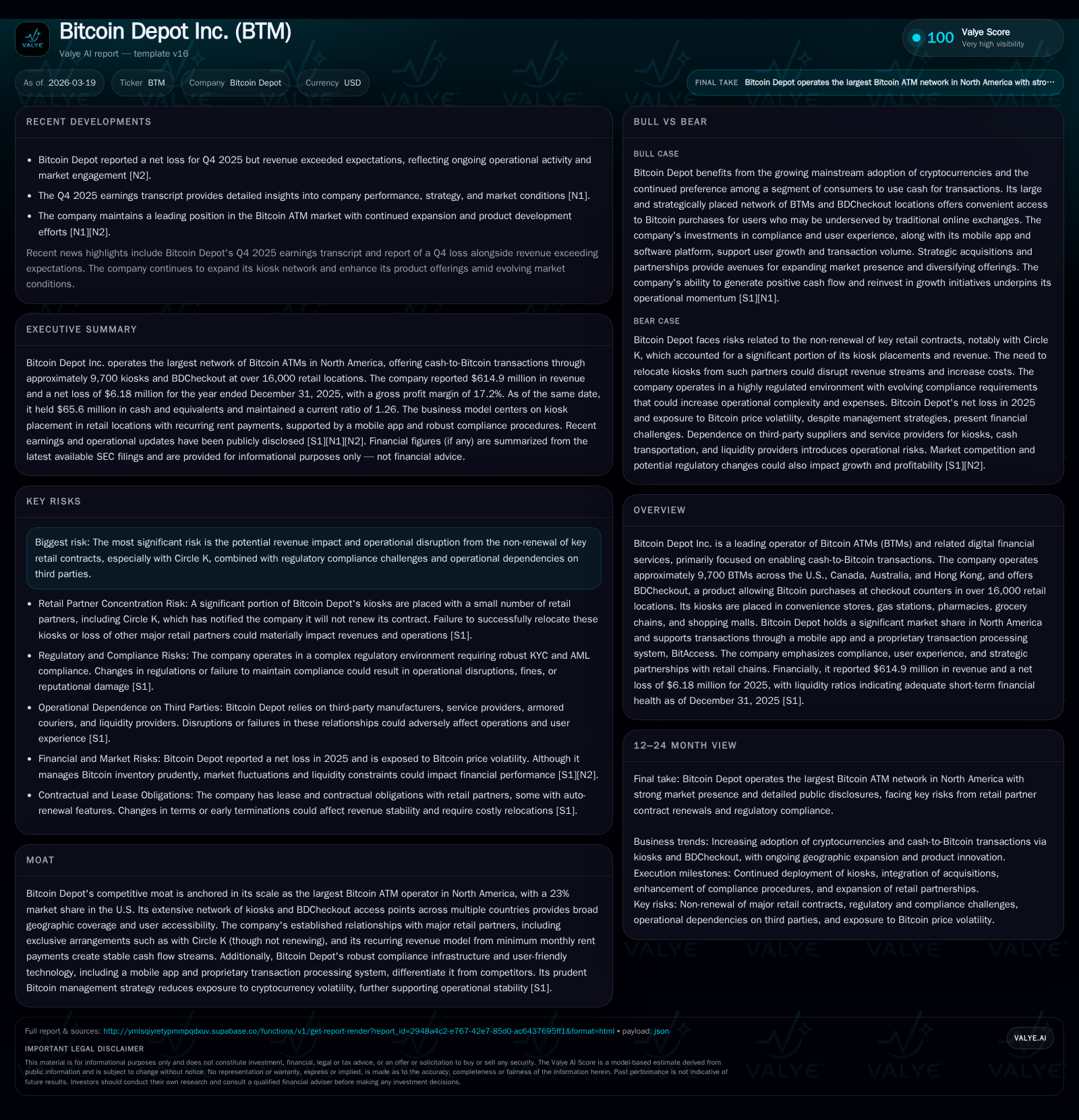
Bitcoin Depot Inc. operates the largest Bitcoin ATM network in North America with approximately 9,700 kiosks and a complementary retail checkout solution, BDCheckout, deployed at over 16,000 locations. The company achieved $615 million in revenue for 2025, growing 7.2% compared with the prior year, supported by expanding transaction volume and product innovation despite a net loss of $6.18 million. Future growth depends on maintaining retail contracts—most notably with Circle K, which has opted not to renew its partnership—and managing regulatory risks amid evolving cryptocurrency compliance frameworks. The company has maintained positive operating cash flow and invests strategically in products and market expansion while balancing capital allocation between dividends and reinvestment.
Company Overview and Business Model
Bitcoin Depot Inc. stands as the preeminent operator of Bitcoin ATMs across North America with a sizable presence extending to Australia and Hong Kong, owning approximately 9,700 kiosks as of December 31, 2025 [S1][F1]. These kiosks enable physical cash-to-Bitcoin transactions primarily located within convenience stores, gas stations, pharmacies, grocery chains, and malls—integrating digital currency accessibility into everyday consumer environments.
Alongside BTMs, Bitcoin Depot has established BDCheckout, a product facilitating Bitcoin purchases through checkout counters at more than 16,000 retail locations across North America [S1]. This dual-channel approach addresses both direct kiosk users and consumers who prefer transacting through familiar retail points. Both platforms are reinforced by a proprietary transaction system known as BitAccess that not only powers Bitcoin Depot’s network but also generates software revenue from third-party operators.
The company targets an underserved demographic that predominantly uses cash but desires entry into the digital financial ecosystem—a niche it calls "bringing Crypto to the Masses™" [S1]. It complements this physical infrastructure with a mobile app offering remote purchase capabilities.
Historical Financial Performance
Bitcoin Depot recorded total revenues of $614.9 million for FY2025 representing a 7.2% increase over FY2024's $573.7 million after experiencing a downturn in FY2023 ($689 million) compared to FY2022 levels [F1]. Despite cyclicality typical of crypto markets impacting wallet activity volumes and pricing spreads on Bitcoin sales:
Historical performance (annual)
| FY | Rev ($mm) | Net ($mm) | CFO ($mm) | OpInc ($mm) | Rev YoY | Net YoY |
|---|---|---|---|---|---|---|
| 2025 | 615 | -6 | 34 | 41 | +7.2% | +47.1% |
| 2024 | 574 | -12 | 23 | 24 | -16.7% | +55.2% |
| 2023 | 689 | -26 | 41 | 30 | -1411.1% | |
| 2022 | -2 | -2 | -5 |
Source: SEC companyfacts cache [F1].
Capital returns and efficiency (annual)
| FY | Div ($mm) | Buybacks ($) | FCF ($mm) |
|---|---|---|---|
| 2025 | 10 | 0 | 28 |
| 2024 | 37 | 158000 | 12 |
| 2023 | 15 | 279000 | 41 |
| 2022 |
Source: SEC companyfacts cache [F1].
Revenue growth since inception owes much to expanding kiosk deployments—integration into Circle K's chain (~800 kiosks) was significant until recently—and BDCheckout rollout that lowers customer acquisition cost through retail checkout points rather than solely hardware installs [S1][S5][F1]. Operating income showed marked improvement in FY25 driven by operational scale benefits despite net losses remaining due largely to ongoing investments in technology and compliance infrastructure.
Operating cash flow turned strongly positive reaching nearly $34 million with capital expenditures declining sharply in FY25 relative to FY24 reflecting maturing deployment cycles [F1]. Dividend payments resumed modestly following larger payouts in previous years though no buybacks occurred in the last reported fiscal year.
Competitive Positioning and Moat
Bitcoin Depot’s competitive advantage is rooted primarily in scale: commanding roughly a quarter share of the U.S cash-to-Bitcoin ATM market alongside leadership positions internationally [S1]. The breadth of retail partnerships provides extensive geographic coverage particularly valuable given how BTM transaction volume correlates strongly with kiosk visibility and foot traffic [S23][S26]. Consumer convenience achieved via multiple touchpoints including kiosks, BDCheckout counters, and mobile apps enhance brand loyalty and user stickiness.
Crucially, the company emphasizes stringent compliance frameworks encompassing Anti-Money Laundering (AML), Know Your Customer (KYC), privacy protections adhering to complex multi-jurisdictional requirements [S6][S10][S14]. This reduces risk exposures common in crypto-financial interfaces prone to fraud or illicit use allegations—a persistent reputational hazard industry-wide [S4][S16]. The internal BitAccess platform distinguishes Bitcoin Depot through integrated transaction processing control supporting uptime reliability superior to many peer-operated BTMs dependent on more fragmented tech stacks.
However, exclusivity arrangements such as those previously held with Circle K account for nearly one-fifth of revenues; losing these agreements without replacement could materially impact revenue [S24][S8]. Also critical is licensing progress such as the pending New York state license essential for expansion into one of the largest potential markets presently inaccessible [S24].
Risks Affecting Current Operations and Future Growth Prospects
Bitcoin Depot’s biggest immediate risk lies in contract renewals with large retail chains like Circle K whose decision not to renew means strategic repositioning or mitigation becomes urgent [S8][S24]. Coverage loss there impacts roughly between one-fifth and one-quarter of revenue depending on calculation period.
Regulatory complexity remains elevated with cryptocurrency-related services increasingly scrutinized under jurisdictions’ AML laws plus new UDAAP regulations enforced by U.S federal agencies like CFPB creating risk for operational adjustments or fines [S6][S10][S11][S14]. The firm is also subject to increasingly diverse privacy laws globally complicating standardization efforts.
Cybersecurity threats persist as BTMs are targets for fraudsters seeking transaction exploits; rigorous risk management investments have been made but incidents could still impose reputational damage or financial liabilities [S15]. Furthermore, technological competition converges on AI-driven user experiences by newer entrants potentially threatening user retention if Bitcoin Depot fails to innovate consistently [S26].
Geopolitical risks associated with growing non-U.S operations include currency exposures plus local regulatory conflicts adding complications should international revenues rise significantly without effective hedging [S10].
Outlook & Monitoring Points (Analysis)
While explicit forward guidance for revenues or profitability was not disclosed explicitly as per filings up to early March 2026 [N1], several areas warrant observation:
- How effectively can Bitcoin Depot replace lost revenue from Circle K's contract elimination?
- Progress on state licensing approvals such as New York may unlock lucrative market expansions.
- Uptake trends on BDCheckout deployments could signal decreasing dependence on capital-intensive kiosks.
- Regulatory developments regarding cryptocurrency transactional fees will influence pricing power dynamics.
- Innovation cadence especially around user interface enhancements or new service acquisition targets will be barometers of competitive positioning.
- Legal outcomes relating to ongoing investigations or class action suits could materialize impacting costs.
Returns Profile & Capital Allocation
Despite the net losses over recent years reported at -$6.18 million in FY25 improving from double-digit millions earlier (net loss narrowed by ~47%) Bitcoin Depot has shown consistent positive operating income (+$41 million FY25) and healthy operating cash flow generation (+$33+ million in FY25), indicating strong underlying business fundamentals when excluding non-cash charges or investment spending [F1].
Capital expenditures declined almost half from prior year (~$5.5 million vs $10.7 million), in line with matured kiosk networks requiring less frequent rollout capex [F1]. Dividend distributions remain meaningful but significantly reduced from peak levels signaling conservative prioritization balancing shareholder return against reinvestment needs: $10M dividends paid vs ~$37M prior year amid uneven earnings [F1]. No buybacks reported for FY25 highlighting cautious capital stewardship given uncertain environment.
The approximate Return on Equity computed via last annual net loss divided by equity yielded an unusual figure (~280%), likely distorted by accounting classifications or equity fluctuations; therefore ROE must be interpreted cautiously without detail beyond official disclosures [F1]. Liquidity ratios remain healthy with current ratio >1 indicating adequate short-term coverage.
Industry Context & Domain Nuance (Analysis)
The BTM industry is somewhat niche yet strategically pivotal within crypto adoption ecosystems serving cash users reluctant or unable to engage purely digitally—a demographic often underappreciated by online-only platforms . Moreover, BTM transaction economics inherently depend on transaction size plus fee structures governed partly by regulation ranging from markup limits to flat fees complicating sustainable margins .
Lastly mounting integration of offline payments into blockchain-based finance creates opportunity corridors beyond pure Bitcoin exchange—multi-currency support or fiat bridge functionalities may be necessary evolutions requiring R&D investment but also promising diversification avenues if managed properly.
Disclaimer: This analysis is based solely on publicly available data up through March 19, 2026, including SEC filings and recent news transcripts related to Bitcoin Depot Inc., without any speculative projections or investment recommendations.
Disclaimer: This is research-only, informational analysis and not investment advice. It may include AI-generated interpretation and general industry context. Always verify important details using primary sources.

Comments