
Crona Corp.: Evaluating the Quest for Profitability in Funeral Casket Supply
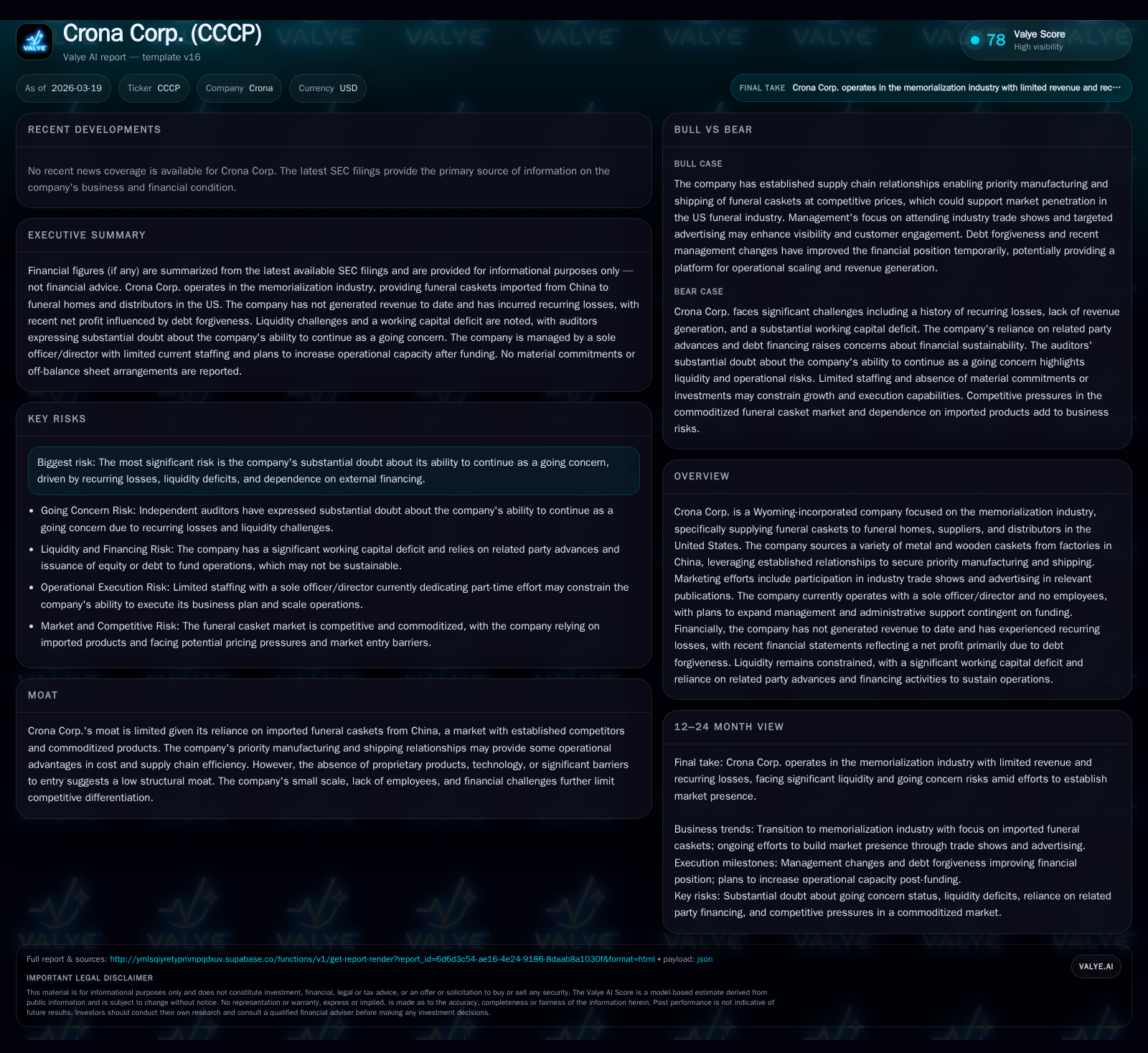
Crona Corp. faces a challenging financial path with no revenue history and mounting liquidity pressures while seeking to establish itself in the commoditized funeral casket market.
Since its inception, Crona Corp. has yet to generate revenue despite pivoting into the U.S. funeral casket supply chain, leveraging imported metal and wooden caskets from China. Over recent years, the company has recorded recurring losses, although net income improved in FY2024 due to debt forgiveness rather than operational profitability. Liquidity remains strained with severe working capital deficits and a negative equity base, raising substantial doubt about its ability to continue as a going concern. Future growth depends heavily on capital infusion, management expansion, and execution against competitive pressures in a commoditized industry with limited differentiation.
Historical Financial Performance Spotlight: Recurring Losses and Expense Evolution
Crona Corp.'s financial track record paints a stark picture of a pre-revenue company grappling with persistent operating losses. From fiscal year (FY) 2021 through FY2024, revenues stood firmly at zero dollars reflecting no commercial sales activity during this entire span [F1]. Net income mirrored this absence of top-line progress with losses ranging from approximately -$19K in FY2021 to a substantial -$194K in FY2023 before narrowing to -$77K in FY2024—a clear reduction but still negative. This improved bottom line in FY2024 stems largely from a noted decrease in professional fees and an accounting gain from approved debt forgiveness rather than operational gains [S1][F1].
Operating expenses over this period consisted mainly of professional fees, depreciation, amortization related to convertible notes, and general administrative costs. For example, FY2024 amortization expenses were $1.9K versus $15.1K depreciation expenses alongside sharply reduced professional fees of $15.6K compared to $110.5K in FY2023 [S1]. Despite incremental improvements in controlling certain expenses, the company has yet to reach breakeven on operations or produce positive cash flow from core business activities.
Cash flows from operating activities remained negative but improved substantially from -$120K in FY2023 to approximately -$20K in FY2024 indicating slightly better cost management but ongoing cash burn relative to no corresponding revenue generation [F1][S1]. No investing cash flows have occurred during these years reflecting an absence of capital expenditure commitments.
Operational Footprint: Sourcing Strategy and Market Positioning in Funeral Caskets
Crona’s business model revolves around sourcing funeral caskets—both metal varieties such as copper, stainless steel (18-20 gauge), and wooden types including pine, mahogany, oak among others—from manufacturing partners in China. Leveraging longstanding supplier relationships facilitates priority manufacturing slots and privileged shipping arrangements at negotiated rates allowing for import arbitrage advantages versus domestic production costs [S2][S26].
The firm targets U.S.-based funeral homes, distributors, and suppliers as primary customers—an end-market characterized by steady demand given demographic drivers but significant competition from entrenched domestic producers and other importers offering commoditized products lacking meaningful differentiation [S26]. Crona aims to sell full container loads (64 caskets per 40-foot container), focusing on cost-efficiency and breadth of choice regarding materials and finishes to appeal across different customer preferences [S26]. Marketing efforts are planned around participation at industry trade shows nationally and regionally along with advertising placements in key funeral trade publications designed to increase brand visibility within a specialized B2B environment.
Despite these efforts, absent proprietary technology or unique product features the competitive moat appears shallow with price sensitivity heightened due to product commoditization evident across the sector.
Liquidity Crisis and Capital Structure: Working Capital Deficits Underpinning Going Concern Doubts
Financial distress is evident when scrutinizing Crona’s balance sheet composition. As of September 30, 2025, current liabilities vastly outstrip current assets by an estimated $298,501—a profound working capital deficit reflective of unpaid obligations far exceeding liquid assets ([F1],[S3],[S4]). Notably, current assets stood effectively at zero while total liabilities trimmed slightly below $277K primarily consisting of related party advances, accrued interest payables, and accounts payable balances [F1],[S3].
Cash balances were negligible for multiple quarters culminating in reported zero cash as recently as June 30 and September 30 of 2025 highlighting severe liquidity constraints that restrict operational flexibility profoundly ([S3],[S4]).
Management acknowledges its expectation to continue incurring operating losses coupled with negative operating cash flows well into the foreseeable future necessitating further equity or debt injection for survival [S3],[S4]. The auditor's reports for fiscal years ending December 31, 2023 and 2024 officially include explanatory notes expressing "substantial doubt" regarding Crona's ability to continue as a going concern — capturing the precarious financial position decisively ([S7],[S3]).
No bank credit lines exist placing heavy dependence on shareholder advances or convertible debts as critical funding sources underlining fragility within its capital structure.
Growth Prospects: Management's Vision and Sector-Specific Hurdles
Management articulates plans for growth contingent upon securing additional capital infusions sufficient to expand beyond the current skeletal management architecture consisting solely of a part-time sole officer/director [S2],[S20]. Specifically, staffing expansion into full-time management combined with administrative support remains conditional pending funding availability.
The shift into the memorialization sector represents a strategic pivot away from prior antimicrobial surface protection services executed until mid-2023 toward targeting stable demand funeral product supplies within U.S markets offering straightforward commercial appeal but scant scalability absent proprietary offerings or technological innovation ([S2]).
Given entrenched competitive pressures characteristic of commoditized funeral merchandise—including competing imports priced similarly or domestic players capable of rapid order fulfillment—growth prospects are inherently constrained without scale economies or intensified marketing presence (). The strategic playbook centers on prioritizing supply chain cost efficiencies through buyer-supplier bargaining leverage while pursuing measured customer acquisition via trade shows and niche media channels.
Such path dependency on repeated capital raises combined with operational staffing limitations signals that sustainable expansion requires simultaneous execution across fundraising efficiency plus market penetration effectiveness amid tight industry margins.
Capital Allocation Review: Absence of Dividend Policy and Dependence on Equity/Debt Financing
To date Crona has neither declared dividends nor engaged in share repurchase programs consistent with typical early-stage microcap profiles focusing exclusively on liquidity preservation ([F1],[S22],[S23],[S27]). Capital injections primarily take the form of related party advances augmented sporadically by convertible promissory notes evidencing reliance on insider funding mechanisms rather than broad market financing access.
Free cash flow remains negative when considering operating cash flow less negligible capital expenditures underscoring continuous cash burn despite modestly improving operational expense controls ([F1]). Equity stands deeply negative reflecting cumulative losses surpassing contributed capital eroding book value which depresses any potential return on equity metric calculation reflective of operational non-profitability ([F1]).
This financing approach entails dilution risk for existing shareholders should fresh equity be issued at lower valuations—a typical challenge within subscale firms lacking positive earnings momentum issuing securities primarily as lifelines rather than growth enablers.
Key Milestones to Monitor: Path to Generating Revenue and Cash Flow Stability
Though explicit guidance is absent from regulatory filings reflecting informational opacity typical for such early-stage firms without commercial traction ([N/A]), several key performance indicators merit close investor watch:
- First recognition of revenues signaling transition from pilot/operational buildup phase toward commercial engagement;
- Achievement of positive operating cash flows evidencing effective cost control aligned with successful sales scaling;
- Declines in working capital deficits indicative of improving liquidity alongside reductions or restructuring of liabilities;
- Expansion beyond sole part-time officer providing operational bandwidth necessary to fuel growth efforts including marketing outreach;
- Confirmation of supply chain reliability sustaining inventory availability avoiding costly disruptions.
Given absence of both recent news releases nor explicit milestones articulated by management beyond general intentions ([N/A]), these metrics carry heightened significance embodying fundamental tests for Crona’s future viability.
Risk Analysis: Structural Moat Limitations and Financial Sustainability Challenges
Crona operates amidst substantive risks attributable primarily to its lack of competitive protective moats. The heavy reliance on imports positions it within an intensely price-sensitive segment whereby rival importers vying for identical factory output coexist alongside domestic manufacturers minimizing switching costs for buyers ().
Absence of intellectual property rights or patented technologies limits differentiation capabilities rendering pricing power weak. Concurrent geopolitical factors such as potential shifts in China-U.S trade dynamics introduce additional supply chain vulnerabilities compelling vigilance around cost structures.
Financially Crona’s endemic losses compounded by persistent liquidity shortages necessitate continual external financing exposing it acutely to capital market access risks unfavorable terms or valuation compression raising existential concerns despite laudable attempts at structural expense rationalization (, [S3]).
Any inability to secure necessary funds threatens operational continuity underpinning auditor warnings highlighting material uncertainty about going concern validity emphasizing fragility throughout corporate strategy execution.
Summary Table: Financial Trends from FY2021 through FY2024
Historical performance (annual)
| FY | Rev | Net ($) | CFO ($) | OpInc ($) | Net YoY |
|---|---|---|---|---|---|
| 2024 | 0 | -77395 | -20140 | -77395 | +60.0% |
| 2023 | 0 | -193626 | -120094 | -193626 | -528.9% |
| 2022 | 0 | 45148 | -43881 | 45148 | +156.6% |
| 2021 | 17596 | -1100 | 17596 |
Source: SEC companyfacts cache [F1].
Capital returns and efficiency (annual)
| FY | ROE% |
|---|---|
| 2024 | 28.7 |
| 2023 | 100.8 |
| 2022 | 6543.2 |
| 2021 | -39.6 |
Source: SEC companyfacts cache [F1].
Note: All figures sourced from official company filings per SEC XBRL data snapshot; YoY percentage reflects change between adjacent years where calculable.
Disclaimer: This analysis reflects historical financial data alongside publicly disclosed corporate information without offering investment advice. Forward-looking commentary is limited exclusively to verifiable management statements; all projections represent non-speculative assessments based solely on documented evidence provided herein.
Disclaimer: This is research-only, informational analysis and not investment advice. It may include AI-generated interpretation and general industry context. Always verify important details using primary sources.

Comments