
Accelerant Holdings: Transforming Specialty Insurance with Data-Powered Risk Exchange
Accelerant leverages proprietary technology and a selective underwriting ecosystem to drive rapid growth in specialty insurance while facing challenges in profitability and operational scalability.
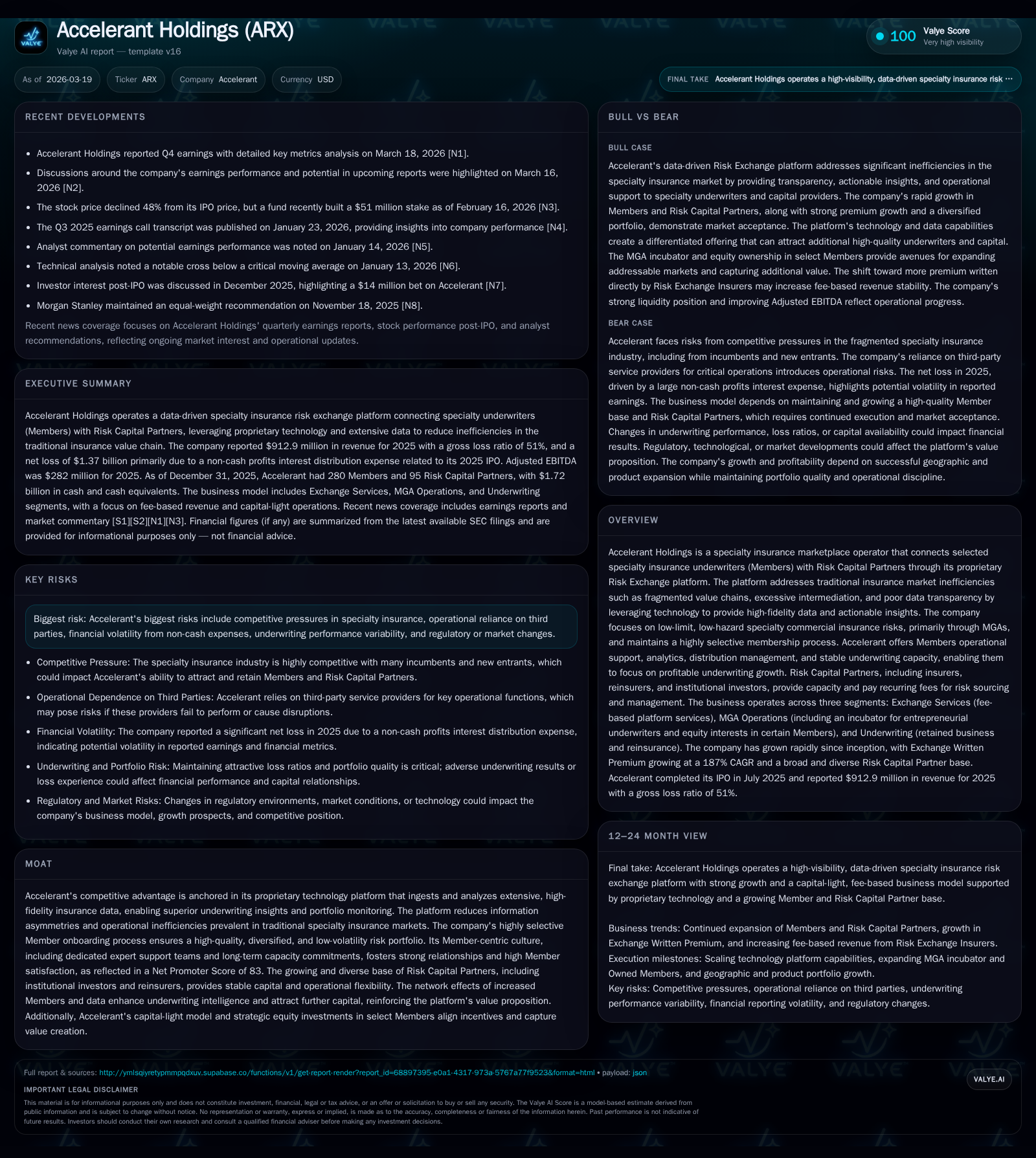
Since its founding in 2018, Accelerant Holdings has constructed a technologically advanced risk exchange platform that connects specialty insurance MGAs with diverse capital providers, enabling rapid premium volume expansion. Despite impressive revenue growth fueled by robust Member onboarding and innovative data analytics, the company endures significant net losses exacerbated by non-cash expenses and underwriting variability. Its long-term contracts with Members and capital commitments from reinsurers underpin the platform’s competitive moat, though future progress depends on managing contract renewals, regulatory complexity, and sustaining technological lead amidst market pressures.
From Launch to Scale: Accelerant’s Historic Growth Trajectory
Founded in 2018 by experienced insurance industry veterans disillusioned by legacy specialty insurance market inefficiencies, Accelerant Holdings rapidly evolved into a technology-powered specialty insurance marketplace operator. The company’s proprietary Risk Exchange platform connects specialty underwriters—primarily Managing General Agents (MGAs)—with a diversified set of institutional Risk Capital Partners seeking access to specialty commercial insurance premiums.
The business expanded rapidly post-launch, benefiting from its ability to streamline fragmented value chains and circumvent traditional intermediation barriers through superior data transparency. As of December 31, 2025, Accelerant managed a growing network comprising 280 Members, up from roughly 265 during Q3 2025 [S1][N1]. Concurrently, the number of Risk Capital Partners rose to 95. This membership growth supported a top-line reaching $912.9 million in revenue for fiscal year 2025 representing a sustained compounded annual growth rate around 187% since inception [F1][S1].
Despite this top-line acceleration, the company’s net income exhibits significant volatility with cumulative quarterly losses amounting to approximately -$1.37 billion trailing twelve months driven chiefly by large non-cash expenses—including a $1.38 billion profits interest distribution related to IPO share vesting—and ongoing investments in scaling operations and technology development [F1][S20]. The contrast between hypergrowth revenue trends and sizeable losses underscores the early-stage nature of Accelerant's scaling journey within specialty insurance marketplaces.
Historical performance (annual)
| FY |
|---|
| 2025 |
Source: SEC companyfacts cache [F1].
Table shows fiscal year performance highlighting booming revenue alongside negative ROE reflecting large non-cash items and operational stage effects.
Distinctive Technology and Member Ecosystem as Competitive Advantage
At the core of Accelerant’s moat lies its proprietary technology platform designed to ingest complex insurance policy data across heterogeneous sources into an analytically rich dataset comprising well over 58,000 distinct risk attributes per policy amounting to some 134 million rows as of the end of 2025 [S1]. This granular data processing capability uniquely addresses material information asymmetry prevalent in traditional specialty insurance where incomplete or opaque data hinders accurate underwriting decisions.
By integrating actionable insights directly into underwriting workflows used by Members—most notably independent MGAs—the Risk Exchange enables more disciplined portfolio monitoring and risk selection at an unprecedented scale relative to legacy models that often rely heavily on manual or siloed processes [N1][S8]. Additionally, Accelerant benefits from long-term Member contracts typically spanning five years with annual renewal windows enabling stable operating relationships while reserving rights to terminate based on performance factors [S1].
Crucially, the platform supports Flywheel Re—a Cayman Islands special purpose vehicle providing collateralized quota share reinsurance capacity backed by institutional partners—as part of its advanced capital structure ensuring stable underwriting backing that reinforces Members’ ability to underwrite profitably without disproportionate exposure [S1][S12].
This fusional approach combining deep technological enablement with carefully curated underwriting talent forms what insiders refer to as a “flywheel effect,” whereby increased data leads to better underwriting outcomes which attract more Risk Capital Partners facilitating further premium growth and risk diversification.
Assessing 2025 Financial Footprint: Revenue Growth vs Profitability Challenges
While the firm posted $913 million in annual revenue for calendar year 2025 demonstrating continued rapid organic expansion among its niche specialty commercial risk segment [F1], this top-line contrasts sharply with its negative trailing twelve-month earnings exceeding -$1.3 billion net loss as reported for Q3 ending September [F1]. This severe negative profitability metric stems primarily from two factors:
- First, a non-cash profits interest expense amounting to approximately $1.38 billion connected with settling outstanding equity awards coincident with the company’s IPO completion in mid-2025 dramatically weighs on GAAP earnings but represents an accounting adjustment rather than cash outflow [S20].
- Second, elevated operating costs associated with aggressive investment in technology platform expansion, MGA incubation support through Mission Underwriters, and expanding administrative headcount have yet to be offset fully by operational leverage gains.
Additionally, underwriting income itself fluctuates due to inherent specialty insurance loss variability alongside fluctuation in reinsurance recoverable dynamics despite disciplined quota share partnerships with fronting reinsurers maintaining A.M Best ratings "A-" or higher—a credit strength filter mitigating counterparty risk [S16][S21].
Cash flow remains robust due to premium receipts preceding claim payouts typical in property & casualty businesses; as such Accelerant had $1.72 billion cash & equivalents at December year-end reflecting IPO proceeds plus operating scale benefits versus limited capital returns evidenced by absence of dividends or buybacks [F1][S28]. The resulting negative ROE (-196%) reflects mainly accounting peculiarities of early-stage equity-based compensation expense rather than fundamental returns disruption but nonetheless flags substantial short-term earnings challenges facing management.
Underwriting Excellence and Platform Constraints Impacting Future Growth
Accelerant faces operational constraints tied to its reliance on accurately acquired third-party policy data submitted by independent Members/MGAs. Any lapses or inconsistencies could deteriorate actuarial precision hampering pricing accuracy crucial for sustaining retained underwriting margins at scale [S5]. Additionally, contractual terms binding MGAs predominantly span five years introducing rollover risk once initial terms expire potentially leading to churn if better platforms or direct insurer alternatives emerge.
Further complicating scalability is the need for ongoing evolution of analytics incorporating advanced AI methodologies increasingly scrutinized under emerging regulatory frameworks governing big data use cases—heightening compliance complexity particularly within US/EU privacy regimes affecting consumer data handling and algorithm transparency expectations [S18]. Failure to evolve technological sophistication risks losing competitive edge vis-à-vis incumbents adopting newer digital capabilities or alternative insurtech entrants focusing explicitly on segment specialization.
Risk management instrumentation anchored on collateralized reinsurance provisions cushions downside exposures but remains sensitive to catastrophic event frequency fluctuations especially given concentration risks inherent in insuring low-limit commercial niches which have differing loss ratio patterns than traditional large corporate lines.
Capital Structure, Cash Flow Dynamics, and Capital Allocation Priorities
Following its July 2025 IPO which delivered significant fresh equity capital infusion supporting operational runway and MGA incubation financing efforts mainly through Mission Underwriters initiatives that co-own MGAs alongside specialty underwriters themselves [S2], Accelerant also secured multi-year upsizings of Flywheel Re quota share reinsurance capacity extending committed capital availability until at least 2028—critical for maintaining platform underwriting stability without resorting extensively to balance sheet risk retention [S1].
At year-end December 31st cash plus equivalents stood near $1.72 billion bolstered by IPO proceeds offset partially by operating investments highlighting conservative liquidity management given inherent volatility risks associated with claims settlement timing and loss reserving uncertainties characteristic within property casualty lines [F1][S6][S12]. Senior unsecured debt approximated $124 million complemented by a revolving credit facility adding financial flexibility though currently minimally drawn underscoring capital-light funding strategy compatible with marketplace model ethos [S9][S15].
Upfront dividend payouts or share buybacks remain absent reflecting management preference towards reinvesting free cash flow into adding new MGA Members and technology R&D expenditure aimed at refining data extraction/analytics necessitated by marketplace complexity and regulatory demands especially around AI regulation scrutiny evolving globally [F1][S20][S28]. This deliberate capital conservation posture is standard among nascent insurtech marketplaces prioritizing durable foundational build-out over immediate shareholder distributions.
Marketplace Validation: Member and Risk Capital Partner Expansion
Accelerant’s high-touch approach has successfully built network effects central to specialty insurance marketplaces where trust among participants is paramount. Key indicators include growth in Membership reaching 280 Members—primarily independent specialized MGAs—and near doubling Risk Capital Partner count approaching mid-90s by end-2025 fostering broad risk dispersion across multiple reinsurers and institutional investors capable of delivering stable underwriting backing alongside flexible deal structuring [N1][S1].
A standout measure unique outside tech-focused B2B ecosystems is their exceptional Net Promoter Score (NPS) of 83 signaling very strong satisfaction levels among platform users including both supply-side underwriters benefitting from enhanced analytics insights plus demand-side capital providers gaining diversified access—a rarity bringing substantive qualitative validation rarely seen within conservative specialty lines markets dominated traditionally by legacy insurers resistant to customer-centric innovation paradigms [N1][S8].
Such satisfaction metrics portend well for retention rates beyond initial contract terms provided Accelerant mitigates underlying operational risks sufficiently while maintaining continuous service quality improvements aligned tightly with participant feedback loops embedded within the Risk Exchange design.
What Investors Should Monitor: Key Milestones and Analytical Outlook
Key upcoming milestones include monitoring renewal behavior among Independent Members as their initial five-year contracts mature—with performance-based termination rights representing potential inflection points influencing premium retention trajectories—which will be critical signals of platform endurance amid rising competition from larger incumbent carriers seeking direct MGA engagements without intermediary platforms alike [N2][S5].
Expansion plans governed partly by Flywheel Re's further upsizings post-2028 will reflect institutional investors’ confidence levels toward model durability while continued evolution of AI-driven analytics modules remains vital for sustaining accelerated underwriting insight enhancements essential amid tightening global regulatory frameworks targeting algorithmic decision-making fairness/transparency especially within insurance product pricing domains where "big data" approaches face greater scrutiny evolving around privacy laws internationally [S18].[N2]
Underwriting loss ratio trending coupled with reserve adequacy assessments will serve as barometers for margin stabilization—which combined with steady growth rates moderating from historical hyper-expansion levels anticipated—will signal maturation stages clarifying future earnings paths.
Investors should also track regulatory developments surrounding AI usage policies within US/EU jurisdictions as any restrictive mandates could increase compliance costs or constrain data sourcing strategies integral for maintaining competitive differentiation beyond simple digital presence.
While current negative ROE results reflect accounting nuances tied largely to IPO-share-based compensation charges rather than core economics failure,[F1] improvement trends here would confirm effective monetization leverage consistent with mature insurance marketplace norms assuring longer-term shareholder value realization scenarios.
Disclaimer: This analysis is provided solely for informational purposes based on publicly available filings and news disclosures without offering investment advice or recommendations.
Disclaimer: This is research-only, informational analysis and not investment advice. It may include AI-generated interpretation and general industry context. Always verify important details using primary sources.

Comments