
AIRWA INC.’s Turnaround Story: From Heavy Losses to Positive Operating Income
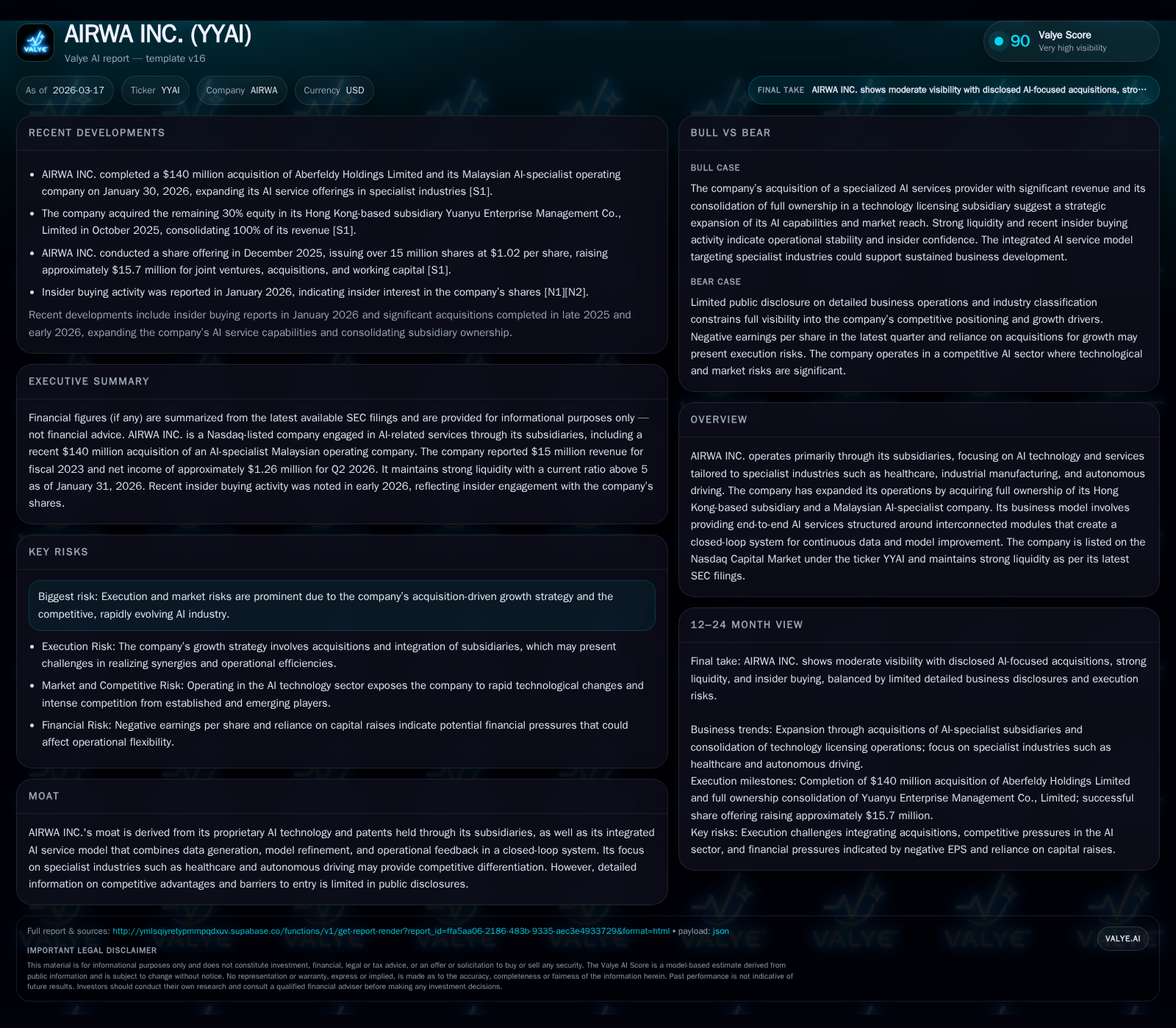
AIRWA's financial transformation reflects its strategic acquisition-driven growth in specialist AI sectors and evolving capital structure.
From 2022 through 2024, AIRWA INC. faced steep operating and net losses, with operating income plunging to nearly -$52 million and net losses exceeding -$71 million, reflecting significant challenges in its business model prior to its pivot. By FY2025, the company reversed this trend, achieving positive operating income of approximately $6.58 million and a net income of $3.49 million, marking a substantial financial turnaround within the competitive AI landscape. This recovery stems largely from acquisitions that expanded AIRWA's foothold in specialist AI verticals such as healthcare and autonomous driving, supported by a proprietary closed-loop AI service system. With ample liquidity—cash and equivalents topping $35 million as of early 2026—and prudent capital management, AIRWA stands at a crossroads where integration success and market dynamics will crucially influence sustained profitability.
Historical Growth and Financial Turnaround
AIRWA INC.'s financial journey over the past several years outlines a compelling narrative of recovery within the volatile AI sector. Early fiscal years displayed minimal revenue—just $14,700 in FY2017 rising marginally to roughly $13,240 in FY2018—reflecting nascent commercial activity [F1]. By FY2024 (ending March 2023), revenues had risen sharply to $15 million, marking substantial top-line expansion.
However, profitability metrics during this period tell a story of significant strain. Operating income slumped drastically, hitting an unprecedented low of -$51.9 million in FY2022 before narrowing the loss to -$21.96 million in FY2023 and improving to -$6.44 million in FY2024 [F1]. The company flipped to positive operating income of nearly $6.58 million in FY2025 (ending April 2025), embodying a more than 200% year-over-year increase.
Net income followed similar dynamics: from deep deficits of -$71.15 million in FY2023 toward a positive return of $3.49 million in FY2025 [F1]. Despite this earnings improvement, free cash flow remained slightly negative at around -$376k for FY2025 due to continued negative operating cash flow ($-379k) underlining ongoing investment or working capital use [F1].
Overall, this represents one of the sharpest financial recoveries documented among specialist AI firms transitioning from R&D-heavy phases towards sustainable commercial models.
Historical performance (annual)
| FY | Net ($mm) | CFO ($mm) | OpInc ($mm) | Net YoY |
|---|---|---|---|---|
| 2025 | 3 | 0 | 7 | +122.3% |
| 2024 | -16 | -3 | -6 | +78.0% |
| 2023 | -71 | -6 | -22 | -37.4% |
| 2022 | -52 | -11 | -52 |
Source: SEC companyfacts cache [F1].
Capital returns and efficiency (annual)
| FY | ROE% |
|---|---|
| 2025 | 13.8 |
| 2024 | -162.9 |
| 2023 | 382.3 |
| 2022 | -159.2 |
Source: SEC companyfacts cache [F1].
*FYs end April or March per fiscal calendar; revenues reported as per last available [F1]
Acquisition-Led Expansion into Specialist AI Verticals
Core to AIRWA’s resurgence has been an aggressive acquisition strategy that expands its industry footprint across highly specialized AI applications. In October 2025 and early 2026 filings [S11], AIRWA acquired the remaining minority interest (30%) it did not own in Yuanyu Enterprise Management Co., Ltd (YYEM), thereby consolidating full ownership of its Hong Kong-based subsidiary that holds key patents and technology licenses central to company operations [S19].
Additionally on January 30th, 2026 [S22], AIRWA completed the purchase of Aberfeldy Holdings Limited for $140 million in cash—an acquisition that secured control over Malaysian-based AI specialist firm 26 Rafael Sdn. Bhd. This subsidiary operates an advanced end-to-end AI framework designed for verticals including healthcare diagnostics systems, industrial automation monitoring solutions, and autonomous driving technologies with reported revenues around $27 million for its latest fiscal year.
These transactions underline AIRWA’s push into specialist AI verticals by leveraging entities with modular capabilities that interlock into closed-loop systems—enabling data generation to feed machine learning models which continuously evolve via operational feedback . The cross-sector synergy created strengthens AIRWA’s market positioning by addressing complex industry needs beyond general AI applications.
Business Model Integration and Technology Moat
AIRWA’s moat derives not solely from acquisitions but from proprietary technology housed largely within YYEM's patents and augmented by targeted innovations at its Malaysian operation . The company's approach implements interconnected AI modules spanning data ingestion pipelines through model training phases to deployment monitoring offering clients continuous improvement — typical of modern closed-loop learning systems essential for high reliability demanded in healthcare or autonomous vehicle domains.
This modular architecture allows AIRWA's platform to deliver customization without sacrificing scalability—a significant barrier for emerging competitors given the specialized integration required across disparate industrial applications. Additionally capturing operational feedback not only enhances algorithm accuracy but offers insights fostering client stickiness amid industry-specific regulatory and quality hurdles.
Such vertical specialization combined with IP protection creates an ecosystem effect where increasing customer adoption elevates data diversity powering more robust models—hallmarks of defensible technology moats in AI businesses focused on regulated sectors.
Current Liquidity and Capital Structure Analysis
The company exhibits strong liquidity as of January 31st, 2026 with cash & equivalents totaling approximately $35.7 million against current liabilities near $12.3 million resulting in a robust current ratio exceeding five times — a remarkable buffer often atypical for emerging tech firms [F1].
Recent SEC filings document multiple equity issuances underpinning this liquidity position: notably a $15.7 million gross proceeds offering closing December 22nd, 2025 fueling ongoing corporate initiatives including acquisitions [S12], alongside other equity placements totaling several millions further shoring up operational flexibility [S20],[S23]. Simultaneously AIRWA strategically eliminated minority interests via cash acquisitions consolidating profitable subsidiaries fully onboard thus enhancing balance sheet visibility.
Debt exposure appears limited based on filings through late-2025 evidencing absence of long-term leverage burden . Such capitalization provides AIRWA room for maneuver as it continues to pursue further integration while shielding against external shocks prevalent across volatile capital markets targeting mid-tier AI enterprises.
Capital Allocation: Dividends, Buybacks, and ROE Trends
Following years marked by steep net losses culminating close to negative $71 million in FY2023 [F1], AIRWA recorded an approximate return on equity (ROE) rebounding to about 13.8% for FY2025 reflecting normalized profitability relative to shareholders’ equity estimated near $25.3 million at that point.
Notably absent are dividend payments or formal share repurchase programs according to recent SEC disclosures [S14],[S17],[S19],[S22],[S26],[S27],[S28]. This withholding aligns logically with an asset-heavy growth phase typical within the tech startup lifecycle where capital is prioritized towards reinvestment especially amidst acquisition rollouts and technology upgrades.
Equity movements tracked between fiscal years reveal substantial recapitalization efforts supporting expansion yet careful not diluting control excessively post reverse stock split executed October 27th, 2025 [S14]. The firm appears focused on preserving flexibility rather than returning capital prematurely given operational turnaround remains underway.
Forecasting AIRWA’s Growth Trajectory and Milestones
Explicit guidance from AIRWA remains undisclosed; nonetheless prospects hinge strongly on effective assimilation of acquired entities—namely achieving anticipated synergies both operationally within closed-loop AI services and commercially expanding recurring revenue streams particularly via contract renewals and domain-specific solution scaling.
Key indicators for future progress will include any updates regarding revenue contribution breakdowns from YYEM post full consolidation and Malaysian subsidiary alongside margin expansions signaling improving cost structures versus previous loss-making periods [N1],[S3]. Monitoring shifts towards subscription-based licensing or managed service offerings could signify maturation enhancing revenue visibility typically prized by sector specialists.
As the broader AI market accelerates with intensifying competition especially in healthcare analytics or autonomous navigation algorithms requiring constant innovation cycles maintaining leadership through proprietary tech enhancements will remain critical for sustaining momentum.
Risks Embedded in Execution and Market Dynamics
Per recent SEC filings referencing persistent risk factors unchanged from prior annual reports [S4],[S5], AIRWA faces tangible execution challenges stemming from its acquisition-centric growth strategy including integration delays or cultural mismatches potentially hindering expected performance uplift.
The fast-evolving nature of artificial intelligence also imposes innovation risk; nimble competitors backed by larger platforms or specialized startups could erode market share if AIRWA's technology fails to keep pace or adapt rapidly within regulated environments like healthcare diagnostics compliance standards or autonomous vehicle safety certifications.
Additionally geopolitical concerns impacting cross-border operations especially involving China-Hong Kong-Malaysia triad introduce regulatory complexities adding uncertainty around intellectual property enforcement or operational continuity.
Continuous vigilant management addressing such multidimensional risks will be paramount as upcoming quarters unfold whether gains established recently can be entrenched sufficiently amid sector headwinds.
Disclaimer: This report synthesizes publicly available financial data and SEC documents without making investment recommendations; readers should conduct their own analysis before action.
Disclaimer: This is research-only, informational analysis and not investment advice. It may include AI-generated interpretation and general industry context. Always verify important details using primary sources.

Comments