
StoneBridge Acquisition II Corp's Strategic Pursuit of Initial Business Combination
StoneBridge Acquisition II Corp stands ready with $57.5 million in IPO proceeds, positioned to secure a cross-border business combination within targeted high-growth international sectors.
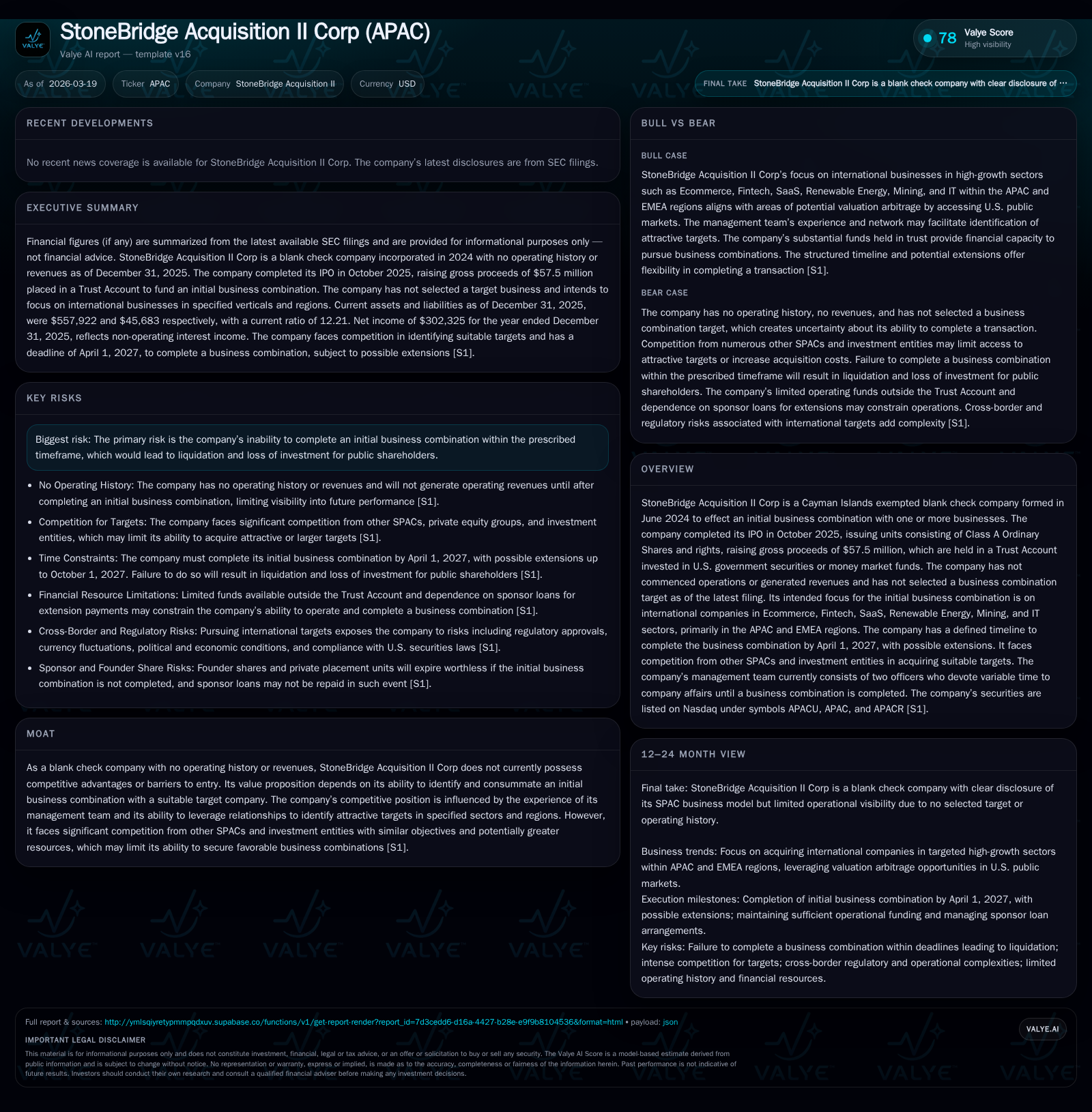
StoneBridge Acquisition II Corp (APAC) was founded as a Cayman Islands exempted blank check company in mid-2024 and completed its IPO in October 2025, raising $57.5 million held in trust invested conservatively. Operating without revenues or ongoing business, the company focuses on identifying an initial business combination target primarily within APAC and EMEA regions across Ecommerce, Fintech, SaaS, Renewable Energy, Mining, and IT sectors. Its strategy leverages management’s international experience but faces intense competition typical of the SPAC environment. With a firm April 1, 2027 deadline (subject to extensions), failure to consummate a combination will lead to liquidation. Governance structures grant founder shares substantial voting influence on combination approvals. Investors should watch for target announcements and any extensions ahead of the mandated timeline.
From Inception to IPO: Funding Milestone and Historical Financial Snapshot
Founded in June 2024 as a Cayman Islands exempted blank check company, StoneBridge Acquisition II Corp conducted its IPO in October 2025. The offering comprised units each including one Class A Ordinary Share and associated rights, collectively generating gross proceeds of $57.5 million before underwriting costs [F1][S1]. This capital was placed into a Trust Account invested predominantly in U.S. government securities and money market funds—a conservative approach aligning with SPAC norms aimed at capital preservation until deployment [S4].
Operationally inactive through December 31, 2025, StoneBridge's only income arises from interest accreted on Trust Account funds. No revenues have yet been generated given it has not selected or acquired any target [F1][S1]. Key metrics as of FY2025 evidence this financial status: net income totaled $302 thousand attributed primarily to interest income; cash and cash equivalents were nil outside the Trust Account; current assets stood at approximately $558 thousand against current liabilities near $46 thousand resulting in a strong current ratio of 12.21 indicating solid short-term liquidity support but reflective mostly of the preserved funding framework rather than operational assets [F1].
While the reported Return on Equity (ROE) shows an elevated figure at approximately 55.5%, this reflects limited equity base effects rather than operational profitability given no revenue activities [F1]. Thus ROE here should be cautiously interpreted within the context of this being a capital-holding shell.
Historical performance (annual)
| FY |
|---|
| 2025 |
Source: SEC companyfacts cache [F1].
Figures sourced from [F1] latest available data.
Securing Growth Through Strategic Target Selection: Sector and Geographic Focus
StoneBridge’s strategic intent is underscored by a targeted sector approach focusing on industries with demonstrable growth trajectories and potential for sustainable earnings: Ecommerce, Fintech, SaaS, Renewable Energy, Mining, and IT/IT-enabled services [S1][S4]. Such sectors offer favorable alignment with digital transformation trends globally alongside demand for renewables amidst evolving regulatory frameworks.
Geographically, the company concentrates predominantly on Asia-Pacific (APAC) and Europe-Middle East-Africa (EMEA) regions—markets offering distinct valuation arbitrage opportunities by accessing U.S. public investors while leveraging local growth drivers [S1][S4]. The rationale hinges upon these markets harboring high-potential private enterprises that are primed for public market entry via efficient SPAC-led transactions.
In evaluating potential targets, StoneBridge considers several critical factors: established market position accompanied by consistent cash flow generation potential; clear competitive advantages such as barriers to entry protecting profit margins; viable public market reception prospects ensuring enthusiasm upon transaction announcement; governance structures suitable for public investor scrutiny; and operational readiness of incumbent management teams for transitioning to publicly traded entities [S4][S5].
The due diligence process integrates comprehensive reviews including meetings with management and stakeholders, legal assessments, financial scrutiny, and operational site inspections aimed at mitigating integration risks post-combination [S4]. Regulatory considerations particularly around foreign ownership restrictions or geopolitical risk factors in targeted regions also feature prominently [S12].
Navigating Competitive Pressures in the Blank Check Space
Like other SPACs targeting international high-growth companies seeking U.S. market access through valuation arbitrage routes, StoneBridge confronts a crowded competitive landscape marked by numerous vehicles vying for quality targets with finite availability [S1]. Despite management’s experience and networks that constitute a value driver differentiating it from lessconnected peers, broader sector dynamics pressure deal sourcing timelines and terms.
Founder shares grant the sponsor significant voting power estimated at over 25% combined with initial shareholders’ holdings—allowing control leverage over final approval outcomes irrespective of dissent among public shareholders [S1]. While this control can streamline deal approval processes it simultaneously poses governance questions regarding minority shareholder protections.
Competition may also induce concessions during negotiations limiting pricing flexibility or prompting earlier-than-ideal transaction closures to meet deadlines mandated under SPAC regulations. These dynamics highlight the imperative for management to harness proprietary insights and relationships swiftly.
Financial Positioning and Capital Allocation Approach Prior to Merger
Pre-merger capital management adheres strictly to custodial principles safeguarding investors' funds pending business combination completion. Proceeds from the IPO plus private placements totaling roughly $59 million net after underwriting costs are invested mainly in low-risk instruments within the Trust Account generating nominal interest income comprising nearly all reported earnings so far [F1][S4][S14].
No dividends or share repurchase programs exist given absence of operating profits or distributable cash flow [S4]. Upon consummation of an initial business combination, funds released from the Trust Account may be allocated towards transaction consideration payment, working capital needs of combined entity operations post-closing, debt repayments if applicable, or further acquisitions contingent upon strategic plans developed collaboratively between new target management and StoneBridge leadership [S14][S8].
Potential equity issuances or debt financings are contemplated post-merger to enhance available growth capital or shore up balance sheet flexibility as dictated by transaction structure specifics awaiting negotiation completion [S14][S8]. Preserving upfront capital integrity while maintaining optionality for financing arrangements is central to StoneBridge’s pre-merger stewardship.
Understanding the Governance Dynamics Influencing Deal Approval
Governance architecture prioritizes sponsor oversight coupled with protection mechanisms aligned with statutory requirements under Cayman Islands law applicable to StoneBridge [S1]. Initial shareholders together—including founder shares held by sponsor originally numbering over five million but adjusted downward following forfeitures tied to IPO size changes—currently aggregate at least 25% ownership enabling meaningful voting bloc power.
Shareholder approval thresholds vary based on legal structuring of proposed transactions under Cayman corporate law—with ordinary resolutions requiring majority votes cast while statutory mergers demand special resolutions achieving two-thirds affirmative support among voting shareholders present either physically or via proxy at general meetings [S1]. Founders have covenant obligations to vote founder shares affirmatively towards initial business combination proposals regardless of minority dissent among public stockholders enhancing probability of deal closure.
Public shareholders retain redemption rights subject to procedural requirements when votes occur but their ability to block transactions unilaterally is tempered by concentrated sponsor control participation in votes alongside possibility that management may opt against holding votes where legally permissible opting instead for tender offer redemptions reducing procedural hurdles but introducing other considerations around investor protections [S9][S10]. These arrangements underscore inherent tradeoffs between streamlined deal execution versus full democratic shareholder consent within SPAC structures.
Risks Related to Business Combination Timing and Shareholder Outcomes
The unambiguous principal risk confronting StoneBridge is failure to consummate an initial business combination prior to the April 1, 2027 deadline set forth in governing documents—with extensions subjectively possible but not guaranteed—after which mandatory liquidation procedures would activate resulting in return of trust account funds minus expenses thereby extinguishing investment value for public holders who did not redeem earlier [S1][S6].[Note: This timing risk is distinctive for blank check companies where latent assets exist primarily as escrowed IPO proceeds not yet deployed into operating businesses.]
Additional risks relate to peculiarities surrounding governance provisions where management-affiliated founder shares enjoy disproportionate voting rights possibly misaligning interests relative to unaffiliated public investors potentially impacting perceived transaction fairness or terms negotiated under pressure amid finite timelines., internationally focused targets entail geopolitical risks spanning regulatory unpredictability including CFIUS reviews limiting combinations involving U.S.-based critical infrastructure-affiliated assets or sensitive technologies possibly curtailing investable universe further complicating search efforts under strict time constraints [S18][S12].
Although legal proceedings have not been reported as material involving the company or its executives since inception suggesting low litigation risk currently [S6], reputation sensitivities owing to participants’ other involvements elsewhere remain latent contingent event considerations yet unquantified directly impacting transactional scope indirectly through counterparty evaluation scrutiny [S22].
What Investors Should Watch: Timelines, Milestones, and Potential Catalysts
Given absence thus far of concrete target identification as per latest filings dated March 18, 2026 confirming no specific business combination arrangements currently executed investors must key monitoring attention towards disclosures relating:
- Formal announcements pertaining any entered definitive agreements naming acquisition candidates;
- Filing proxy statements initiating shareholder vote schedules if applicable;
- Notifications about requests for extensions beyond original April 2027 deadline;
- Updates concerning capital raises ancillary to announced combinations such as forward purchase commitments or PIPE (private investment in public equity) financings enhancing financing certainty;
- Market responses subsequent to transaction reveal providing signals around valuation reception reflecting how well selected target aligns with stated industry/geographic focus producing anticipated valuation arbitrage benefits.
Rigorous due diligence encompassing legal review especially addressing cross-border transactional complexities linked to jurisdictional incorporation shifts remains crucial due diligence dimension influencing ultimate successful closing probability thereby modulating residual risk exposures commensurate with venture horizon truncation advancing toward definitive merger achievement stage.
In summary, StoneBridge’s progress remains at foundational phase traversing typical SPAC lifecycle trajectory focused on sourcing high-quality international businesses amenable for US public listing benefits backed by conservative financial stewardship ahead of imminent timeline pressures necessitating agile decision-making supported by experienced governance frameworks balancing control prerogatives against fiduciary duties owed broadly.
This analysis provides an objective overview strictly grounded in publicly filed data points without offering investment recommendations or speculative forecasts beyond documented corporate disclosures as of March 19, 2026.
Disclaimer: This is research-only, informational analysis and not investment advice. It may include AI-generated interpretation and general industry context. Always verify important details using primary sources.

Comments