
Core Laboratories' Financial and Operational Trajectory Through Energy Transition
Core Laboratories balances legacy oilfield services with emerging energy transition initiatives despite recent operational pressures.
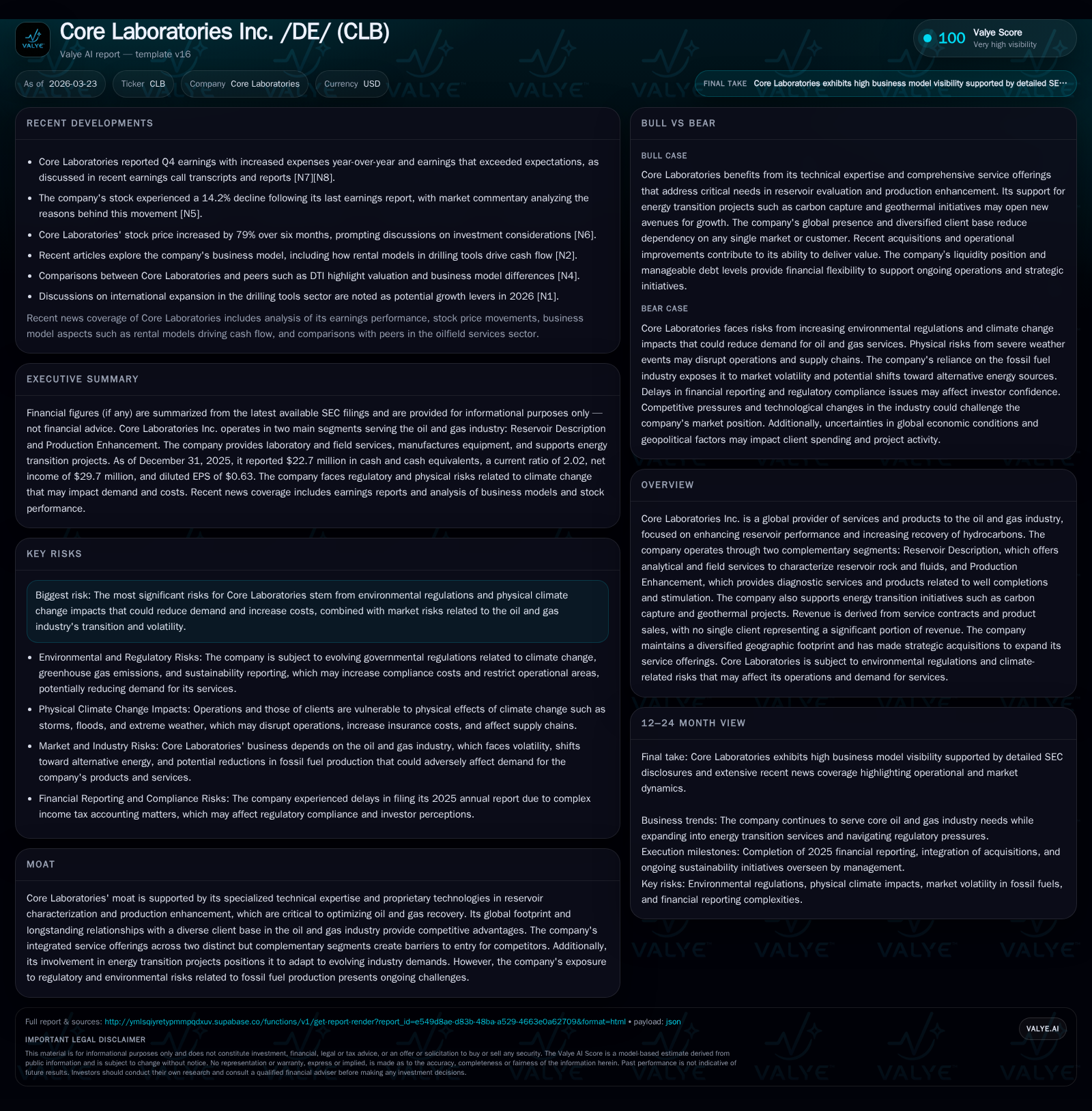
Core Laboratories reported a modest decline in operating income and net income for FY2025, alongside a notable contraction in operating cash flow. The company's dual segments of Reservoir Description and Production Enhancement continue to underpin revenue resilience through specialized technologies and global diversification. Strategic capital allocation has favored increased share repurchases while maintaining consistent dividends amid a conservative leverage profile. Environmental regulations and climate risks loom as headwinds, countered by incremental steps into carbon capture and geothermal project support. Key indicators to watch include drilling tool rental adoption and regulatory impacts on production levels.
Historical Performance Overview: Revenue, Profitability, and Cash Flow Trends
Core Laboratories' fiscal year ending December 31, 2025 showed a nuanced financial performance, layering moderate declines with underlying strengths characteristic of mature oilfield services providers embracing evolving energy demands. Operating income contracted 3.6% from $58.6 million in FY2024 to $56.5 million in FY2025 [F1], while net income followed a similar downward trajectory, decreasing by 5.5% to $29.7 million over the same period [F1]. This erosion reflects margin pressure possibly tied to cost increments or mix shifts despite relatively stable top-line conditions.
More pronounced was the drop in operating cash flow (CFO), which plunged 34.3% year-over-year from $56.4 million down to $37 million [F1]. The sizable reduction compared to the net income dip suggests working capital effects or timing differences in collections/payments that merit close attention going forward. Capital expenditures decreased by approximately 14% from $13 million in FY2024 to $11.2 million in FY2025 [F1], indicating a modest pullback consistent with broader industry capital discipline.
Despite these declines, Core Labs maintained positive free cash flow (FCF) of roughly $25.8 million (CFO minus capex) underpinning ongoing reinvestment capability and shareholder distributions [F1]. Such cash generation remains critical for technology-driven service companies within capital-intensive reservoirs characterization niches.
Historical performance (annual)
| FY | Net ($mm) | CFO ($mm) | OpInc ($mm) | Capex ($mm) | Net YoY |
|---|---|---|---|---|---|
| 2025 | 30 | 37 | 56 | 11 | -5.5% |
| 2024 | 31 | 56 | 59 | 13 | -14.4% |
| 2023 | 37 | 25 | 55 | 11 |
Source: SEC companyfacts cache [F1].
Capital returns and efficiency (annual)
| FY | Div ($) | Buybacks ($mm) | FCF ($mm) |
|---|---|---|---|
| 2025 | 1869000 | 12 | 26 |
| 2024 | 1876000 | 5 | 43 |
| 2023 | 1868000 | 2 | 14 |
Source: SEC companyfacts cache [F1].
*Revenue not explicitly reported [F1].
Segment Analysis: Reservoir Description and Production Enhancement Contributions
Core Laboratories operates primarily across two synergistic segments: Reservoir Description and Production Enhancement [S10]. The former specializes in laboratory-based analyses of reservoir rock and fluids—critical inputs for optimizing hydrocarbon recovery—leveraging proprietary technologies that form part of its competitive moat [N2][S10]. Services extend beyond traditional hydrocarbons into energy transition domains such as carbon capture utilization and storage (CCUS), geothermal exploration support, and mineral resource evaluation vital for battery storage materials like lithium.
Production Enhancement centers on diagnostic services related to well completion effectiveness and stimulation optimization—a domain increasingly relying on advanced diagnostic well stimulation technologies that offer real-time insights into reservoir performance enhancements [N1][S7]. Integration between these segments enables cross-selling leveraging detailed reservoir analytics combined with field diagnostics.
This combination positions Core Labs well to serve their upstream oil & gas clients who demand precision in both fluid characterization and effective well stimulation strategies amidst fluctuating commodity environments.
Geographic Revenue Composition and Market Exposure
Geographically diversified revenues underpin Core Labs’ risk mitigation strategy with approximately one-third sourced from U.S.-based operations ($175 million revenue FY2025), while other countries contributed about two-thirds ($351 million) [S7][F1]. This bifurcation provides exposure balancing mature domestic markets against higher-growth international fields.
Property Plant & Equipment (PPE) investments also reflect this geographic duality: PPE net at ~$44 million within the U.S., contrasted with ~$56 million abroad suggesting an expanding footprint outside North America to capture service demand linked to global exploration activities [S7]. Service revenues are booked according to location of performance rather than project origin clarifying operational concentration metrics.
However, this diverse geographic presence also implies varying degrees of regulatory environments—U.S regulators focusing aggressively on environmental compliance juxtaposed against emerging markets where social license around fossil fuels may fluctuate rapidly—a dynamic requiring careful governance of local operational risks.
Capital Structure, Debt Profile, and Liquidity Position
Core Labs finalized repayment of its January 12, 2026 maturity for the 2021 Senior Notes Series A worth $45 million by tapping into its revolving credit facility drawing down a delayed draw term loan (DDTL) for $50 million as of January 12th [S4][S5]. This proactive refinancing maintained manageable leverage metrics with total debt outstanding at approximately $113 million net of issuance costs at year-end versus equity totaling roughly $266 million [F1][S4].
The company maintains conservative bank covenants including an interest coverage ratio minimum of 3x and leverage capped at 2.50x EBITDA; actual leverage stood well below this ceiling at circa 1.10x as of December 31st, 2025 [S6]. Interest coverage was robust at nearly eight times EBITDA enhancing flexibility amid interest rate uncertainty given mix of fixed-rate senior notes (interest rates ranging ~4%-7%) plus variable rate credit facility priced at SOFR plus spread [S4][S6].
Liquidity is fortified by approximately $136 million available borrowing capacity after considering outstanding letters of credit providing ample working capital coverage for ongoing operations including capex investment ramp-ups aligned with strategic priorities [S5][S6].
Capital Allocation Priorities: Dividends, Buybacks, and Capex Decisions
Core Laboratories presents a disciplined capital deployment framework geared towards consistent shareholder returns alongside strategic reinvestment into proprietary capabilities [F1][S9][S13]. Return on equity stands near 11.2%, reflecting moderate profitability given industry cyclicality [F1].
The company sustained dividend payments steady at around $0.01 per share quarterly translating to roughly $1.87 million annually over consecutive years including FY2025—emphasizing reliability despite market fluctuations [F1][S9]. Notably buyback activity accelerated markedly during FY2025 with repurchases totaling about $12.4 million versus approx. $5.3 million the prior year—underscoring management’s commitment to capital return even as earnings experienced pressure [F1][S13].
Capital expenditures moderated from the previous peak but remained elevated relative to earlier years (~$11M in FY2025), focused primarily on maintaining technological differentiation in reservoir characterization equipment and field diagnostics tools that are vital for sustaining competitive edge [F1][S15].
Environmental and Regulatory Risks Impacting Demand and Operations
Regulatory landscapes pose significant challenges as Core Labs navigates between legacy fossil-fuel markets and emerging environmental imperatives [S1][S22][S24]. The company acknowledges exposure to evolving climate-related regulations including compliance costs stemming from GHG cap-and-trade frameworks, carbon taxes and related reporting mandates motivated by accords like the Paris Agreement or regional laws such as the European Climate Law.
Physical climate risks—including increased storm intensity or drought conditions—also threaten operational continuity directly via asset impact or indirectly through insurance premium inflation [S1][S24]. Political pressures manifest through potential restrictions or delays on client projects reinforcing uncertainty around demand longevity within traditional hydrocarbon sectors.
Litigation risks coupled with stakeholder activism further compound this environment requiring adaptive risk management strategies that reconcile fossil fuel reliance with decarbonization trajectories.
Strategic Initiatives Supporting Energy Transition Adaptation
Core Laboratories has incrementally extended its portfolio into areas aligned with global energy transition trends [N2][N7][S1]. Participation in carbon capture utilization/storage services addresses clients’ needs for emissions mitigation technology validation while geothermal project evaluations form early-stage diversification consistent with broader decarbonization efforts within energy infrastructure.
These activities are nascent relative to core revenue streams but function strategically as hedges against declining hydrocarbon demand scenarios while leveraging existing technical expertise in subsurface analysis—a natural extension enabling gradual repositioning without wholesale disruption of established business lines.
Outlook: Key Indicators to Monitor and Potential Growth Catalysts
Absent explicit forward guidance beyond standard regulatory disclosures [N2], key developments warrant diligent observation:
- Adoption rates for drilling tools rental models—which enhance operational cash flow by shifting CAPEX burdens onto clients—represent critical signs of competitive positioning efficacy within Production Enhancement services [N1].
- Regulatory reforms impacting client production volumes will directly influence order books for reservoir characterization services requiring agile response capabilities.
- Management’s capital allocation shifts toward buybacks or reinvestment could presage confidence levels regarding near-term stabilization or growth inflections.
- Post-earnings share price volatility (-14.2%) following earnings calls contrasts starkly with a prior six-month gain (~79%), illustrating cyclical sentiment swings common in oilfield services sectors reliant on upstream capital spending patterns.[N2][N7]
Continued monitoring of environmental policy evolutions alongside technological innovation advances remains prudent for appreciating Core Laboratories’ trajectory within an increasingly complex energy landscape.
This analysis synthesizes publicly filed financial data along with regulatory disclosures without offering investment recommendations or price forecasts. All figures adhere strictly to audited reporting periods through FY2025 per SEC filings.
Disclaimer: This is research-only, informational analysis and not investment advice. It may include AI-generated interpretation and general industry context. Always verify important details using primary sources.

Comments