
Home Depot's Path from Strength to Selective Reinvestment
Home Depot leverages its dominant market position while recalibrating investments to sustain growth amidst evolving market dynamics.
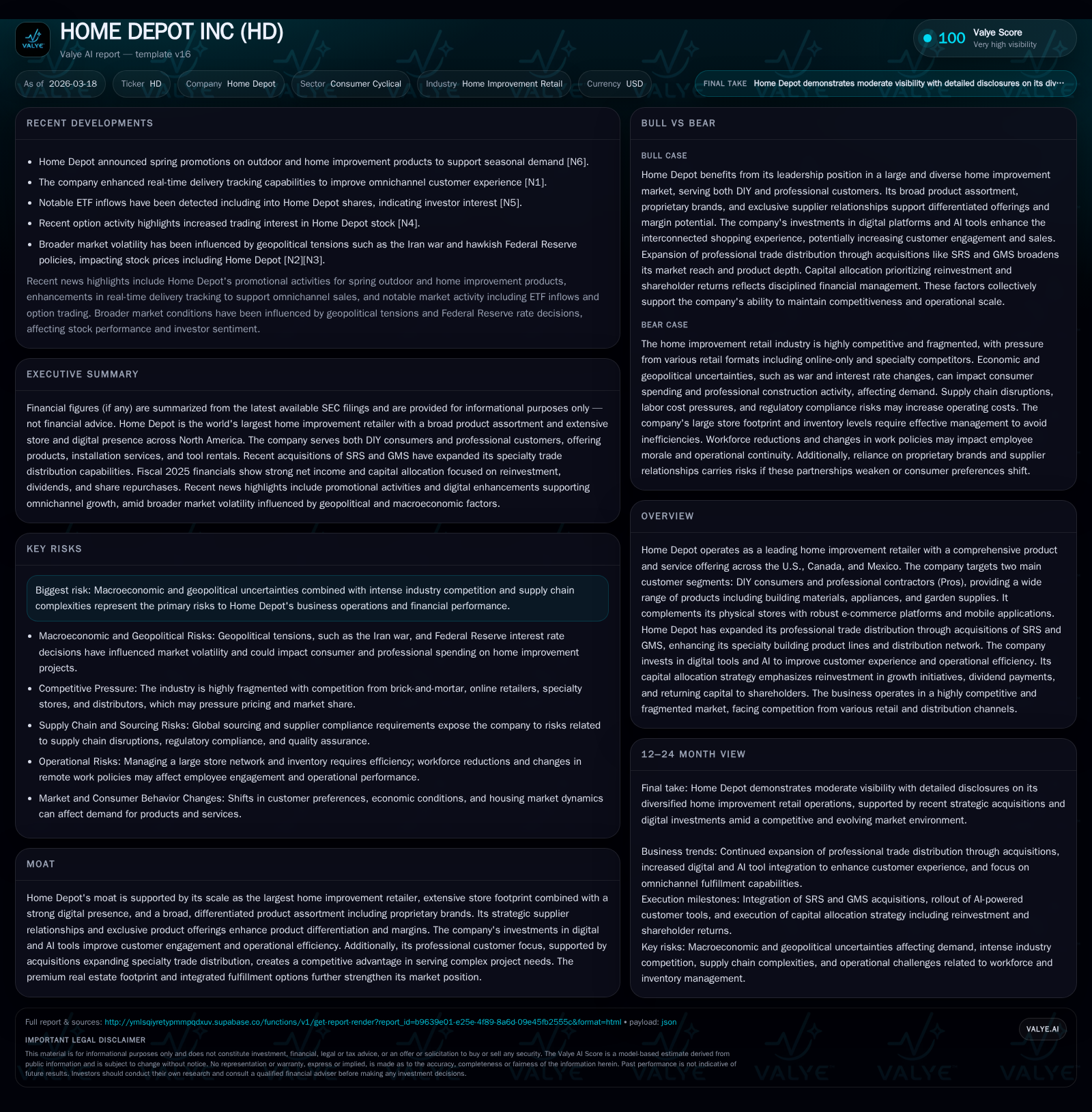
Home Depot remains the largest home improvement retailer, underpinned by a vast store network and accelerated professional trade expansion through strategic acquisitions of SRS and GMS. Recent years have shown moderation in earnings growth with slight declines in operating and net income, driven by competitive pressures and macroeconomic uncertainties. The company is investing selectively in digital transformation and supply chain capabilities to enhance its interconnected customer experience. Capital allocation prioritizes reinvestment, dividend growth, and has paused buybacks to navigate the current environment.
Historical Growth Trajectory and Evolving Drivers
Home Depot has solidified its market leadership as the largest home improvement retailer based on net sales for FY2025, serving a diverse customer base across the U.S., Canada, and Mexico through 2,359 stores averaging over 104,000 square feet each [S10]. Financially, revenue has remained robust though operating income has recently softened; FY2025 operating income declined 3% to approximately $20.9 billion from $21.5 billion in FY2024 [F1]. Net income similarly fell by 4.4% year-over-year to about $14.2 billion [F1]. The moderation contrasts with prior years where operating income grew steadily — $24 billion in FY2022 down through FY2023–FY2025 declines — reflecting challenges including inflationary cost pressures and intensified competition.
These financial shifts align with business model evolutions emphasizing both expansion in product assortment and targeted acquisitions enhancing specialty trade distribution. The purchases of residential specialty distributor SRS (FY2024) followed by GMS (FY2025), which offer products like roofing materials, pool supplies, drywall, ceilings, and steel framing have been instrumental in diversifying offerings particularly for professional contractors (Pros) [S4][S10]. This strategy contributes to steady revenue streams less correlated with consumer DIY cycles.
Historical performance (annual)
| FY | Net ($bn) | CFO ($bn) | OpInc ($bn) | Capex ($bn) | Net YoY |
|---|---|---|---|---|---|
| 2025 | 14.2 | 16.3 | 20.9 | 3.7 | -4.4% |
| 2024 | 14.8 | 19.8 | 21.5 | 3.5 | -2.2% |
| 2023 | 15.1 | 21.2 | 21.7 | 3.2 | -11.5% |
| 2022 | 17.1 | 14.6 | 24.0 | 3.1 |
Source: SEC companyfacts cache [F1].
Capital returns and efficiency (annual)
| FY | Div ($bn) | Buybacks ($bn) | FCF ($bn) |
|---|---|---|---|
| 2025 | 9.2 | 0.0 | 12.6 |
| 2024 | 8.9 | 0.6 | 16.3 |
| 2023 | 8.4 | 8.0 | 17.9 |
| 2022 | 7.8 | 6.7 | 11.5 |
Source: SEC companyfacts cache [F1].
Note: Revenue figures omitted per source data constraints; capex increase reflects strategic reinvestments.
The Professional Customer Base: Strategy and Expansion
The 'Pros' segment represents a cornerstone for Home Depot's resilience amid cyclical consumer spending fluctuations [S4]. This group encompasses renovators/remodelers, contractors across specialties such as roofing, landscape, plumbing, painting, as well as property managers servicing multifamily or institutional buildings.
Home Depot’s expansion into specialty trade categories via SRS and GMS enables it to provide targeted solutions including interior building products unique to Pros' project-specific demands like steel framing or ceiling systems—a step beyond commodity retailing [S4][S10]. This depth is supported by value-added services such as the Pro Xtra loyalty program which offers preferred pricing tiers, trade credit extensions via Pro Trade Credit programs facilitating cash flow flexibility for large job-lot purchases, alongside dedicated digital project planning tools that streamline order management.
The combination of enhanced fulfillment—leveraging an extensive branch network capable of direct job site delivery—and specialized credit offerings cements a differentiated value proposition difficult for national big-box competitors or local distributors to replicate consistently.
Digital Transformation and Operational Efficiency Initiatives
Complementing physical assets is Home Depot’s commitment to delivering an interconnected shopping experience that integrates both online and offline touchpoints seamlessly [S6]. Investments include AI-driven inventory algorithms balancing stock levels with demand forecasts, enabling better product availability across stores supported by technology enhancements like real-time delivery tracking apps launched recently [N8].
In logistics operations, new freight flow management systems combined with expanded fulfillment centers allow multiple delivery options including same-day service for certain markets [S6][N8]. Initiatives such as FDC Relay leverage existing flatbed distribution centers to extend reach effectively for larger items like lumber or appliances requiring specialized transport.
Digital enhancements also emphasize customer-facing tools within Home Depot’s mobile applications—empowering both DIY users with project help and Pros with complex quote builders leveraging technology models supporting project planning [S25][S26].
Current Challenges and Market Competitive Pressures
Recent geopolitical events such as the Middle East conflict introduce uncertainty into mortgage rates and consumer confidence curves that ultimately impinge on home improvement budgets [N7]. Inflationary pressure compounded by elevated costs throughout global supply chains adds margin compression risk evident in reported profit declines despite maintained top-line levels [N12][F1].[S2]
Competition intensifies particularly from digitally-native retailers expanding omni-channel capabilities, heightening price transparency as consumers compare offers instantaneously online [S6]. Seasonal cyclicality remains relevant; spring quarters generate peak sales volumes but fluctuations in discretionary spending further require agility in inventory management.
Capital Allocation Framework and Financial Returns
Home Depot’s capital allocation principles prioritize reinvestment first to sustain competitive advantage—demonstrated by a meaningful increase in capex to $3.7 billion (+5.6% YoY) focusing on store upkeep, technology platforms supporting Pro segment growth, and supply chain automation projects supporting efficiency gains [F1][S7].
Dividend policy continues steady trajectory with quarterly payouts increased by approximately 2.2% during fiscal year ending February 2026 resulting in $9.15 billion distributed to shareholders—underscoring disciplined shareholder return amid uncertain economic backdrop [F1][S7]. Buybacks were notably suspended this fiscal year compared with prior repurchase activity ($649 million spent FY2024 versus zero FY2025), indicating prudent cash use given external uncertainties.
Calculated ROE exceeds an extraordinary ~110%, highlighting efficient capital deployment even as revenue growth moderates; ongoing reinvestments aim to sustain this level over time while balancing shareholder returns [F1].
Near-Term Outlook and Key Milestones to Monitor
Looking ahead into fiscal Q2—typically Home Depot’s strongest seasonal quarter reflecting spring home projects—metrics on same-store sales trajectory will be critical to confirming customer demand resilience alongside supply chain responsiveness around peak periods [N6][S26].
The operational integration of SRS/GMS specialized channels will be an important gauge of expanded Pro ecosystem scale benefits realized from synergies in distribution networks and product breadth expansion.
Further indicators include adoption rates of new AI-enabled tools impacting project quoting efficiency; effectiveness here could deepen Pro loyalty while expanding wallet share per customer.
Analyst commentary highlights downside near-term risks tied to macroeconomic volatility but maintains confidence in long-term structural advantages Home Depot holds given scale and digital investments [N9].
Conclusion: Maintaining the Leadership Edge
Home Depot commands a resilient franchise forged through the breadth of its scale—a multi-thousand location footprint complemented by unmatched digital sophistication creating an interconnected shopping experience tailored closely to evolving customer needs—from homeowners embarking on DIY projects to demanding professional contractors managing complex renovations.
The company’s moat is sustained not only by proprietary branded assortments driving margin differentiation but also through high-touch professional services investment including credit solutions, job-lot purchasing capabilities, industry-leading delivery options enabled via strategic fulfillment centers alongside technological innovation.
Amid macroeconomic headwinds rooted partly in geopolitical instability and inflationary environments impacting consumption patterns, Home Depot pursues selective reinvestment strategies aimed at digital advancements and supply chain optimization while balancing shareholder returns conservatively via dividend hikes prioritized over buybacks presently.
This calibrated approach suggests management intent on preserving long-term market leadership rather than maximizing short-run gain amidst uncertainty—a disciplined rhythm unveiled clearly through recent results and strategic disclosures.
Disclaimer: This is research-only, informational analysis and not investment advice. It may include AI-generated interpretation and general industry context. Always verify important details using primary sources.

Comments