
EBR Systems Advances Leadless CRT Despite Early Commercial Hurdles
EBR Systems embarks on commercial rollout of its pioneering leadless cardiac resynchronization therapy device while managing regulatory mandates and financial pressures.
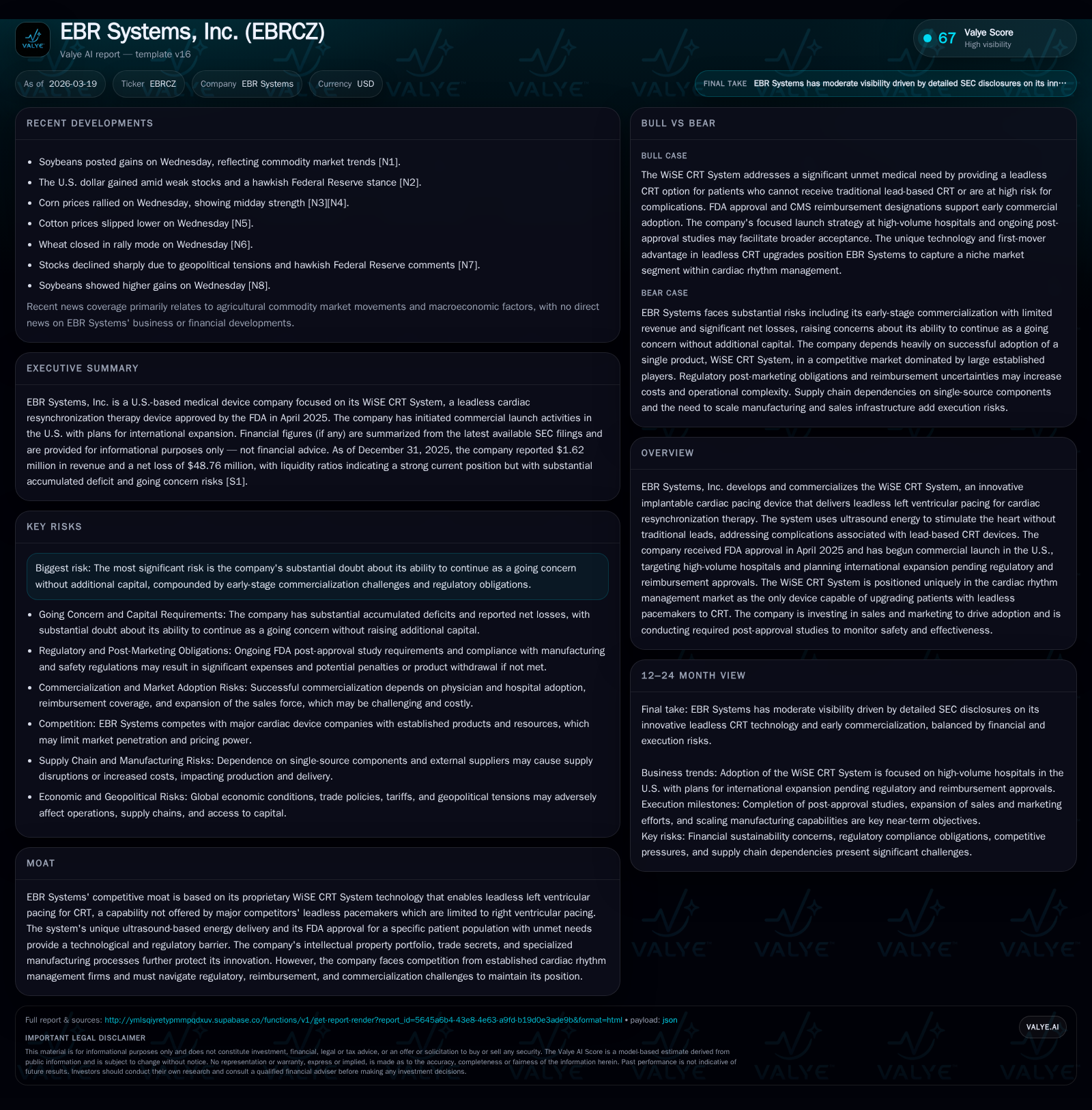
EBR Systems has introduced the WiSE CRT System, an innovative leadless left ventricular pacing technology that received FDA approval in April 2025 and began U.S. commercialization targeting specialized patient segments. Despite technological differentiation and reimbursement progress, the company reports growing operating losses and substantial cash outflows typical of early-stage medtech commercialization. Regulatory post-approval commitments and capital constraints present significant challenges as EBR seeks to scale adoption domestically and expand internationally in select markets. Monitoring of clinical study enrollment, sales execution, and funding adequacy remains critical for near-term value realization.
Technology Innovation and Market Position: The WiSE CRT System’s Unique Edge
EBR Systems’ flagship product, the WiSE CRT System, embodies a breakthrough in cardiac rhythm management (CRM) by delivering leadless left ventricular pacing for cardiac resynchronization therapy (CRT). Unlike conventional systems reliant on transvenous leads — which are recognized as the primary cause of device failure — WiSE employs ultrasound energy to stimulate endocardial heart tissue without leads [S1][S14]. This novel mechanism permits CRT upgrades for two core patient groups: those previously untreatable due to unsuccessful or disabled coronary sinus leads, and "high risk upgrades" with contraindications to traditional CRT procedures [S1][S19].
The system integrates an implantable electrode placed in the left ventricle, a subcutaneous ultrasound transmitter powered by a battery, a co-implanted right ventricular pacing device (to sense pacing spikes), and a programmer for control [S1][S26]. Its compatibility with existing leadless right ventricular pacemakers enables fully leadless biventricular pacing — unique in the CRM field given established leadless devices primarily target right ventricular pacing only [S14][S15]. This technology not only addresses the inherent limitations of lead-based devices but also opens opportunities to reduce complications linked to lead failure.
The FDA’s April 11, 2025 PMA approval for use in adults meeting specific indications anchored EBR’s regulatory moat while validating safety and efficacy demonstrated notably in trials such as SOLVE-CRT [S1][S19]. This clearance positioned WiSE as the sole device providing a leadless upgrade pathway to CRT in complex patients. However, while disruptive technically, regional payor acceptance drives commercial viability alongside clinical endorsement.
Historical Financial Performance: Operating Losses Amid Revenue Initiation
The company remains in an early commercial phase marked by nascent revenues juxtaposed against significant expenditures tied to development, regulatory compliance, and market entry. Fiscal year 2025 revenue reached approximately $1.62 million following the product launch [F1]. While modest top-line growth evidences initial commercialization traction, operational metrics reveal intensified losses: operating income fell from -$38.3 million in FY2024 to -$46.1 million in FY2025 (a 20% decline), with net income deteriorating similarly from -$40.8 million to -$48.8 million [F1].
Cash outflows from operations expanded markedly to -$53.2 million (a near 30% worsening year-over-year), reflecting scaling efforts including sales infrastructure ramp-up and ongoing R&D [F1]. Concurrently, capital expenditures sharply increased over twelvefold from ~$273k to $3.68 million as EBR invested in manufacturing capabilities [F1][S15][S17]. This capex spike implies strategic intent to address production scale but exerts pressure on cash reserves.
Equity rose slightly from $24.4 million to $25.6 million across the period; however, negative net income against this base yields a severely adverse return on equity nearing -191%, consistent with early-stage medtech commercialization where upfront investments predominate prior to profitable inflection [F1]. Liquidity metrics remain adequate with a strong current ratio exceeding 5x due partly to working capital build-out though cash balances are limited at $5.8 million year-end [F1].
Historical performance (annual)
| FY | Net ($mm) | CFO ($mm) | OpInc ($mm) | Capex ($mm) | Net YoY |
|---|---|---|---|---|---|
| 2025 | -49 | -53 | -46 | 4 | -19.5% |
| 2024 | -41 | -41 | -38 | 0 |
Source: SEC companyfacts cache [F1].
Capital returns and efficiency (annual)
| FY | Buybacks ($mm) | FCF ($mm) | ROE% |
|---|---|---|---|
| 2025 | 1 | -57 | -190.6 |
| 2024 | 4 | -42 | -167.5 |
Source: SEC companyfacts cache [F1].
Operating losses increased alongside incremental revenue initiation reflecting typical early operational leverage challenges.
Launch Momentum: FDA Approval and Initial Commercial Efforts in Key U.S. Hospitals
Following FDA premarket approval in Q2 2025, EBR Systems undertook an initial soft launch targeting select trial sites from its pivotal SOLVE-CRT study [S25]. The Limited Market Release (LMR) began October 1, 2025 focusing on high-volume U.S. hospitals known for electrophysiology expertise, leveraging relationships from clinical trial sites for streamlined patient identification and procedural training [S25]. Early enrollment into mandated post-approval studies coincided with procedure rollouts supporting clinical data generation alongside real-world use validation.
The company emphasized building dedicated sales teams trained specifically on WiSE’s benefits relative to conventional CRT upgrades which target a niche subset of patients typically underserved by standard technologies [S17][S25]. Adoption challenges stem from physician awareness gaps given procedure complexity and relatively small eligible populations initially—translating into gradual site penetration.
Anticipation surrounds a planned broader full market release slated for H2 2026 that aims to extend geographical reach within established accounts while onboarding new hospital customers via scaled marketing efforts [S25]. Salesforce expansion is central to these plans although patient case volumes per center will be critical levers impacting revenue ramp speed.
Regulatory Commitments and Post-Marketing Surveillance: Risks and Opportunities
EBR is obligated under FDA PMA conditions to conduct a comprehensive prospective post-approval study enrolling approximately 320 patients across multiple centers by December 2027 [S2][S6][S11]. Known as the WiSE System Utilization and Performance Registry (WiSE-UP), this observational registry tracks acute and long-term outcomes including device safety endpoints such as rates of serious adverse events related to implantation or device function over up to five years post implant [S11]. Failure to meet enrollment targets or demonstrate acceptable safety profiles could trigger withdrawal of approval or necessitate label changes impacting market positioning.
Initial enrollments commenced late Q4 2025 at prominent centers including St. Bernards Heart & Vascular Center under leading electrophysiologists [S11]. Monitoring endpoints span procedural success rates, heart failure functional status assessments like NYHA classification changes, mortality measures along with device longevity data—which collectively inform ongoing risk-benefit evaluations essential for physician confidence.
Maintaining cGMP compliance across manufacturing processes plus adherence to extensive post-market reporting obligations amplify operational overheads but solidify FDA relations ensuring sustainable market access [S6][S7][S10]. These regulatory engagements also carry reputational stakes where any adverse safety signals could hinder clinician adoption or invite litigation risks.
Future Growth Outlook: Expansion Plans, Adoption Challenges, and International Markets
Looking ahead, EBR plans measured geographic expansion beyond U.S. soil targeting regions like Australia, the UK, and European Union subject to additional local regulatory approvals and reimbursement framework establishment [S13]. Each jurisdiction presents distinct payer landscapes influencing coverage timing which remains a gating factor for international commercial rollout.
Domestically, growth drivers hinge upon accelerating physician familiarity with leadless CRT upgrade utility coupled with increasing procedural volumes at existing high-volume centers through workflow optimization strategies initiated during LMR phase [S25]. The recent CMS New Technology Add-On Payment (NTAP) scheme effective October 2025 provides favorable incremental reimbursements up to $41k supplementing standard Diagnosis Related Group (DRG) payments easing hospital cost burdens during early adoption periods—a crucial facilitator given historic reimbursement delays impairing novel device launches [S18]. Complementary outpatient Transitional Pass-Through coverage further supports flexible care settings enhancing device appeal.
Competition remains formidable from entrenched CRM giants Medtronic, Boston Scientific, and Abbott who possess extensive portfolios of right ventricular leadless pacemaker systems but lack an analogous solution offering left ventricular leadless pacing required for CRT upgrade indication addressed exclusively by WiSE [S14]. This unique competitive position affords potential premium pricing power but also necessitates continued differentiation investing heavily into clinical advocacy.
Capital Allocation Analysis: Cash Flow Dynamics, Investment Priorities, and Buybacks
EBR’s capital deployment underscores intensive R&D spend coupled with salesforce scaling concurrent with early production capacity investments reflected in capex expansions surpassing $3.6 million in FY2025 compared with under $300k prior year [F1][S15][S17][S26]. These efforts have generated heightened negative operating cash flows reaching over $53 million exacerbating liquidity depletion despite moderate equity base growth.
Interestingly, despite cash burn profiles indicative of typical pre-profit-cycle biopharma/medtech startups there has been limited share repurchase activity—with about $900k spent on buybacks during FY2025 down significantly from prior year levels suggesting capital preservation considerations amid constrained resources rather than aggressive capital returns policy at this stage [F1][S29].
This usage profile aligns with reported going concern disclosures highlighting dependency on fresh financing rounds or partnerships to support ongoing commercialization ambitions without disrupting operational continuity [S8][S23]. Return metrics emphasize acute investor caution signals with ROE approximated near negative 190% emphasizing retention over distribution.
Risk Factors Impacting Value: Liquidity Concerns and Competitive Pressures
The company openly acknowledges substantial doubt about its ability to continue as a going concern absent timely access to additional funding sources driven partly by elevated cash consumption amid slow revenue build phases integral to device commercialization life cycles [S23]. Global macroeconomic uncertainties alongside intensifying trade disputes inject further uncertainty over supply chain resilience or cost escalations especially given reliance on key single-source components such as proprietary piezoelectric crystals sourced purchase order-based without formal supplier agreements introducing supply risk vulnerabilities noted in filings [S26].
Regulatory compliance risks are non-trivial given rigorous post-marketing surveillance commitments along with GMP/GCP/GLP adherence required continuously or risk marketing authorization loss which would materially impair business prospects [S6][S7][S10]. Cybersecurity governance performed actively at board audit committee level aims at minimizing exposure yet any breach could yield operational disruptions or reputational damage compounding existing headwinds amid competitive pressure from multinational CRM incumbents expanding their leadless pacing portfolios nationally/internationally limiting share gains opportunity margins intensely contested ultimately influencing valuation perceptions negatively [S5][S20].
What to Watch Ahead: Milestones, Data Updates, and Commercial Execution
Going forward critical indicators include enrollment momentum within the FDA-mandated post-approval registry scheduled through December 2027—early completion success would de-risk regulatory overhang whereas delays might elevate investor caution [N3][S11]. Monitoring quarterly updates concerning implants per site expansion during full market launch phases will clarify adoption velocity helping calibrate revenue forecasts absent explicit guidance presently available publicly [N1]. Additionally, progress toward securing reimbursement frameworks beyond NTAP/TPT for durable coverage especially internationally will be determinant for sustainable unit growth across OUS geographies targeted initially including Australia/UK/EU markets pending approvals status updates also merits close attention [S13][S18].
Capital measures such as upcoming financing rounds or potential strategic collaborations would provide vital runway extending resources preserving continued operational capacity premised on execution risk mitigation currently shaped by early-stage investor sentiment fluctuation variability inherent in medtech sector launches lacking confirmed profit cycles.
This analysis synthesizes information solely from public filings including recent SEC reports alongside credible news sources applying domain expertise without extrapolating beyond verifiable data points or providing investment recommendations.
Disclaimer: This is research-only, informational analysis and not investment advice. It may include AI-generated interpretation and general industry context. Always verify important details using primary sources.

Comments