
Mountain Lake Acquisition Corp. II’s SPAC Launch and Strategic Growth Framework
MLAA’s seasoned sponsorship and robust capital raise underpin its strategic approach to identifying sustainable business combinations within a rigid timeframe.
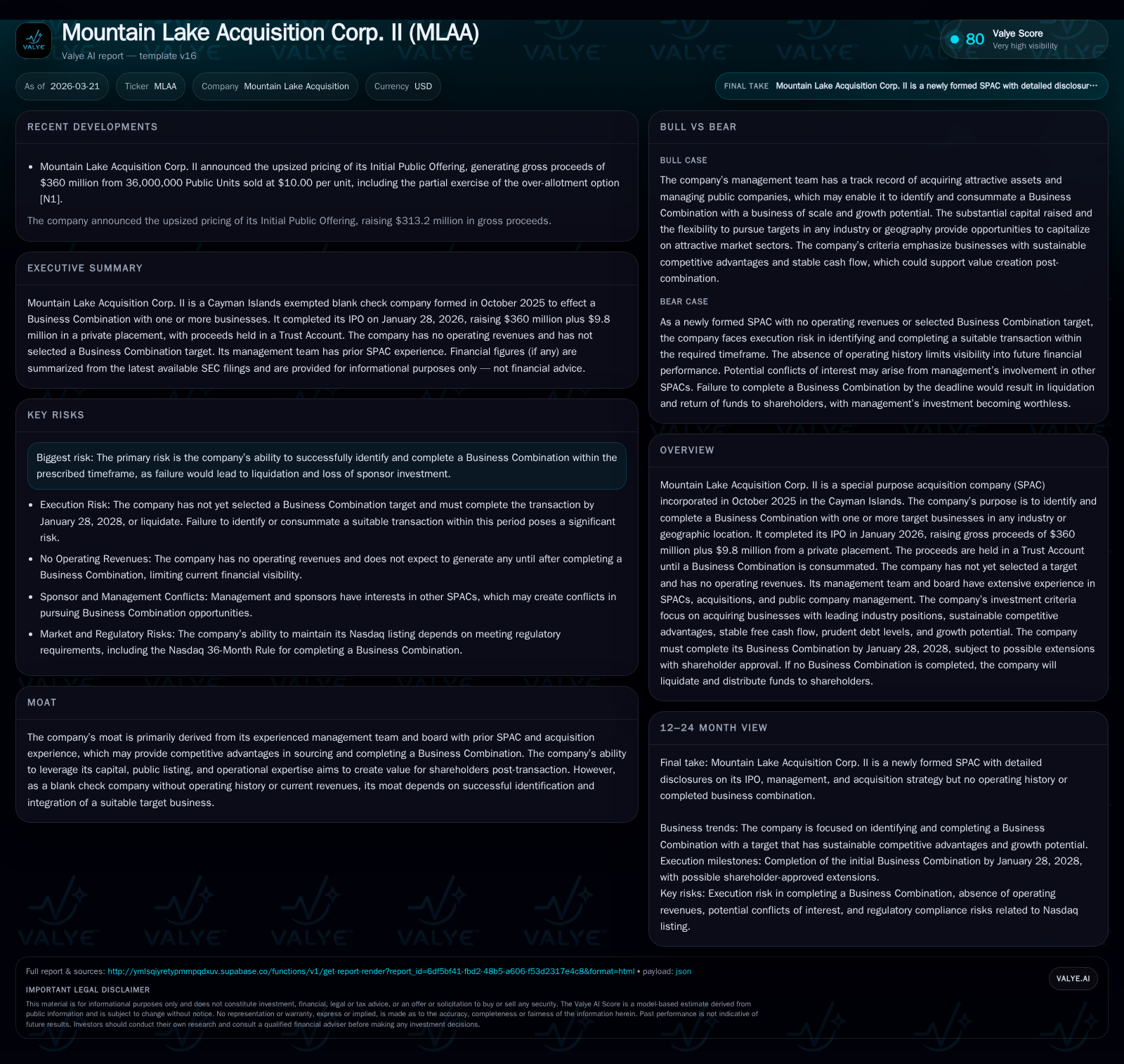
Mountain Lake Acquisition Corp. II (MLAA), incorporated in October 2025 as a Cayman Islands exempted company, completed its IPO in January 2026, raising $360 million plus $9.8 million from a private placement, establishing a strong financial foundation for pursuing an initial Business Combination. The company currently holds no operating revenues or target but leverages a management team with significant prior SPAC experience, focusing on acquiring businesses with durable competitive moats and stable free cash flow. MLAA faces the typical constraints of SPACs, such as the imperative to complete an acquisition within 24 months or face liquidation, making governance structures, capital allocation mechanisms, and sponsor incentives crucial to monitor going forward.
SPAC Formation and IPO Execution: Establishing the Capital Base
Mountain Lake Acquisition Corp. II was incorporated on October 16, 2025 as a Cayman Islands exempted company specifically structured as a Special Purpose Acquisition Company (SPAC). Its foundational purpose is to identify and consummate one or more initial Business Combinations without restriction on industry or geography [S1]. The firm swiftly completed its IPO by late January 2026, issuing 36 million Public Units priced at $10 each—comprising one Class A ordinary share plus half a warrant exercisable at $11.50. The offering generated gross proceeds of approximately $360 million from public investors [S1]. Coupled with a simultaneous private placement of nearly one million units ($9.8 million) bought by the Sponsor and BTIG at same unit price, the total gross cash infusion reached roughly $370 million [S1][S3].
Crucially, all proceeds from both public and private subscriptions were deposited into a Trust Account administered by Continental acting as trustee—ensuring these funds remain secure and solely available for an eventual acquisition or shareholder redemption payments [S1][F1]. This setup exemplifies a fundamental SPAC mechanism designed to preserve investor capital until validated business combination execution.
Absence of Operating History: Challenges and Opportunities Ahead
As expected for a blank check vehicle formed recently in late 2025, Mountain Lake Acquisition Corp. II carries no operating revenues at this stage nor any substantive business operations beyond organizational activities related to its IPO and initial target search efforts [S1]. The company's fiscal year ended December 31, 2025 recorded a net loss of approximately $82 thousand attributable primarily to administrative expenses incurred during startup [F1]. This baseline financial state typifies SPACs prior to Business Combination consummation.
Without operational metrics or income streams, valuation depends entirely on prospective deal execution capability by management and sponsor credibility. Absent acquisition closure within the prescribed timeframe (two years from IPO close), liquidity events triggered would forcibly liquidate remaining funds in Trust Account back to public shareholders at roughly the original unit cost.
Historical performance (annual)
| FY |
|---|
| 2025 |
Source: SEC companyfacts cache [F1].
Limited data reflecting the status at fiscal year-end with no revenues due to SPAC structure.
Acquisition Criteria Anchored in Sustainable Competitive Advantages
The Management Team’s acquisition criteria emphasize long-term durability over transient market opportunities. MLAA seeks businesses that hold or can attain dominant industry positions supported by macroeconomic tailwinds alongside defensible moats difficult for competitors to replicate. These moats may include proprietary technologies, entrenched brand recognition, broad distribution networks, network effects, customer switching costs or territorial exclusivity among others [S4].
Financially, targets should exhibit historically stable free cash flows paired with conservative leverage policies enabling predictable capital management post-combination. Forward-looking visibility on key operational metrics is also stressed to reduce uncertainties surrounding future performance projections [S4]. The Company favors entities whose growth trajectory benefits materially from entering public markets via MLAA’s capital infusion and strategic guidance.
Governance and Sponsor Incentives: Aligning Interests for Success
Governance structures are designed to align incentives between sponsors, management, and public shareholders while navigating potential conflicts inherent in SPAC arrangements. The Sponsors hold Founder Shares acquired at a nominal price prior to IPO that convert into equity post-Combination providing substantial upside if value creation occurs [S5][S6]. They also invested alongside third parties in Private Placement Units mirroring Public Unit terms [S27].
While these elements create profit potential for sponsors even if shares trade below $10 post-transaction—thus inciting risks of sponsor-favoring deal decisions—the Company seeks independent fairness opinions for affiliated party transactions to mitigate conflicts [S5]. Furthermore, Sponsor market purchases pre- or post-deal (within regulatory safe harbors such as Rule 10b-18) may occur strategically to bolster transaction success probabilities [S6].
The board comprises seasoned individuals with prior SPAC experience that inform oversight capabilities during target selection and merger structuring phases.
Capital Allocation Dynamics: Trust Account and Shareholder Protections
All funds raised remain deposited in the Trust Account earning interest net of minimal allowable fees until an initial Business Combination closes or the company liquidates [S5][S7].[F1] No dividends or share repurchases have been declared or are planned prior to acquisition completion given lack of operating cash flows.
Shareholders retain strong protections wherein Public Shares can be redeemed upon combination at a per-share redemption price equal to the pro rata Trust Account balance plus accrued interest (less permitted expenses) regardless of how they voted on the deal proposal [S12][S25]. This feature targets mitigation of economic risk when merging with potentially uncertain targets.
The Redemption Process may be executed either through tender offers regulated under Exchange Act rules or proxy solicitations compliant with Regulation 14A depending on transaction specifics decided internally mainly based on timing pressures or regulatory status changes such as foreign private issuer designation—offering flexible mechanisms whilst preserving shareholder recourse options [S9][S22].
Risks in Completing a Business Combination Within Time Constraints
A salient risk factor remains the obligation under MLAA's Amended and Restated Articles of Association to consummate an initial Business Combination no later than January 28, 2028—or face mandatory dissolution and liquidation procedures returning trust funds pro rata but resulting in loss of Sponsor’s Founder Share investment entirely [S1][S14][S16]. This "Combination Period" imposes intense pressure to identify suitable targets amid competitive bidding environments where valuation discipline must balance with timing urgency.
Additional risks stem from potential failure of shareholder approval votes on announced combinations or deteriorating market conditions adversely affecting transaction pricing/funding strategies. Moreover, conflicts arising from Sponsor involvement with multiple concurrent SPAC deals could influence priority setting potentially detracting focus from MLAA's acquisition pipeline integrity unless thoroughly managed through independent director oversight mechanisms [S21].
Outlook and Milestones: Key Dates and Management’s Growth Vision
Following IPO close on January 28, 2026 with capital securely allocated in trust accounts holding approximately $370 million gross proceeds combined (public plus private placements), MLAA has until January 28, 2028 end-date set for structuring agreements definitive enough for signing targeting shareholder meetings/tender offer commencement no later than Q4 calendar year 2027 ([N/A]). Milestones ahead include detailed due diligence completion steps after preliminary target identification plus proxy/tender offer documentation preparation filed with SEC ensuring transparency.
Management articulates an intention to deploy substantial experience drawn from successful prior SPAC transactions emphasizing valuation discipline supported by their deep industry networks geared towards proprietary deal sourcing enhancing likelihood of additive acquisitions generating shareholder value over time after Business Combination closing [S1][S28][S29].
What to Monitor: Indicators of Successful Deal Sourcing and Integration
Given current absence of announced targets—as typical early-stage SPAC status—market participants should watch:
- Timely announcement of preliminary Letter of Intent(s) or Business Combination Agreement(s)
- Independent fairness opinion filings as indications of conflict mitigation steps taken for affiliated deals
- Proxy materials dissemination including comprehensive target disclosures enabling informed shareholder voting decisions
- Redemption request volumes before combination reflecting investor confidence in proposed deal
- Sponsor share purchase activity signaling belief in value creation prospects;
- Any PIPE financing arrangements supporting minimum cash conditions required under merger agreements;
- Progress toward governance enhancements within prospective target companies denoting preparedness for public company responsibilities. This constellation provides real-time visibility into whether Mountain Lake Acquisition Corp. II navigates successfully through intrinsic SPAC risks toward consummating accretive mergers aligned with their stated investment criteria.
This analysis summarizes Mountain Lake Acquisition Corp. II's current state grounded strictly in audited filings dated March 20–21, 2026 without speculative forward-looking projections beyond disclosed management intentions. Given its nascent operational lifecycle typical of SPACs pre-business combination stage, investors should incorporate awareness of structural risks inherent in blank check vehicles including timing pressures and sponsor incentive dynamics when assessing potential future developments.
Disclaimer: This is research-only, informational analysis and not investment advice. It may include AI-generated interpretation and general industry context. Always verify important details using primary sources.

Comments