
AEYE INC Navigates Ongoing Losses and Supply Chain Challenges While Advancing Lidar Technology
AEYE develops AI-driven active lidar sensing platforms targeting automotive autonomy and diverse industrial markets amid continued financial losses and commercialization efforts.
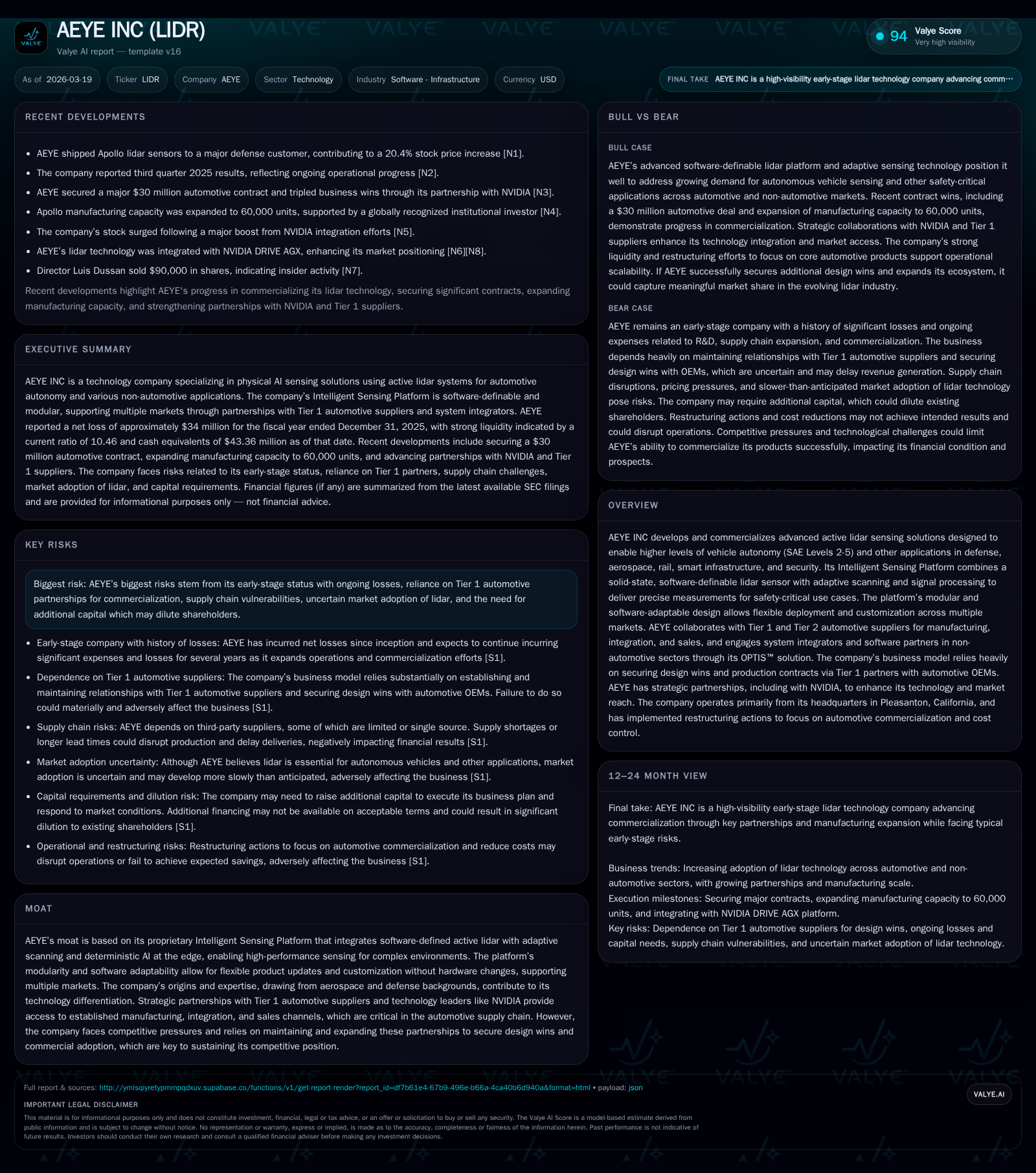
AEYE INC specializes in advanced lidar solutions designed for vehicle autonomy and non-automotive applications. The company’s Intelligent Sensing Platform integrates adaptive scanning with edge-based AI. Despite strategic Tier 1 partnerships and technology progress, AEYE remains an early-stage company with persistent operating losses and negative cash flow. Key risks include supply chain dependencies, market adoption uncertainties related to OEM selections, regulatory compliance, and legal contingencies. Capital-light manufacturing via Tier 1 suppliers reduces capex needs but necessitates ongoing funding to support growth initiatives amid competitive pressures.
Company Overview and Technology Differentiation
AEYE INC develops active lidar solutions focused on advancing driver assistance systems (ADAS) and vehicle autonomy (SAE Levels 2–5). Its core offering is the Intelligent Sensing Platform—a solid-state lidar system featuring software-definable sensing combined with an adaptive SmartScan architecture that dynamically adjusts scan patterns for diverse environments. This platform employs deterministic artificial intelligence processed at the edge to enable precise interpretation of complex physical environments in real time. Founded in 2013 by Luis Dussan—whose background includes aerospace defense targeting systems—the company leverages expertise from NASA, Lockheed Martin, Northrop Grumman, the U.S. Air Force, and DARPA (S12).
The modular design supports hardware longevity through software updates without physical replacements, facilitating deployment across automotive, rail, aerospace/defense, smart infrastructure, and security markets (S12). AEYE’s go-to-market strategy emphasizes securing design wins primarily via Tier 1 automotive suppliers responsible for integration, manufacturing scale-up, OEM relationships, liability management, and warranty support. In non-automotive sectors, AEYE partners with system integrators deploying its OPTIS™ solution combined with third-party perception software for tailored applications.
Historical Financial Performance
As an early-stage enterprise investing heavily in research and commercialization, AEYE has reported consistent operating losses over recent years. Key annual metrics are summarized below [F1]:
Historical performance (annual)
| FY | Net ($mm) | CFO ($mm) | OpInc ($mm) | Capex ($mm) | Net YoY |
|---|---|---|---|---|---|
| 2025 | -34 | -28 | -32 | 0 | +4.2% |
| 2024 | -35 | -27 | -36 | 0 | +59.3% |
| 2023 | -87 | -51 | -88 | 2 | +11.7% |
| 2022 | -99 | -72 | -99 | 4 |
Source: SEC companyfacts cache [F1].
Capital returns and efficiency (annual)
| FY | FCF ($mm) | ROE% |
|---|---|---|
| 2025 | -28 | -41.7 |
| 2024 | -27 | -234.5 |
| 2023 | -53 | -300.2 |
| 2022 | -76 | -105.0 |
Source: SEC companyfacts cache [F1].
FY2025 showed a notable reduction in operating losses compared to prior years attributable partly to workforce restructuring focusing on automotive commercialization while downsizing internal sales teams (S14). Nonetheless, losses remain significant.
Operating cash flows remain negative due to ongoing expenditures supporting product development and certification activities (F1). Capital expenditures have declined markedly since FY2023 indicating a shift toward capital-efficient development phases.
Equity balances have fluctuated substantially year-over-year likely reflecting financing activities or asset adjustments (F1). The current ratio exceeds 10x as of December 2025 indicating solid short-term liquidity despite sustained losses.
Return on equity remains deeply negative at approximately -42%, consistent with recurring net losses relative to equity (calculated from net income/equity using F1 data).
Growth Outlook
Future growth depends primarily on two factors: converting Tier 1 supplier design wins into production contracts with automotive OEMs and expanding non-automotive market deployments through OPTIS partnerships (S12).
Automotive Market:
- Lidar is targeted for enabling advanced driver control features requiring high precision sensing; AEYE focuses on SAE Levels 2 through 5 autonomy segments expected to grow but with variable adoption timing (S12).
- Dependence on Tier 1 suppliers carries execution risk; failure to secure or maintain these relationships could limit production scale opportunities (S1,S2).
- Delays in regulatory approvals or emissions/safety mandates may defer ADAS feature rollouts affecting demand (S17).
Non-Automotive Market:
- OPTIS facilitates customized sensing solutions across railways, aerospace/defense, smart infrastructure, ports, and industrial automation sectors increasingly adopting autonomous sensing.
- Market fragmentation requires selective partnership development; success depends on establishing strong integrator networks.
- Entry into Chinese autonomous trucking/railway segments introduces competition from established local lidar vendors challenging AEYE’s positioning (S23).
Technological Advantages:
- Modular hardware paired with software adaptability supports product longevity amid rapid sensor evolution.
- Edge-based deterministic AI differentiates AEYE’s solutions versus conventional passive lidar or radar-camera fusion systems but demands sustained innovation investment.
Milestones / Expectations
No explicit forward-looking financial guidance was provided in filings [N#][S#]. Key milestones to watch include:
- Conversion rates of design wins into series production contracts via Tier 1 suppliers.
- Expansion of manufacturing capacity through partners addressing supply bottlenecks.
- Progress in OPTIS deployments across target verticals outside automotive.
- Regulatory certifications including FDA laser safety compliance and international vehicle sensor standards.
- Resolution of vendor arbitration and lease settlement reducing contingent liabilities.
Given long product development cycles typical in automotive sensor markets, material commercial ramp-up is expected over multiple years rather than quarters.
Returns / Capital Allocation
AEYE’s returns remain negative due to continued operating losses driven by substantial R&D investments (F1). Improved operating income trends indicate better cost management but positive free cash flow has not been achieved.
Capital allocation favors a capital-light model leveraging Tier 1 supplier manufacturing capabilities which reduces fixed asset investments by AEYE directly (S14). Capital expenditures have decreased sharply post-FY2023 consistent with this approach (F1).
Liquidity remains robust with $43 million cash & equivalents at FY-end 2025 supporting runway amid ongoing losses (F1). Nevertheless, further capital raises may be needed if commercialization timelines extend or working capital needs grow (S14), posing dilution risks given "baby shelf" limitations under SEC rules when public float is low.
No dividends or share repurchases have been reported aligning with typical early-stage reinvestment priorities.
Risk Factors Summary
Principal risks identified include:
- Heavy reliance on Tier 1 supplier relationships; loss or failure to convert design wins threatens revenue prospects (S1,S2).
- Uncertain market adoption pace of lidar technology amid competing sensing modalities may suppress growth potential (S13).
- Supply chain vulnerabilities due to dependence on limited or single-source component suppliers could cause delivery delays or cost increases impacting margins (S1,S23).
- Regulatory compliance complexity spans FDA laser safety laws, environmental regulations regarding materials used in products; non-compliance risks fines or product recalls harming reputation and finances (S4-S6,S11).
- Legal contingencies involve disputed vendor claims (~$3.3 million plus interest) and lease settlements affecting liquidity stability (S7).
- Ongoing need for capital infusions creates dilution risk; SEC "baby shelf" rules may constrain fundraising flexibility when public float is below thresholds (S14).
- Intense competition from established global players including Chinese incumbents challenging AEYE’s market entry efforts (S13,S23).
Conclusion
AEYE INC operates within the active lidar sector distinguished by its deterministic AI-driven sensing platform developed from aerospace heritage expertise. While technological differentiation offers promise across automotive autonomy levels and emerging adjacent verticals via modular adaptable designs allied with system integrators, the company remains financially challenged after more than a decade without profitable operations or positive cash flow generation. Continued dependence on critical industry partners presents both opportunities for scale as well as concentration risk should those relationships weaken. Supply chain fragility compounded by resource-intensive development highlights vulnerability amid global trade uncertainties further magnified by legal exposures involving vendors impacting operational continuity assurances. Given intrinsic uncertainties around autonomous mobility technology adoption timing alongside fierce competitive dynamics shaping pricing norms, investors should closely monitor execution progress through milestones such as design win conversions into volume production coupled with expanding end-market footprints outside automotive paired against liquidity preservation strategies ensuring runway for sustained commercial pursuit.
disclaimer: This analysis does not constitute investment advice or recommendation but aims to provide an objective synthesis grounded exclusively on disclosed corporate filings and reported facts as of March 2026.
Disclaimer: This is research-only, informational analysis and not investment advice. It may include AI-generated interpretation and general industry context. Always verify important details using primary sources.

Comments