
Ovid Therapeutics' Strategic Capital Infusion Bolsters Development of Neuronal Hyperexcitability Treatments
Ovid Therapeutics stabilizes financially through a $60 million financing and advances clinical-stage CNS programs targeting drug-resistant neurological disorders.
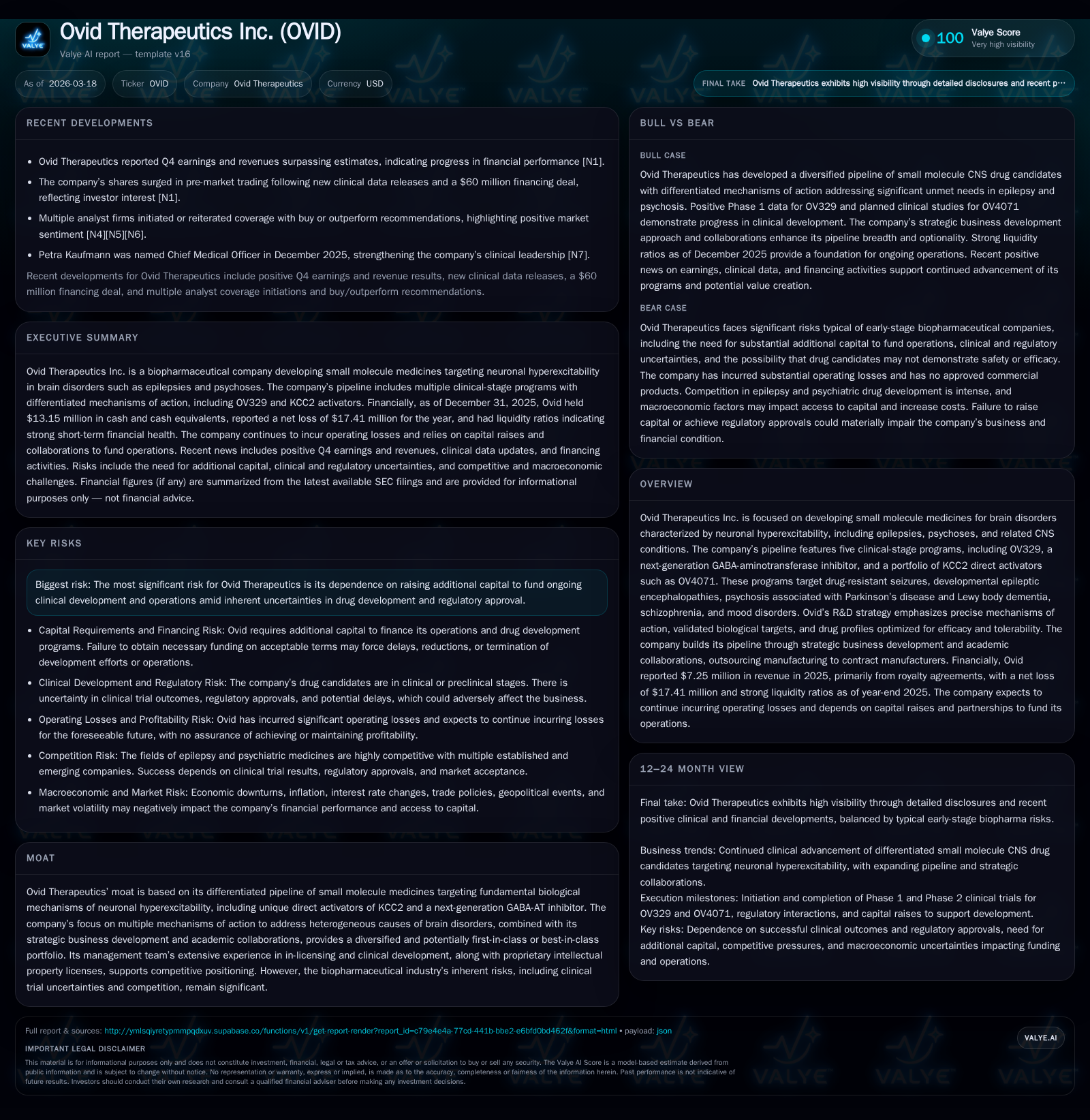
Ovid Therapeutics has shown a marked moderation in its operating losses and net income deficits over the past four years, driven by disciplined expense management amid ongoing investment in its pipeline. The company’s focus on small molecule therapies for neuronal hyperexcitability conditions—including novel GABA-AT inhibitors and KCC2 activators—positions it distinctively within CNS drug development. The recent $60 million capital raise enhances liquidity, providing operational runway to progress key clinical trials and regulatory milestones. Critical risks include continued capital needs and regulatory uncertainties inherent to biopharmaceutical development.
Financial Performance Evolution: From Growing Losses to Moderated Negative Income
Over the four fiscal years ending December 31, 2025, Ovid Therapeutics demonstrated a clear trend of improving financial performance while continuing substantial investment in its developmental pipeline. Operating income losses narrowed from -$55.5 million in FY2022 to -$42.4 million in FY2025, amounting to a 31.4% year-over-year improvement relative to FY2024's deeper loss of -$61.9 million [F1]. Net income mirrored this trajectory with losses reducing sharply by 34.1%, from -$26.4 million in FY2024 down to -$17.4 million in FY2025.
Operating cash flows correspondingly improved with net cash used in operating activities declining from -$55.9 million in FY2024 to -$38.3 million in FY2025, a roughly 31.5% reduction signaling better operational efficiency amidst the early clinical stage progression of multiple projects [F1]. Capital expenditures dropped to zero in FY2025 compared to $71,000 the prior year, emphasizing a strategic reliance on outsourced manufacturing and minimizing fixed asset investments [F1]. The following table encapsulates these key financial trends.
Historical performance (annual)
| FY | Net ($mm) | CFO ($mm) | OpInc ($mm) | Capex ($) | Net YoY |
|---|---|---|---|---|---|
| 2025 | -17 | -38 | -42 | 0 | +34.1% |
| 2024 | -26 | -56 | -62 | 71000 | +49.5% |
| 2023 | -52 | -46 | -59 | 40308 | +3.4% |
| 2022 | -54 | -55 | -56 | 1224379 |
Source: SEC companyfacts cache [F1].
Capital returns and efficiency (annual)
| FY | FCF ($mm) | ROE% |
|---|---|---|
| 2025 | -38 | -13.3 |
| 2024 | -56 | -38.7 |
| 2023 | -46 | -59.6 |
| 2022 | -56 | -41.0 |
Source: SEC companyfacts cache [F1].
Figures based on annual SEC filings [F1]
Drivers behind Historical Operating Trends and Cash Flow Dynamics
The moderation in Ovid’s financial losses reflects a combination of tighter expense control, stabilization of cash burn, and significant noncash accounting adjustments influencing net income comparisons across periods [S1]. For instance, FY2025 benefitted from a notable $21 million unrealized net gain on equity investments impacting other income while the previous year saw a $30 million adverse adjustment related to royalty monetization liability fair value changes [S1][F1].
Research and development expenses remain the cornerstone of the cost base given Ovid’s commitment to advancing clinical programs targeting neurological disorders characterized by neuronal hyperexcitability [S1][S20]. Notably, licensing agreements with third parties such as AstraZeneca, Gensaic, and Northwestern entail contingent milestone payments totaling approximately $660 million—significant future obligations tied to successful development and commercialization events that shape fiscal planning but are excluded from current liabilities due to uncertainty around timing and probability [S1][S23].
Moreover, Ovid’s leasing commitments for its New York headquarters introduce fixed operating expenses amounting to approximately $2.3 million per annum starting January 2023, contributing steadily to overheads but manageable relative to overall expenditure scale [S1].
Pipeline Focus: Small Molecule Therapies Targeting Neuronal Hyperexcitability
At the core of Ovid Therapeutics’ strategic vision is the development of small molecule drugs precisely designed to modulate key biological mechanisms underpinning neuronal hyperexcitability—a hallmark pathophysiological feature implicated across epilepsies, psychoses, and related central nervous system conditions [S1].
The portfolio encompasses five clinical-stage programs prominently featuring OV329, a next-generation GABA-aminotransferase (GABA-AT) inhibitor aimed at reducing drug-resistant seizures by augmenting inhibitory neurotransmission through GABAergic pathways [S1]. Complementing this is an innovative collection of KCC2 direct activators including OV4071 targeting ion channel regulation critical for maintaining neuronal chloride homeostasis—a promising mechanism that could address diverse epileptic encephalopathies and neuropsychiatric symptoms [S1].
This diversified mechanistic approach underscores Ovid’s moat by offering potential first-in-class or best-in-class therapies that could meaningfully address treatment gaps inadequately served by legacy antiseizure medications or antipsychotics which often fail due to tolerability issues or insufficient efficacy [S1]. The scientific rationale aligns with contemporary advancements elucidating genetic mutations affecting transporter function as well as systemic consequences of hyperexcitation such as inflammation and apoptosis [S1].
Implications of Recent Clinical Data Updates and Their Market Impact
On March 18, 2026, Ovid released new clinical data reflecting ongoing progress within its CNS pipeline that resonated positively with investors [N4][N5]. This news coincided with a pre-market trading surge underpinned by excitement around trial readouts indicating potentially enhanced efficacy or safety profiles for lead candidates.
Market participants viewed these results as validation points reinforcing clinical momentum ahead of regulatory submission milestones or pivotal trial completions [N5]. While explicit forward guidance was not provided, this positive sentiment is emblematic of investor confidence buoyed by tangible scientific progress within historically challenging neurotherapeutic domains.
Capital Structure and Liquidity: Details on Recent $60 Million Financing Deal
Strategically timed concurrent with clinical updates was Ovid’s entry into a Securities Purchase Agreement closing March 17, 2026 that raised approximately $60 million through issuance of common stock coupled with pre-funded warrants exercisable for additional shares at set prices [S3]. The transaction involved selling roughly 19 million shares priced at $2.01 apiece alongside warrant instruments designed for reduced upfront purchase price subject to exercise.
This infusion materially bolstered Ovid’s cash position which stood at about $13.2 million at end-FY2025 per financial statements but has since been augmented reflecting proceeds received post-balance sheet date [F1][S23][S3]. Importantly, this capital raise extends operational runway allowing acceleration of trial execution without immediate pressure for near-term dilutive financings.
Pre-funded warrants represent an investor-friendly financing mechanism commonly used when purchasers seek instant ownership at reduced risk combined with flexibility on exercise timing—helping optimize both issuer liquidity needs and investor economics within biopharma fundraising norms.
Future Milestones and Growth Prospects: Clinical Trials and Regulatory Pathways to Watch
Looking ahead, focus centers squarely on progressing pivotal Phase II/III trials especially for OV329 addressing refractory epilepsies where unmet medical need is acute [N1][S1]. Regulatory interactions will be critical junctures encompassing End-of-Phase meetings with FDA or EMA informing final pivotal study designs or label considerations.
Additionally, advancing preclinical-to-clinical transitions for KCC2 activators offers upside optionality given mechanistic novelty expanding therapeutic reach toward neurodegenerative psychoses associated with Parkinson’s disease or Lewy body dementia as indicated internally but lacking explicit scripted timelines currently [S1]. Analysts should monitor publicly disclosed study initiation dates or trial completions communicated via press releases or SEC filings for confirmatory signals.
Risk Analysis: Capital Requirement Challenges and Industry-Specific Regulatory Headwinds
Ovid operates within the inherently high-risk biopharmaceutical sector where drug development timelines are extended and capital intensity is significant [S2]. The critical dependency on securing additional funding periodically remains the principal operational risk—as failure could force delaying or terminating promising programs jeopardizing valuation.
Regulatory complexity extends beyond initial approvals encompassing compliance with complicated healthcare fraud prevention statutes such as the Anti-Kickback Statute, False Claims Act enforcement, HIPAA privacy rules plus emerging state-level mandates affecting data security protocols—a multifaceted mosaic increasing overhead burdens and potential liabilities [S4][S5][S7][S9]. Moreover, intellectual property challenges pose material threat including employee-origin disputes over trade secrets or patent infringement litigation that can consume resources without guaranteed favorable outcomes [S16][S18].
Healthcare reimbursement reforms adding price controls or adjusting Medicare negotiation policies further complicate commercial viability assumptions especially given potential downward pressure on drug pricing frameworks now being actively legislated under recent policy initiatives such as the Medicare Drug Price Negotiation Program [S10][S12]. This evolving regulatory environment necessitates continuous adaptability.
Capital Allocation Overview: Investment in R&D, Absence of Dividends, and Shareholder Returns Prospects
Capital deployment remains predominantly skewed towards sustaining research and development expenditures supporting multiple clinical programs across different modalities emphasized by minimal tangible asset acquisition (zero capex recorded FY2025) evidencing reliance on contract manufacturing organizations rather than internal facilities expansion [F1][S20].
No dividends have been declared historically nor any buybacks executed consistent with standard practice for early-stage biopharma firms prioritizing reinvestment over shareholder returns during product maturation phases—reflected also by approximate negative return-on-equity ratio of -13.3% based on last reported net loss divided by shareholder equity at year-end 2025 [F1].
Total equity increased notably from about $68 million end-2024 to $131 million end-2025 largely attributable to recent equity financing inflows which alleviate balance sheet stress enabling focused progression along long clinical timelines requiring significant upfront costs before commercial revenue realization is feasible.
This report is intended solely for informational purposes regarding Ovid Therapeutics Inc.'s financial performance and operational context within the neurology-focused biotech sector as derived from verified sources including SEC filings and publicly available news reports as of March 18, 2026.
Disclaimer: This is research-only, informational analysis and not investment advice. It may include AI-generated interpretation and general industry context. Always verify important details using primary sources.

Comments