
Core Scientific Shrinks Revenue While Boosting Cash Flow Amid AI Colocation Pivot
The company’s financials reveal sharp revenue contraction alongside heavy investment for its transition from crypto mining to AI data center services.
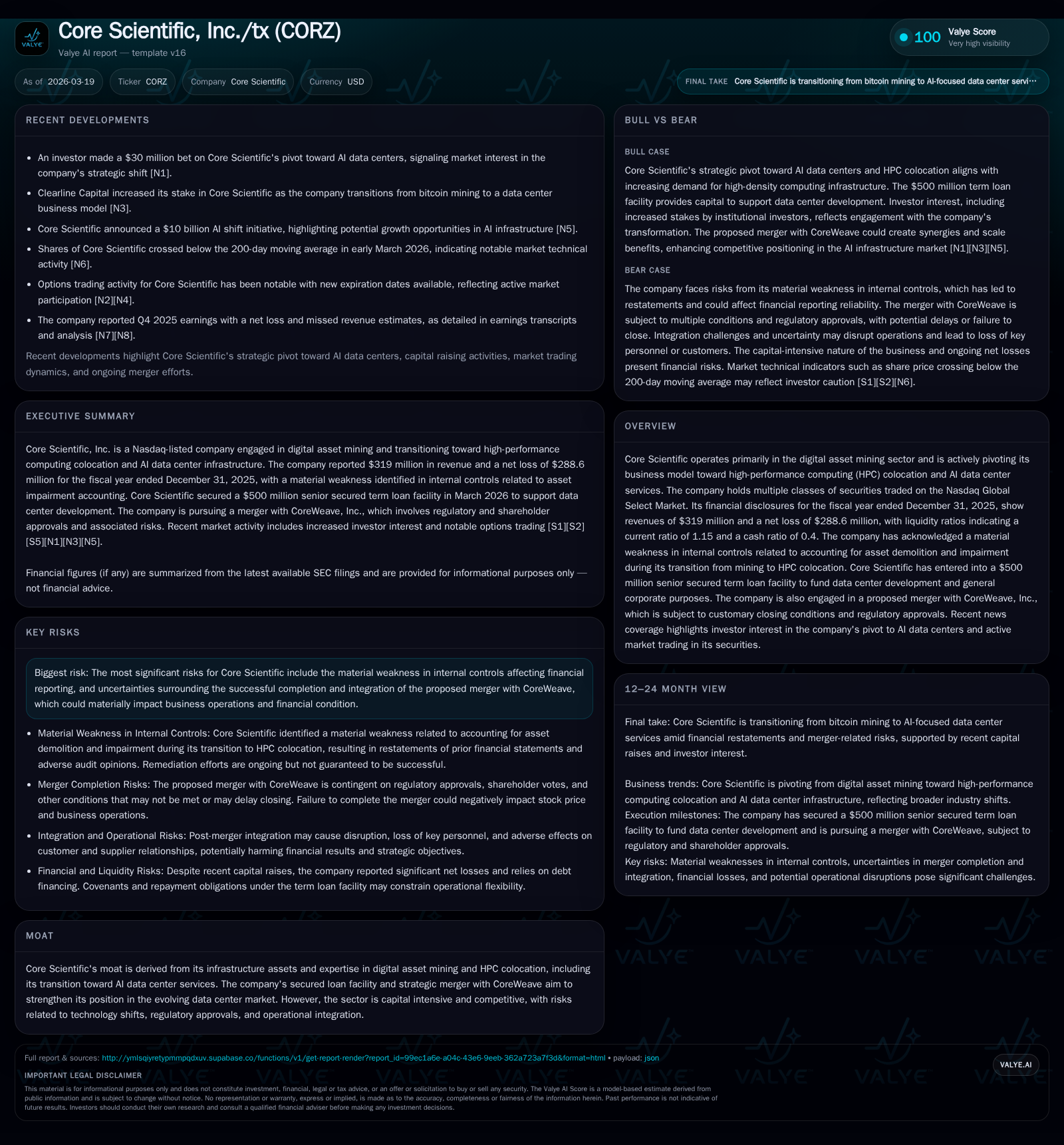
Core Scientific’s 2025 results show revenue falling 37.5% year-over-year to $319 million, driven by a strategic shift away from digital asset mining toward high-performance computing (HPC) colocation and AI data center services. Despite deepening operational losses, the company significantly improved operating cash flows through streamlining and asset monetization but incurred heavy capital expenditures to develop data center infrastructure. Core Scientific also faces challenges including a material weakness in internal controls related to asset impairments and ongoing uncertainties tied to its proposed CoreWeave merger. The newly secured $500 million senior secured term loan facility aims to support its transformative capital needs, yet persistent negative equity highlights balance sheet strain.
Historical Performance and Growth Drivers
Core Scientific experienced a significant top-line contraction in fiscal year 2025, with revenue dropping by approximately 37.5% compared to the prior year—from $511 million in 2024 down to $319 million as reported for the full year ended December 31, 2025 [F1]. This decline reflects the company's strategic decision to exit or scale down traditional digital asset mining operations—a sector that suffered pricing pressures and regulatory uncertainties—while beginning to redeploy assets toward high-performance computing (HPC) colocation facilities geared at supporting burgeoning AI workloads [N1][S1].
Operating income deteriorated sharply, moving into a loss of approximately $246 million, from a negative $65 million in 2024, an adverse swing largely attributable to impairment charges associated with decommissioned mining equipment now classified as demolition commitments and costs related to repurposing data centers [F1][S11][S19]. Despite wider operating losses, net income saw only a marginal improvement versus the previous year, finishing at a net loss of $289 million compared to $291 million in 2024 [F1].
Significantly, operating cash flow (CFO) increased nearly five and a half times year-over-year—to $278 million against only $43 million generated in 2024—suggesting that Core Scientific is gaining traction in liquidity generation through asset monetization and improved working capital management during its transition [F1]. Conversely, capital expenditures surged over sixfold from roughly $95 million in 2024 to $729 million invested during 2025 as the company focused intensely on developing new colocation infrastructure for AI workloads [F1][S4][S8].
The shift from crypto mining rigs towards HPC and AI infrastructure demands heavy upfront capex but offers potential scalability benefits. However, this change has amplified operational expenses in the interim.
Historical performance (annual)
| FY | Rev ($mm) | Net ($bn) | CFO ($mm) | OpInc ($bn) | Rev YoY | Net YoY |
|---|---|---|---|---|---|---|
| 2025 | 319 | -0.3 | 278 | -0.2 | -37.5% | +0.9% |
| 2024 | 511 | -0.3 | 43 | -0.1 | +1.6% | -18.1% |
| 2023 | 502 | -0.2 | 65 | 0.0 | -21.5% | +88.5% |
| 2022 | 640 | -2.1 | 205 | -2.1 |
Source: SEC companyfacts cache [F1].
Capital returns and efficiency (annual)
| FY | FCF ($mm) | ROE% |
|---|---|---|
| 2025 | -451 | 30.0 |
| 2024 | -52 | 30.9 |
| 2023 | 49 | 41.3 |
| 2022 | -179 | 524.3 |
Source: SEC companyfacts cache [F1].
Table: Annual Financial Highlights (USD millions)[F1]
Future Growth Prospects
Core Scientific’s pivot towards becoming an AI-focused HPC colocation provider sets it apart from many traditional crypto miners still heavily exposed to Bitcoin price volatility. The company aims to monetize its existing real estate footprint by upgrading facilities for data center services tailored for artificial intelligence workloads—a sector forecasted for robust expansion given accelerated AI adoption across industries [N8].
This repositioning potentially unlocks triple-digit upside scenarios if Core Scientific can capture rising demand fueled by generative AI models requiring massive computational resources [N8]. Furthermore, strategic partnerships such as its pending merger with CoreWeave could augment capacity and technical expertise in GPU-accelerated compute environments critical to AI [N13]. Yet this deal remains uncertain after failing stockholder approval in late 2025 [S18], posing execution risk.
Near term growth will be constrained by capital intensity and the ramp timeline for new data center assets coming online. Additionally, ongoing remediation of identified internal control deficiencies related to asset impairments stands as a risk that may affect reporting reliability or investor confidence [S11][S19]. The company reaffirmed no dividend payments or share buybacks are planned amid reinvestment needs [S27][N3].
Forecasts and Milestones
Though explicit forward guidance beyond historical filings is unavailable, portfolio developments suggest monitoring four key upcoming milestones: completion pace of AI-centric data center construction funded by the recent term loan; the eventual exit or further scaling down of legacy crypto mining operations; resolution of material internal control weaknesses including restated financial statements through amendments filed early March; and progress or termination outcomes regarding the CoreWeave merger transaction [S1][S4][S7][N1].
Investor interest appears revived notably through sizable equity stakes by activist funds like Two Seas Capital agreeing board governance changes scheduled through late-2026, indicating active shareholder engagement ahead [S25]. Sector peers have similarly seen capital raises targeting chip-dense HPC facilities as Bitcoin miners diversify revenue streams [N6][N9].
Capital Structure and Returns
Core Scientific's balance sheet reveals ongoing strain consistent with transitory transformation losses. Total equity was negative approximately $963 million at end-2025 versus negative $943 million a year prior—a deterioration linked primarily to accumulated deficits despite improving operational cash flows [F1]. Current assets totaled about $896 million mainly driven by cash and equivalents of $311 million against current liabilities nearing $781 million yielding a modest current ratio of about 1.15—reflecting tight liquidity buffers but manageable short-term obligations [F1].
The company executed a significant financing step by drawing fully on a newly established senior secured term loan facility worth $500 million in early March designed largely for data center development capex as well as general corporate purposes; this facility imposes standard covenants restricting additional indebtedness and requires use-of-proceeds rigor [S4][S5][S6]. Interest on this debt is set at SOFR plus roughly 2.50%, maturing within one year—highlighting refinancing risk if growth drivers do not materialize timely.
No dividends were declared or paid during the period under review nor were there share repurchase programs indicated in recent filings emphasizing capital conservation amid transformation [S9][S10][S21][N3]. Given continued net losses and negative equity position, return metrics such as ROE remain non-standard though simple arithmetic suggests an approximate positive ratio due to negative denominator effects (net loss / negative equity ~30%) which warrants caution in interpretation [F1].
Risks Overview
Core Scientific faces several critical risks centered on its operational pivot: first is the material weakness disclosed in its accounting controls tied specifically to capitalization vs impairment decisions concerning assets slated for demolition during conversion efforts—this has led auditors to revise opinions negatively indicating prior reporting unreliability periods affecting multiple quarters including full FY2024[S11][S19]. Second is uncertainty around successfully closing and integrating CoreWeave acquisition which failed shareholder vote—failure here may derail synergies expected from scale combined with exposure to competitive pressures within colocation markets focused on AI workloads.[S18]
Further risks include general sector challenges such as rapid technology evolution requiring continuous capex reinvestment cycles; regulatory complexities particularly on cryptocurrency-related legacy operations; fluctuating energy costs impacting data center economics; and broader macroeconomic conditions constraining capital access.[N7][S20]
Conclusion
Core Scientific’s financial disclosures portray a company deeply engaged in reshaping its business away from legacy cryptocurrency mining toward future-proofing via HPC colocation tailored for AI computing workloads. Although such a pivot aligns strategically with high-growth technology trends, the balance sheet stress markers—continued net losses exceeding revenues, large negative equity balances—and the absence of dividend returns underscore substantial near-term financial risks. The sharp surge in capital expenditures alongside strengthening operating cash flow indicates heavy reinvestment commitments that investors should monitor closely going forward.
Remediation progress on internal control deficiencies coupled with developments surrounding the CoreWeave merger will be pivotal indicators defining Core Scientific’s trajectory toward stabilizing earnings quality while executing on its ambitious infrastructure build-out plan. Active engagement by institutional stakeholders signal intensified governance focus amid these transformational challenges.
This report reflects information available as of March 19, 2026, incorporating official SEC filings, earnings transcripts, and public disclosures related to Core Scientific's fiscal year ended December 31, 2025. It does not constitute investment advice but aims to offer comprehensive contextual insights into the company's financial performance and strategic positioning within evolving digital infrastructure markets.
Disclaimer: This is research-only, informational analysis and not investment advice. It may include AI-generated interpretation and general industry context. Always verify important details using primary sources.

Comments