
Actelis Networks Faces Revenue Decline Amid Strategic Pivot to IoT
The company’s significant revenue drop and mounting losses underscore challenges in its IoT transition and capital constraints.
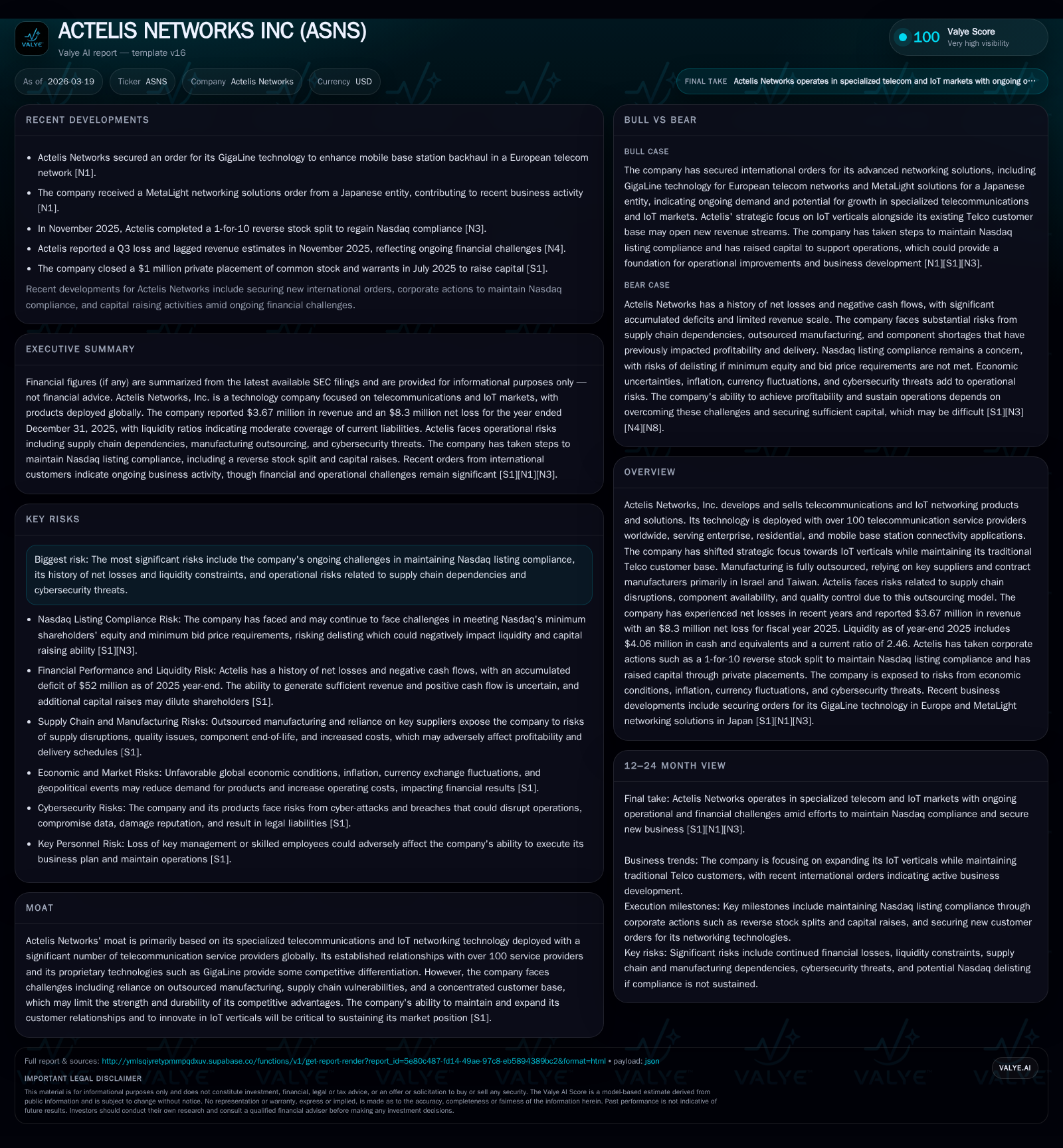
Actelis Networks’ revenue decreased sharply from $8.83 million in 2022 to $3.67 million in 2025, alongside widening operating and net losses. This reflects the ongoing transition toward IoT verticals while maintaining legacy telecommunications customers. The firm’s fully outsourced manufacturing model exposes it to supply chain and quality risks. Liquidity remains constrained with negative operating cash flows and a market capitalization below Nasdaq’s proposed delisting threshold.
Revenue Contraction and Operating Losses Highlight Financial Strain
Actelis Networks experienced a substantial decline in revenue from $8.83 million in 2022 to $3.67 million in 2025, a decrease exceeding 58%. Concurrently, operating losses worsened significantly, with FY2025 operating income reported at -$7.18 million, representing a nearly 91% increase in loss compared to the prior year. Net income followed this trend, with a loss of $8.26 million in FY2025 [F1].
Negative operating cash flows have persisted through this period, totaling approximately -$7.69 million in FY2025, underscoring ongoing cash burn challenges during efforts to realign business strategy [F1][S1].
Historical performance (annual)
| FY | Rev ($mm) | Net ($mm) | CFO ($mm) | OpInc ($mm) | Rev YoY | Net YoY |
|---|---|---|---|---|---|---|
| 2025 | 4 | -8 | -8 | -7 | -52.7% | -88.9% |
| 2024 | 8 | -4 | -7 | -4 | +38.4% | +30.4% |
| 2023 | 6 | -6 | -7 | -7 | -36.5% | +42.8% |
| 2022 | 9 | -11 | -8 | -6 |
Source: SEC companyfacts cache [F1].
Capital returns and efficiency (annual)
| FY | Buybacks ($) | FCF ($mm) | ROE% |
|---|---|---|---|
| 2025 | 50000 | -8 | -172.2 |
| 2024 | 50000 | -7 | -158.7 |
| 2023 | 50000 | -7 | -2745.0 |
| 2022 | 1000000 | -8 | -336.4 |
Source: SEC companyfacts cache [F1].
(Data sourced from [F1])
Strategic Focus on IoT Verticals during Legacy Customer Base
The company has shifted its strategic emphasis toward serving Internet-of-Things verticals while continuing to support its existing telecommunications clients globally across enterprise, residential, and mobile base station applications [S20][S1]. Approximately 27% of revenue in FY2025 was derived from Telco customers.
This dual focus introduces complexities related to sales execution and resource allocation as the company balances growth opportunities in nascent IoT markets with legacy customer retention challenges [S20]. Early signs of traction include a MetaLight networking solutions order from a Japanese entity, validating initial progress in the IoT segment though broader scaling remains necessary [N2].
Operational Risks: Customer Concentration and Outsourced Manufacturing
Actelis's revenue concentration is significant; the top ten customers accounted for roughly 62% of total revenues in FY2025, heightening exposure to any individual customer downturn or contract renewal risk [S4][S5].
Manufacturing is fully outsourced primarily through contract manufacturers located in Israel and Taiwan, which subjects the company to supply chain vulnerabilities such as component shortages, shipping delays, cost inflation, quality variability, and geopolitical risks associated with these regions [S1][S4][S5]. These factors have historically impacted production timelines and profitability.
Liquidity Position and Capital Structure Challenges
As of December 31, 2025, Actelis held approximately $4.06 million in cash and equivalents with a current ratio around 2.46, providing moderate short-term liquidity cushion [F1]. However, persistent negative operating cash flows near $7.69 million annually highlight ongoing cash burn concerns.
The company operates under Nasdaq’s proposed rule that could lead to immediate suspension or delisting if market capitalization remains below $5 million for an extended period—a condition currently met by Actelis—posing substantial risk to continued listing status absent remediation [S1][S8].
Debt levels are modest with an outstanding balance of about $36,000 on an Israeli bank credit line extended through February 2026; future debt raises may be pursued but could increase interest expenses and strain profitability further [S6][S9]. Equity financing remains a likely necessity given ongoing losses.
Capital Allocation: Minimal Buybacks and No Dividends
Capital return initiatives have been limited; share repurchases totaled approximately $50,000 annually over recent periods indicating a focus on liquidity preservation rather than shareholder distributions [F1][S15][S19]. No dividends have been declared or are planned in the foreseeable future.
Profitability metrics remain challenged with approximate return on equity near negative 172%, reflecting sustained net losses relative to shareholders’ equity which was about $4.8 million at year-end 2025 [F1]. Free cash flow remains deeply negative after accounting for minimal capital expenditures (~$9K in FY2025).
Outlook and Key Monitoring Factors
While no formal guidance is provided, key indicators will include order flow trends particularly within IoT sectors highlighted by recent Japanese contracts; progress toward restoring Nasdaq compliance; and quarterly cash flow dynamics reflecting operational efficiencies or restructuring impacts [N2][S1][S8]. These will be critical metrics shaping near-term viability.
This analysis is based on publicly available information as of March 19, 2026 ([F1], [S#], [N#]) for informational purposes only without investment advice or price forecasts.
Disclaimer: This is research-only, informational analysis and not investment advice. It may include AI-generated interpretation and general industry context. Always verify important details using primary sources.

Comments