
Valneva SE Pursues Specialty Vaccine Growth Despite Regulatory and Financial Hurdles
Valneva maintains a niche in specialty travel vaccines while managing regulatory setbacks and pursuing late-stage pipeline advances.
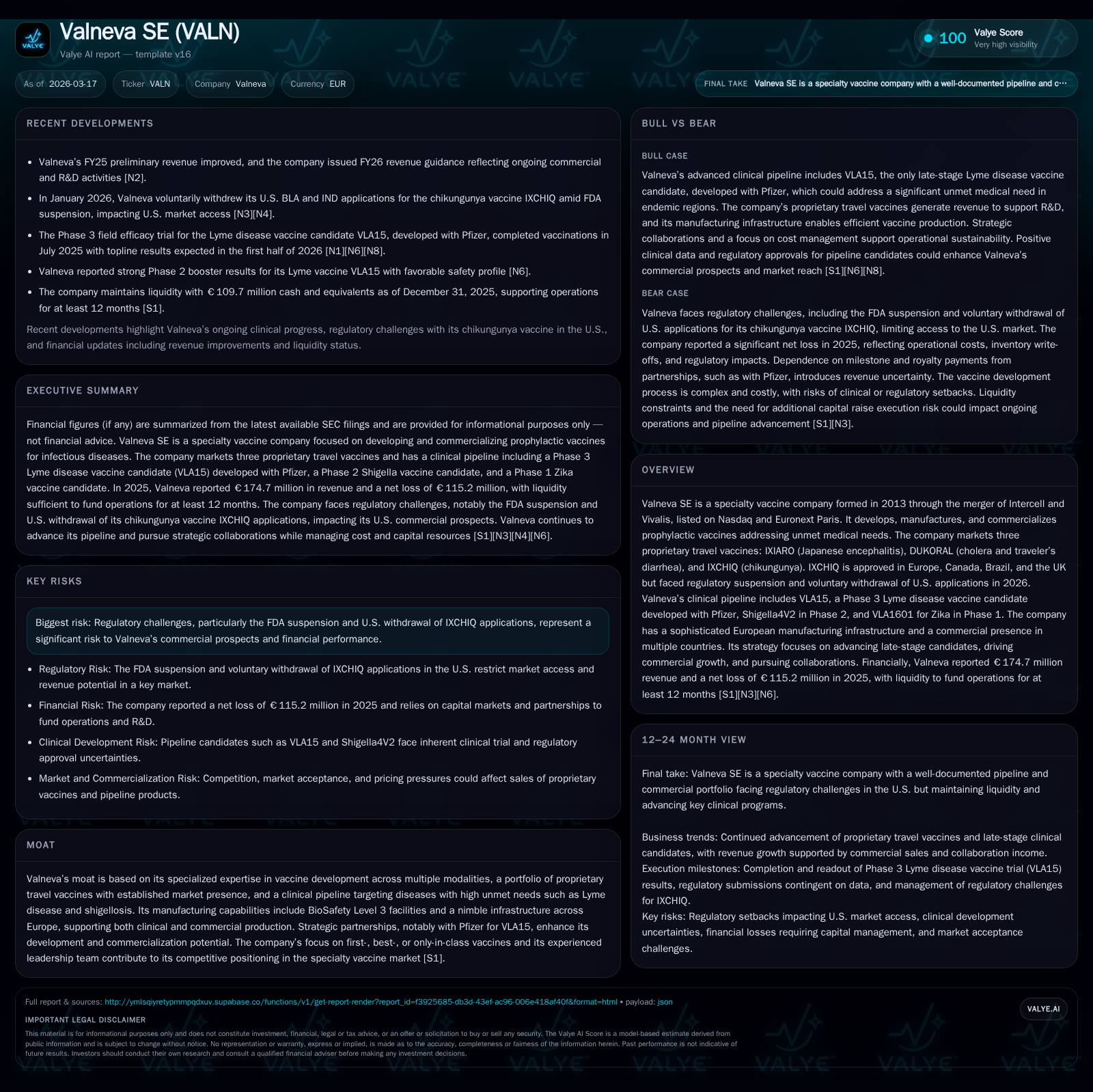
Valneva SE operates in the specialized vaccine market with a portfolio of travel vaccines and an advancing clinical pipeline targeting diseases like Lyme and Shigellosis. The company’s financial performance over recent years shows moderate topline growth tempered by significant net losses, driven partly by operating challenges and regulatory hurdles including FDA suspension in the U.S. for its chikungunya vaccine. Partnerships, notably with Pfizer on VLA15, are key to future diversification. Valneva’s manufacturing infrastructure and DoD contracts underpin its commercial base, yet liquidity management and regulatory compliance remain critical factors for near-term sustainability.
Valneva’s Growth Trajectory: Historical Performance and Sales Drivers
Valneva SE has exhibited modest revenue growth over the recent three-year span following pandemic disruptions. Revenue increased from €153.7 million in 2023 to €174.7 million in 2025, representing about a 3% year-over-year increase last year [F1]. This growth was primarily supported by sales of its two staple travel vaccines: IXIARO (Japanese encephalitis) and DUKORAL (cholera/travelers' diarrhea), which together accounted for over 70% of revenues during this period [S1]. Additional support came from governmental sales channels; notably, recurring contracts with the U.S. Department of Defense (DoD) have underpinned revenue stability amid fluctuating public traveler demand.
Third-party product sales declined to around 12.1% of total revenue in 2025 from nearly a quarter three years earlier, reflecting a strategic focus on proprietary vaccines [S1]. The chikungunya vaccine IXCHIQ generated first commercial revenues only recently in 2024 but faced significant disruption following FDA suspension of its U.S. applications in early 2026 [S1][S4].
Operating results have been volatile: an operating profit of €13.3 million recorded in 2024 was offset by operating losses near €82.1 million both in 2023 and again in 2025 [F1]. These swings highlight transitional challenges amid pipeline investments and regulatory headwinds.
Historical performance (annual)
| FY | Rev ($mm) | Net ($mm) | Rev YoY | Net YoY |
|---|---|---|---|---|
| 2025 | 175 | -115 | +3.0% | -840.6% |
| 2024 | 170 | -12 | +10.3% | +87.9% |
| 2023 | 154 | -101 | -57.5% | +29.2% |
| 2022 | 361 | -143 |
Source: SEC companyfacts cache [F1].
Capital returns and efficiency (annual)
| FY | ROE% |
|---|---|
| 2025 | -108.5 |
| 2024 | -6.8 |
| 2023 | -79.1 |
| 2022 | -65.2 |
Source: SEC companyfacts cache [F1].
Net income year-over-year reflects large swings driven by operational restructurings and regulatory-related impairments.
Pipeline Progress: Late-Stage Candidates and Clinical Milestones
Valneva’s future growth depends heavily on advancing clinical candidates addressing unmet medical needs beyond its mature travel vaccine portfolio [S1]. The lead candidate VLA15 targets Lyme disease and is currently undergoing Phase 3 trials under collaboration with Pfizer [S1][N2]. This partnership includes milestone payments linked to clinical progress that provide non-dilutive capital inflows supporting R&D investment.
Additional pipeline assets include Shigella4V2 advancing through Phase 2 trials aimed at shigellosis, and VLA1601 targeting Zika virus currently in Phase 1 trials [S2][N2]. While no explicit guidance on approval timelines was provided, earnings commentary emphasized continued investment focus on these candidates balancing risks concentrated on existing travel vaccines [N2]. Pipeline advancement remains critical amid current sales headwinds.
Regulatory Challenges: Impact and Strategic Responses
A key setback was the FDA's suspension of IXCHIQ applications in the U.S., followed by Valneva's voluntary withdrawal of submissions during early 2026 [S4][N2]. This disrupted plans for expanding IXCHIQ commercialization into the U.S., a major market.
The company is pursuing alternative markets where IXCHIQ holds approvals including Europe, Canada, Brazil, and the UK [S1][N2]. Regulatory risk is material as Valneva operates within complex compliance frameworks encompassing anti-kickback statutes, false claims act exposures, HIPAA privacy rules, and evolving pricing regulations across the U.S. and EU [S5][S6][S7].
Mitigation focuses on geographic diversification, strengthening compliance infrastructure, and leveraging strategic partnerships aiding regulatory navigation.
Financial Health: Profitability, Liquidity, and Capital Structure
Valneva’s financials reflect a transition phase marked by sustained net losses despite topline improvements [F1]. Net loss widened sharply to €115.2 million in FY25 from €12.2 million loss a year earlier [F1], underscoring ongoing funding needs for R&D programs like VLA15 alongside operational costs.
Cash and cash equivalents totaled €109.7 million at December 31, 2025 providing liquidity sufficient for at least one additional year according to management [S6][F1]. Borrowings stood at approximately €179.2 million focused under a new $500 million loan facility arranged with Pharmakon Advisors that extends debt maturity into Q4/2030 while lowering interest rates compared to prior agreements [S6][S18][S25]. This refinancing enhances flexibility but introduces longer-term leverage considerations.
Capital expenditures contracted steeply to €2.7 million from over €17 million previously as large-scale manufacturing investments stabilized [F1][S11][S13]. Lease liabilities approximated €28 million related mainly to long-term premises leases supporting production capacity primarily in Sweden.
Return metrics illustrate unprofitability challenges; estimated ROE stands near -108% based on latest net losses versus equity base at year-end [F1], highlighting the need for sustained revenue growth toward profitability.
Commercial Execution: Travel Vaccine Franchise and Market Dynamics
The travel vaccine portfolio anchors commercial revenues though trends remain mixed reflecting macro travel patterns post-pandemic alongside product-specific factors [S1]. IXIARO sales benefit substantially from defense contracts—28-31% of IXIARO sales derive from U.S. DoD purchases over recent years sustaining approximately $32 million annual contract volume renewed January 2025 [S21][S1]. Such contract renewals are vital given their scale relative to total revenues.
Declining third-party product sales reflect strategic emphasis on owned intellectual property but reduce diversification outside core proprietary lines [S21]. Product sales experienced minor contractions in key geographies such as the U.S., influenced by currency effects (~€2 million impact vs EUR) alongside IXCHIQ suspension consequences [S21]. Germany showed softness attributed partly to distributor transitions.
Traveler vaccination demand correlates strongly with endemic region advisories, awareness campaigns, and perceived risks; thus geopolitical or pandemic-related disruptions remain inherent volatility drivers impacting short-term uptake.
Strategic Partnerships Amplifying Development Prospects
Partnerships are crucial for Valneva’s clinical-stage programs providing development capital alongside global commercialization expertise [S1][N2]. The alliance with Pfizer on VLA15 exemplifies this synergy—milestone payments triggered by trial progress provide essential non-dilutive funding amid high R&D spend.
This collaboration shares development risks while positioning Valneva for potential access to Pfizer’s extensive commercial infrastructure if approved and marketed successfully, mitigating internal resource constraints typical for mid-cap biotechs [N2]. Licensing deals complement product sale revenues financing Phase III activities amid uncertain near-term earnings.
Outlook: Catalysts and Risks Ahead
Upcoming catalysts include expected pivotal Phase III results for VLA15 Lyme disease vaccine which could unlock licensing revenues or support regulatory filings [N2][S2]. Progress milestones with Shigella4V2 will also be closely watched as indicators of pipeline robustness.
Contract renewal cycles with DoD remain critical given their sizable share of IXIARO revenues; any disruptions could materially affect near-term cash flows [S1][S21].
Regulatory oversight remains a key risk vector—ongoing compliance demands plus potential healthcare reforms such as pricing transparency initiatives or Medicare Drug Price Negotiation implementations may pressure margins or product accessibility especially within major markets like the U.S., EU countries [S8][S10][S22].
Monitoring cash burn relative to revenue ramp-up will be pivotal for assessing financial sustainability beyond current liquidity runway.
Disclaimer: This analysis reflects publicly available data as of March 17, 2026 without investment advice or recommendations regarding Valneva SE securities or financial instruments.
Disclaimer: This is research-only, informational analysis and not investment advice. It may include AI-generated interpretation and general industry context. Always verify important details using primary sources.

Comments