
BlackSky Technology’s Challenge to Scale Real-Time Space Intelligence Under Financial Pressures
BlackSky leverages an advanced AI-powered smallsat constellation and proprietary software platform to offer real-time space-based intelligence, yet financial and operational hurdles constrain its scaling ambitions.
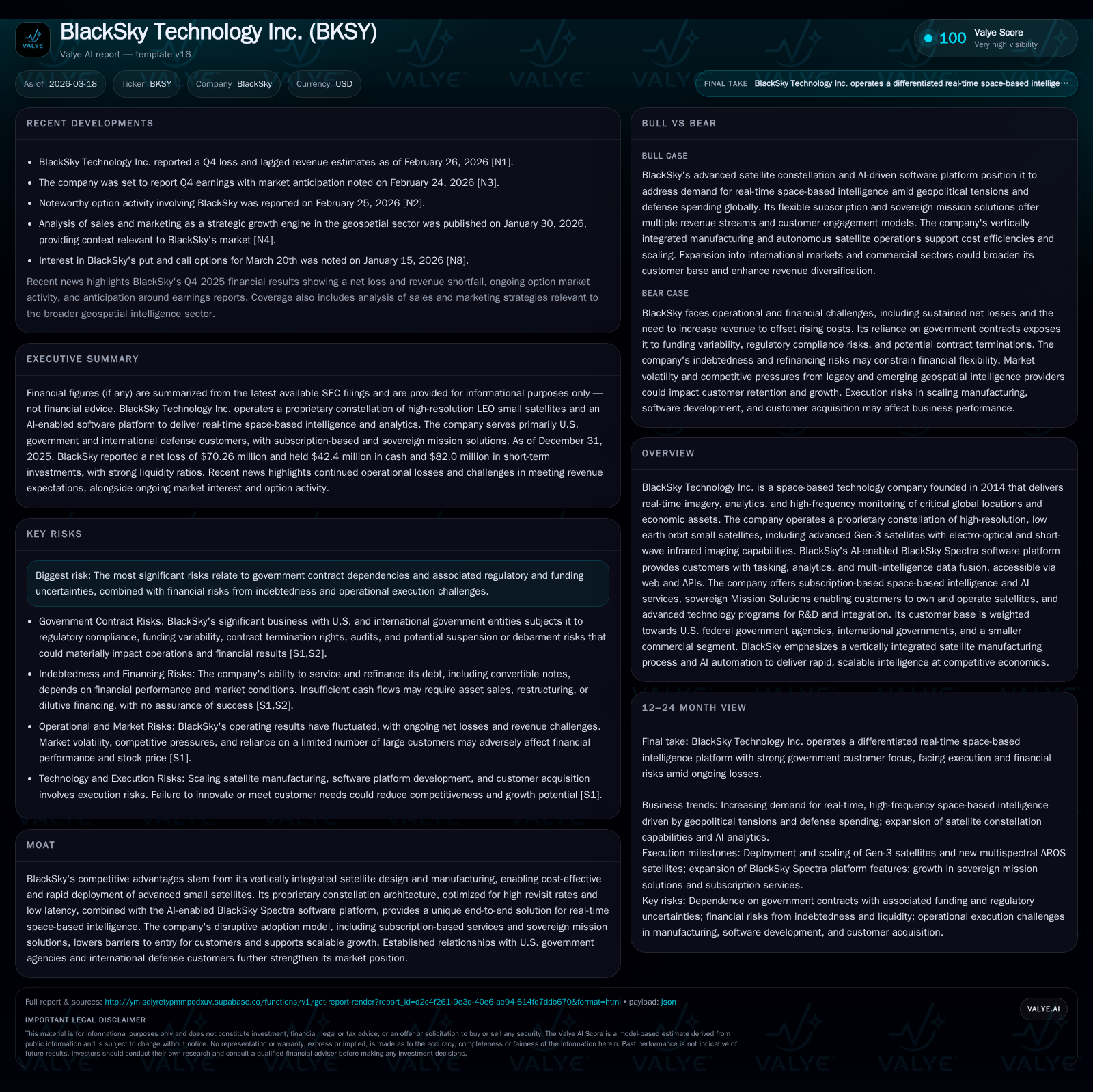
Founded in 2014, BlackSky Technology Inc. has pioneered rapid revisit, high-resolution satellite imagery coupled with AI-driven analytics tailored primarily to government defense and intelligence customers. Despite technological differentiation through a vertically integrated satellite manufacturing approach and the innovative BlackSky Spectra platform, the company has faced persistent operating losses, deepening negative cash flows, and dependency on fluctuating government contracts. Its financial profile reveals widening net losses and concentrated revenue sources under pressure from capital-intensive expansion and regulatory challenges. While promising growth avenues exist via sovereign mission solutions and increased AI adoption, BlackSky’s ability to scale efficiently hinges on navigating intense funding pressures, restrictive debt covenants, and execution risks.
Foundations: BlackSky’s Technology and Market Footprint
BlackSky Technology Inc., established in 2014, has positioned itself as an innovator transforming real-time space-based intelligence delivery through a vertically integrated approach encompassing satellite design, manufacturing, launch, operations, and software analytics [S1]. At the core lies its proprietary constellation of low earth orbit (LEO) small satellites — spanning the second (Gen-2) and third generation (Gen-3) platforms. The Gen-3 satellites notably feature enhanced electro-optical sensors capable of 35-centimeter resolution imagery alongside unique short-wave infrared capabilities reaching 1.2-meter resolution. These imaging advancements facilitate reliable observation across diverse lighting conditions—day to night—and enable high-frequency revisit rates historically unattainable by conventional geospatial intelligence providers.
The constellation’s architecture leverages unconventional inclined orbits combined with autonomous onboard systems permitting near-continuous overhead coverage—up to approximately fifteen passes per day over key locations [S1], optimizing rapid data collection without requiring human-in-the-loop control for tasking or telemetry adjustments. This capability directly supports the company’s flagship software platform, BlackSky Spectra®, which acts as an integrative commercial tasking hub featuring sophisticated AI-enabled analytic modules that fuse multi-intelligence data sources—including third-party sensors—to generate dynamic situational awareness for users [S10].
Customer relationships predominantly revolve around U.S. federal government bodies such as the National Reconnaissance Office (NRO), National Geospatial-Intelligence Agency (NGA), U.S. Space Force, in addition to allied international governments [S8][S11]. These clients depend on BlackSky’s subscription-based space-based intelligence services that emphasize rapid delivery speeds alongside sovereign mission solutions offering customized constellation ownership opportunities—a key differentiator enabling faster national space access without requisite high upfront investments [S12].
Overall, BlackSky melds cutting-edge hardware innovation with a scalable software-first analytic framework designed to meet strategic demands for near-real-time geospatial intelligence in an expanding global threat landscape [S25].
Historical Performance: Growth Drivers and Financial Setbacks
Between fiscal years 2022 through 2025, BlackSky saw improvements in its operating income trajectory but remained deeply in the red amid ongoing scaling efforts. Operating income narrowed from a loss of approximately $86.5 million in FY2022 to around $46.9 million negative in FY2025—a near 6% year-over-year decline relative to FY2024's operating loss of $44.3 million [F1]. However, net income reversed trend during this period; while FY2023 posted approximately $53.9 million loss narrowing from previous years, FY2025 reflected a worsening net loss of roughly $70.3 million representing a -22.8% decline year-on-year [F1]. This divergence between operating improvements but wider net losses underscores rising non-operating charges or investments possibly related to R&D intensification or debt instruments.
Operating cash flow suffered sharply over this period as well: after posting negative $44.5 million CFO in FY2022 improving modestly to nearly negative $6.4 million by FY2024, cash flow declined drastically by about -343% to roughly negative $28.3 million for FY2025 [F1]. This marked deterioration signals capital intensity outpacing operational cash inflows likely due to expanding satellite launches and ground infrastructure development needed for constellation augmentation.
Supporting these financial trends is the concentrated customer base heavily weighted toward governmental contracts that exhibit variability stemming from funding cycles, contract renewals, and programmatic shifts [N1][S3]. Q4 2025 preliminary disclosures revealed revenue misses relative to estimates suggestive of sales growth limitations even amid technology advancements—a reminder of challenges scaling recurring commercial demand beyond sovereign programs [N1][S3].
Historical Financial Performance Summary (FY2022-FY2025)
Historical performance (annual)
| FY | Net ($mm) | CFO ($mm) | OpInc ($mm) | Net YoY |
|---|---|---|---|---|
| 2025 | -70 | -28 | -47 | -22.8% |
| 2024 | -57 | -6 | -44 | -6.2% |
| 2023 | -54 | -17 | -56 | +27.4% |
| 2022 | -74 | -44 | -87 |
Source: SEC companyfacts cache [F1].
Capital returns and efficiency (annual)
| FY | ROE% |
|---|---|
| 2025 | -74.1 |
| 2024 | -60.9 |
| 2023 | -57.8 |
| 2022 | -60.9 |
Source: SEC companyfacts cache [F1].
Note: Operating income improvements reflect scale efficiencies; net income deteriorations partly due to increased financing or non-operating costs; operating cash flow plunge highlights CAPEX outflows exceeding operational cash inflows [F1].
The Constellation Edge: Advantages From Vertically Integrated Smallsat Production
BlackSky’s competitive moat fundamentally arises from its end-to-end vertical integration in designing and manufacturing LEO small satellites domestically at its Tukwila facility [S12]. This capability grants nimble control over the satellite lifecycle enabling continuous upgrades—from Gen-2 baseline platforms advancing into Gen-3 with high-res EO and SWIR sensors—and streamlined launch cadence matched explicitly to constellation replenishment needs.
This contrasts sharply with legacy providers reliant on third-party manufacturers or large monolithic satellites incurring higher costs and longer development cycles; BlackSky's approach reduces barriers for rapid constellation scaling critical for achieving low-latency global coverage vital in modern ISR markets [S1]. The smallsat form factor combined with unconventional orbital inclinations facilitates time-diverse data acquisition windows stretching dawn-to-dusk intervals autonomously—absent human-in-the-loop latency—making the system commercially unique.
Furthermore, the BlackSky Spectra platform integrates this proprietary constellation seamlessly providing customers instant access via secure APIs for automated tasking requests paired with AI-enhanced multi-intelligence fusion analytics—a powerful disruptive combination supporting subscription adoption models at elastic pricing tiers based on frequency and data volumes.
Collectively these elements reinforce an end-to-end architecture deliberately engineered not just for hardware innovation but also software scalability—unlocking new customer segments able to source data dynamically via cloud interfaces rather than engaging traditional static geospatial contracts [S1][S12].
Emerging Risks: Dependence on Government Contracts and Regulatory Challenges
A central risk profile element is BlackSky’s substantial dependence on U.S government contracts subject to Federal Acquisition Regulations (FAR) framework granting governments wide latitude including unilateral contract modifications or terminations for convenience often at unfavorable terms for contractors [S2][S23]. Consequently revenue visibility remains variable tied directly to appropriations cycles impacting contract awards or extensions.
Contractual terms also impose extensive auditability obligations increasing compliance costs while non-compliance might trigger severe consequences including penalties or debarment jeopardizing business continuity [S23]. In Q3/Q4 2025 periods reported reductions in contract values resulted from U.S budget constraints illustrating sensitivity effects on inflows [S24].
Compounding these factors are ongoing legal proceedings linked to the merger transaction originating from 2021 with allegations of fiduciary breach claiming misleading proxy disclosures; although forthcoming settlements funded primarily by insurance minimize direct financial hits presently such matters represent reputational uncertainties that could distract management focus [S14][S15].
Capital structure is further strained by significant indebtedness carrying covenants limiting incremental borrowings with refinance risk heightened amid volatile credit markets; failure on debt service obligations could precipitate liquidity crises necessitating asset dispositions detrimental to operational plans [S4][S5][S16][S17].
Added regulatory complexity arises from emerging legislation focused on privacy protections governing collected data and growing requirements around cybersecurity certifications affecting DoD-related contracts potentially increasing operational overheads or causing award delays if certification thresholds are unmet [S18]. International expansion invites geopolitical risks tied to export controls or foreign regulatory regimes requiring vigilance across multiple jurisdictions impacting go-to-market strategies [S19][S20].
Future Growth Catalysts and Constraints: Expanding AI-Driven Delivery Versus Market Uncertainties
Going forward BlackSky seeks growth through broadening adoption of its subscription-based intelligence services augmented by AI-powered analytics enhancements that deliver actionable insights faster than competitors provide raw imagery alone [N2][S1]. Their Mission Solutions business targets sovereign customers wishing ownership/control over bespoke Gen-3 satellites backed by scalable access across BlackSky’s shared constellation capacity mitigating initial capital hurdles common among national space programs.
Emerging geopolitical tensions worldwide underscore heightened demand for dynamic ISR capabilities enabling early warning and operational planning serving as tailwinds fueling government procurement interest especially within Europe, Asia-Pacific, Middle East regions where defense budgets are rising substantially [S22][N2]. Moreover continual technology upgrades like improved sensor packages or enhanced spectral bands could open adjacent use cases beyond classical military domains into industrial supply chain transparency or environmental monitoring expanding addressable markets [N1][S10][S12].
Nonetheless considerable obstacles remain — large upfront CAPEX requirements borne internally push cash burn higher creating pressure points balancing aggressive deployment plans against financing availability given debt leverage levels capped by covenants and potential delays related to contracting friction or integration complexities underscoring execution risk despite strong technology positioning [N1][N2][S24][F1]. The interplay between macroeconomic tightening in credit markets alongside unpredictable government funding cycles can cap growth momentum intermittent contract renewals may result in lumpy revenue recognition constraining margin expansion possibilities.
Capital Structure and Returns: Navigating Negative Operating Cash Flows and Debt Obligations
The fiscal year ending December 31, 2025 figures lay bare BlackSky's challenging financial profile: operating income persisted deep into negative territory at roughly -$46.9 million while net losses expanded close to $70 million representing a YOY deterioration of nearly twenty-three percent despite some Opex containment visible previously [F1]. Cash flows from operations plunged precipitously by over threefold worsening from about negative $6 million in FY24 down below negative $28 million FY25 implying heavy investment outlays overshadowing any sales-generated inflows—reflecting intense capital deployment chiefly directed toward Gen-3 builds plus associated ground segment expansions likely required for longer-term constellation reliability targeting scalability goals.
Balance sheet strength measured via current ratio remains robust at approximately 3.48 highlighting adequate short-term liquidity buffers supported by $42 million cash equivalents at year-end firmly above current liabilities near $59 million offering some operational runway flexibility if executed prudently [F1][S5]. However sizable leverage encumbers these positives with loan agreements imposing restrictive covenants limiting future borrowings while mandating stringent compliance creating refinancing risks accentuated by broader economic tightening paradigms confronting aerospace sectors currently at elevated volatility levels globally [S4][S16][S17].
No dividends have been declared nor repurchases executed since heavy buyback activity pre-2020 thus signaling prioritization of internal reinvestment over capital returns given ongoing developmental stage emphasizing growth over shareholder distributions at present horizons [F1]. Rough return on equity approximates negative seventy-four percent denoting substantial capital consumption relative to equity base—a hallmark signifying early commercial maturity phase weighted toward scale buildout rather than profitability extraction yet underscoring substantial patience expected among investors backing ambitious space infrastructure ventures.
Disclaimer: This is research-only, informational analysis and not investment advice. It may include AI-generated interpretation and general industry context. Always verify important details using primary sources.

Comments