
Sound Financial Bancorp Sustains Profitability and Dividend Growth with Strong Capital and Liquidity
The community bank holding company demonstrates resilient net income growth, robust cash flow generation, and disciplined capital management through 2025.
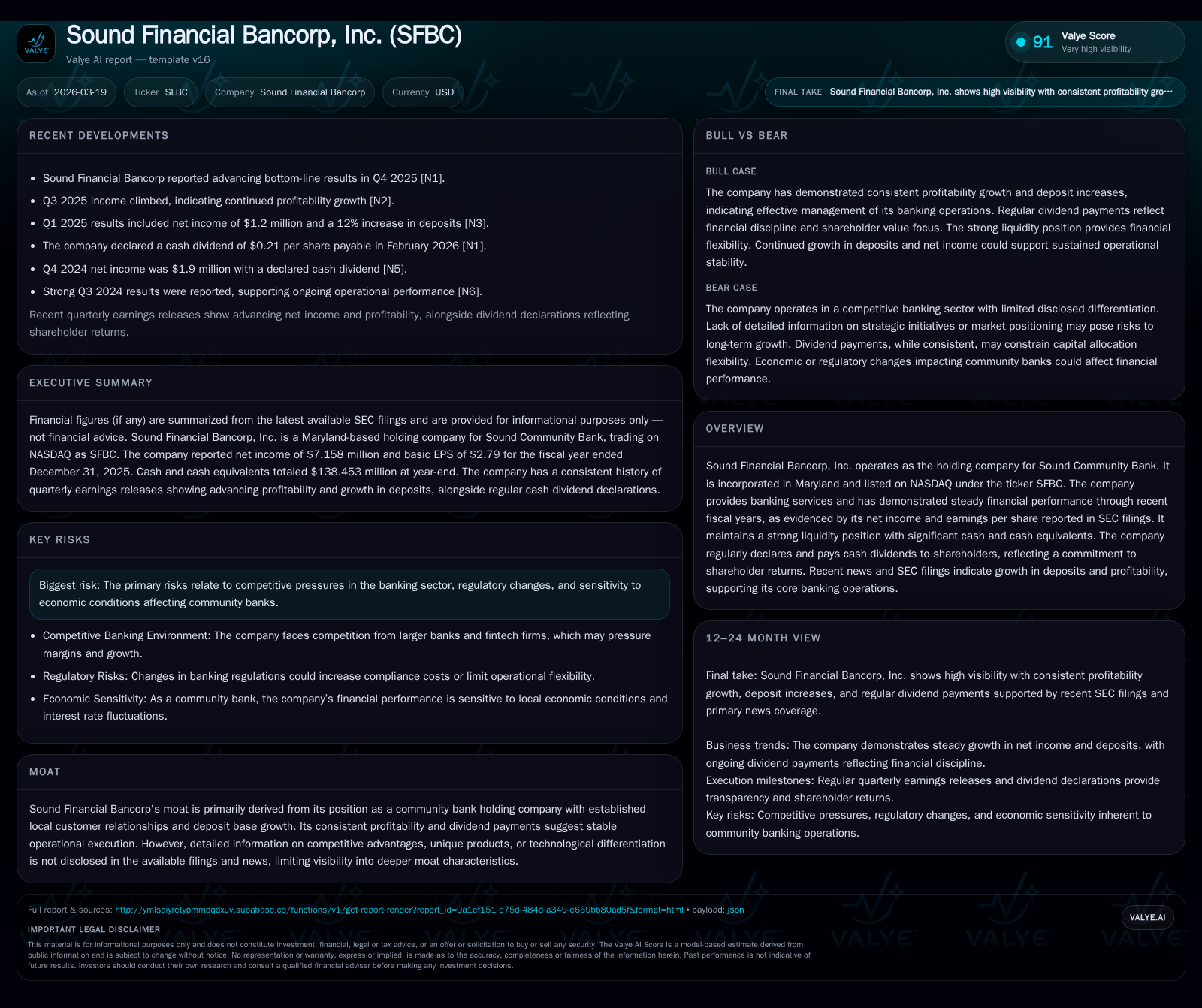
Sound Financial Bancorp, Inc., the holding company for Sound Community Bank, maintained stable profitability amid a competitive banking environment. Net income rose 54% in 2025 after a prior dip in 2024, reflecting operational resilience. The company sustains a strong capital base with equity exceeding $109 million and consistently generates positive operating cash flow that supports dividends and modest capital expenditures. Regulatory compliance including CECL adoption and Community Reinvestment Act ratings remain steady. Key risks revolve around interest rate sensitivity and regulatory changes affecting community banks.
Company Overview
Sound Financial Bancorp, Inc., listed on NASDAQ under ticker SFBC, is the holding company for Sound Community Bank based in Maryland. It focuses primarily on community banking services characterized by local customer relationships and deposit gathering. The bank operates within a regulated environment requiring adherence to numerous consumer protection laws and capital adequacy mandates [S1].
Historical Performance
Over the four most recent fiscal years ending December 31, annual net income demonstrated some volatility before recovering strongly in 2025 to $7.16 million from a low of $4.64 million in 2024, representing a 54.3% rebound [F1]. Operating cash flow mirrored this pattern by more than doubling to $7.16 million in 2025 from $2.93 million the prior year—a sign of improving core earnings quality.
Equity capital expanded consistently from $97.7 million at end-2022 to $109.4 million by end-2025, reinforcing the firm's capital base relative to asset growth [F1]. Capital spending remained modest but increased from around $76K in 2024 to $170K in 2025, consistent with targeted technology investments common among community banks aiming to maintain compliance standards and service digital expectations.
Dividends were steadily paid quarterly throughout this period, with recent dividends raised slightly to $0.21 per share reflecting management's commitment to shareholder income despite broader macroeconomic uncertainty [S11][S12][S13]. Share repurchases declined significantly post-2023 and were absent entirely by 2025 indicating greater focus on preserving capital [F1].
Historical performance (annual)
| FY | Net ($mm) | CFO ($mm) | Capex ($) | Net YoY |
|---|---|---|---|---|
| 2025 | 7 | 7 | 170000 | +54.3% |
| 2024 | 5 | 3 | 76000 | -37.6% |
| 2023 | 7 | 7 | 444000 | -15.5% |
| 2022 | 9 | 10 | 398000 |
Source: SEC companyfacts cache [F1].
Capital returns and efficiency (annual)
| FY | Buybacks ($mm) | FCF ($mm) | ROE% |
|---|---|---|---|
| 2025 | 0 | 7 | 6.5 |
| 2024 | 0 | 3 | 4.5 |
| 2023 | 2 | 6 | 7.4 |
| 2022 | 2 | 10 | 9.0 |
Source: SEC companyfacts cache [F1].
Note: Dividends prior to detailed filings are estimated based on press releases.
Drivers of Past Growth
The recovery in net income during FY2025 was supported by continued deposit growth fueling lending activities alongside disciplined expense management [N/A]. The shift toward adoption of CECL accounting beginning January 1, 2023 introduced earlier recognition of credit losses which initially pressured retained earnings but has since been embedded into earnings assessments [S1].
Interest rate risk is a prominent factor for the bank given its reliance on deposit funding repricing faster than loans; an asset/liability committee meets regularly to implement strategies mitigating potential margin compression across fluctuating rate environments [S1]. This active risk management helps stabilize earnings.
Steady dividend payments reflect stable profitability and positive operating cash flow generation underlining the bank’s ability to generate free cash flow consistently despite modest capex expenses.
Future Growth Prospects
Looking ahead, growth will hinge largely on sound credit performance amidst economic conditions affecting local communities served by Sound Community Bank [S1]. Increased deposits provide scope for loan portfolio expansion if credit quality remains intact; however competitive pressures from larger financial institutions and fintech entrants could limit market share gains.
Technology adoption incorporating digital channels is necessary for customer retention but requires investment balanced against cost controls—a challenge common among community banks striving to modernize without compromising margins.
Regulatory developments such as changes to the Community Reinvestment Act or consumer protection rules foster uncertainty but also create opportunities to demonstrate compliance leadership [S1]. The bank’s satisfactory CRA rating positions it adequately but ongoing monitoring is key given federal agencies’ evolving approaches.
Management succession was addressed recently with appointment of Wesley Ochs as President while retaining CFO duties ensuring continuity in both governance and financial oversight—a factor supporting strategic execution [S15].
Forecasts and Milestones to Watch
While explicit guidance is not disclosed by Sound Financial Bancorp for upcoming periods [N/A], investors should monitor:
- Quarterly earnings reports for trajectory of net income recovery or margin pressures amid interest rate movements.
- Deposit trends as bellwether for lending potential.
- Regulatory filings clarifying impacts of any new banking regulations or capital requirements.
- Dividend declarations signaling confidence or caution regarding cash flow sustainability.
- Market developments related to cybersecurity investments given noted board-level oversight extending into vendor risk management [S1].
Returns and Capital Allocation
Return on equity approximated at around 6.5% in FY2025 derived from net income relative to shareholders’ equity indicates moderate profitability reflective of regional banking sector norms [F1]. Operating cash flows have been sufficient to cover dividend payouts comfortably while enabling incremental capex spending resulting in free cash flows exceeding $6.99 million most recently [F1].
The cessation of buybacks since FY2024 suggests prudent prioritization of maintaining regulatory capital buffers over aggressive capital return programs at present [F1]. Dividend policy remains consistent with modest growth indicative of steady operational cash generation capability without excessive leverage or payout strain.
Industry Context (Analysis)
Community banks like Sound Financial Bancorp navigate a crowded marketplace balancing relationship-driven business models with technological innovation imperatives. Interest rate volatility following Federal Reserve rate actions influences net interest margins critically; thus robust asset/liability management frameworks seen here are essential tools industry-wide.
Compliance costs continue rising amid patchwork regulations imposing data privacy, anti-discrimination lending standards, identity theft protections, and evolving CRA rules—requiring sustained investments even for smaller banks with limited scale advantages.
Furthermore, shifts toward digital interfaces amplify cybersecurity risks necessitating board involvement as described by SFBC’s rigorous governance framework involving certified cybersecurity professionals—illustrating alignment with best practices among prudent financial institutions [S1].
Risks Summary
Key risks include heightened competitive pressure especially from larger banks capable of broader product offerings; regulatory shifts potentially increasing compliance costs or altering lending restrictions; economic downturns adversely impacting borrower creditworthiness; interest rate mismatches stressing margins; and operational risks tied to cybersecurity threats requiring continuous vigilance [S1,S4,S5].
Together these factors define an operating environment demanding strategic balance between growth ambition versus capital preservation and regulatory stewardship.
This analysis is based solely on publicly available SEC filings and verified numeric data through fiscal year-end December 31, 2025 without speculative assumptions or investment recommendations.
Disclaimer: This is research-only, informational analysis and not investment advice. It may include AI-generated interpretation and general industry context. Always verify important details using primary sources.

Comments