
Telomir Pharmaceuticals’ Growth Hinges on Licensed IP and Preclinical Progress
Telomir Pharmaceuticals remains a preclinical-stage developer reliant on licensed intellectual property and additional funding to advance its lead candidate.
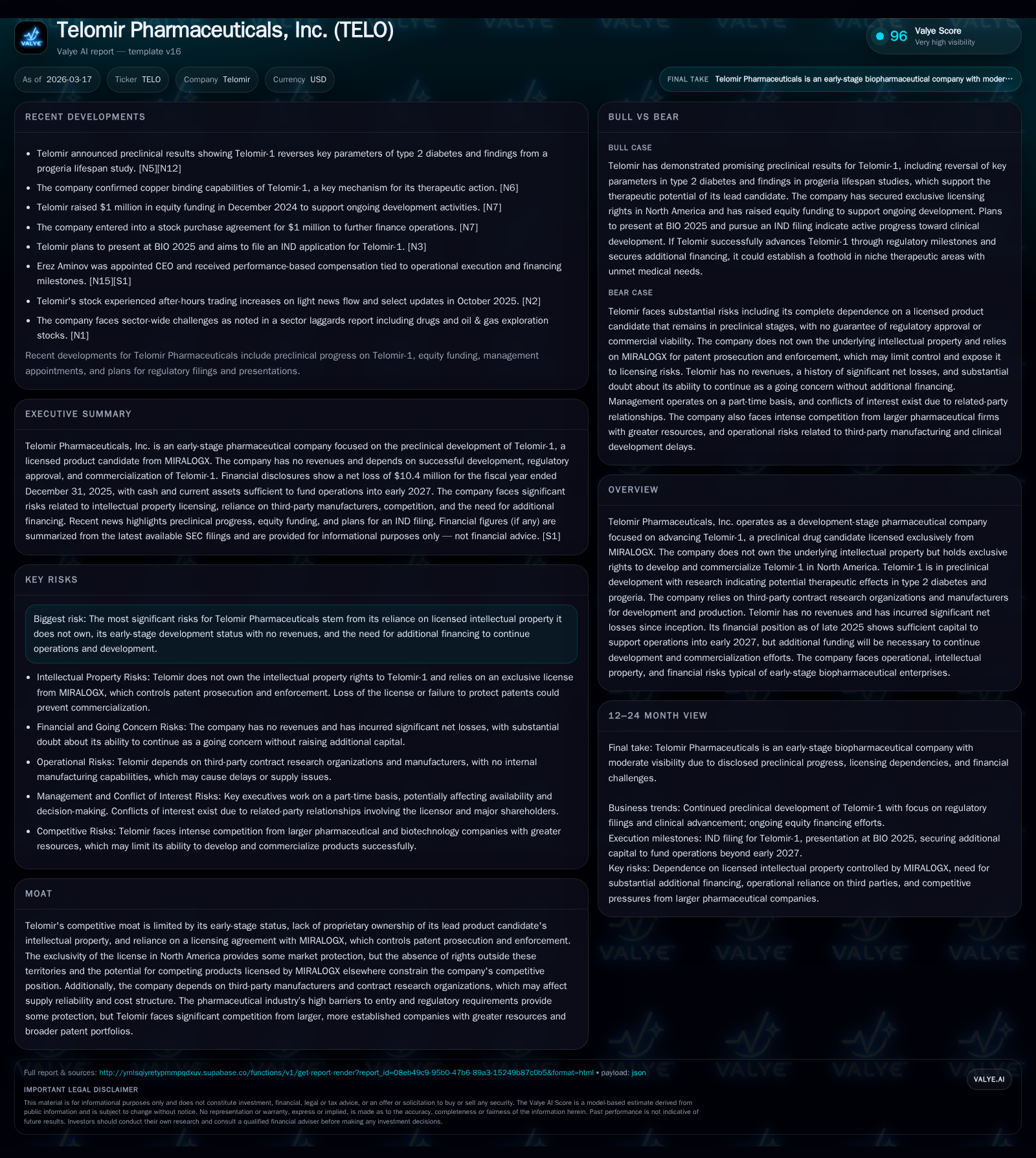
Telomir Pharmaceuticals, Inc. is an early-stage biotech focused exclusively on developing Telomir-1, a preclinical drug candidate licensed from MIRALOGX for North America. The company has no revenues and continues to post significant net losses as it relies entirely on external contract research organizations for development. Its competitive position is constrained by the lack of ownership of underlying IP and reliance on a licensing agreement. Available capital supports operations into early 2027, but further financing is essential to sustain research, clinical progress, and commercialization efforts. The company faces typical sector risks including regulatory approval uncertainty, patent protection challenges, and competitive pressures from larger pharma players.
Company Background and Business Model
Telomir Pharmaceuticals, Inc. (ticker TELO) operates as a development-stage pharmaceutical company primarily focused on advancing its lead product candidate, Telomir-1. This compound is still in the preclinical development phase with promising experimental results related to treating conditions such as type 2 diabetes and progeria [S1]. Importantly, Telomir does not own the underlying intellectual property rights to Telomir-1 but holds exclusive license rights for North America from MIRALOGX LLC, an intellectual property development firm owned by a trust associated with the company's founder [S11], [S14]. This licensing agreement grants Telomir the right to develop and commercialize Telomir-1 in the United States, Mexico, and Canada but excludes other global territories.
The licensor, MIRALOGX, retains ownership of the patent applications and manages all patent prosecution activities. Consequently, Telomir’s strategic control over IP matters is limited, including drafting patents and enforcing rights [S7], [S9], [S12]. This unique relationship poses operational considerations since any failure by Telomir in compliance or royalty payments can risk termination of its license rights [S14].
Development activities are largely outsourced to third-party contract research organizations (CROs) for research services and contract manufacturers for production processes [S13], [S16]. Such reliance underscores potential supply chain or quality risks that could affect timelines or costs.
Historical Financial Performance
Since inception, Telomir has generated no revenues and remains loss-making as expected for an early-stage biopharma company without commercial products [F1]. Net losses have been substantial but showed some improvement in fiscal year (FY) 2025 compared to FY2024:
Historical performance (annual)
| FY | Net ($mm) | CFO ($mm) | Net YoY |
|---|---|---|---|
| 2025 | -10 | -4 | +37.0% |
| 2024 | -17 | -5 | -26.5% |
| 2023 | -13 | -4 |
Source: SEC companyfacts cache [F1].
Capital returns and efficiency (annual)
| FY | ROE% |
|---|---|
| 2025 | -176.1 |
| 2024 | -2571.0 |
| 2023 | -380.2 |
Source: SEC companyfacts cache [F1].
Net losses narrowed by approximately 37% in FY2025 versus FY2024 while operating cash outflows decreased by nearly 27%, reflecting some enhanced cost efficiencies or slower spending pace [F1]. However, cash burn remains significant.
Equity values have fluctuated materially year-to-year possibly reflecting financing rounds and accumulated losses. ROE calculated as net income divided by equity was about -176% in FY2025 indicating sustained negative profitability despite the equity base growth [F1].
As of mid-2025, cash and equivalents stood at approximately $754K while current assets totaled about $7.34 million against $1.43 million in current liabilities—yielding a robust current ratio over 5x—signifying short-term liquidity stability but not implying long-term funding sufficiency [F1], [S13].
Future Growth Prospects
Future growth largely depends on successful advancement of Telomir-1 through preclinical stages into clinical trials followed by regulatory approvals. While specific milestones or timelines have not been publicly detailed post-March 2026 filings [N/A], recent disclosures indicate mechanistic activity in tumor cell mortality models relevant to cancer indications but core targets remain diabetes and progeria [S3].
Growth drivers include:
- Progression into human clinical trials.
- Continued funding availability for R&D.
- Regulatory approvals enabling commercialization.
- Establishment of manufacturing aligned with scale-up needs.
- Favorable payer reimbursement landscapes.
Constraints involve:
- Licensed IP limits direct control over patent enforcement or prosecution.
- Risk of license termination upon breach or disputes.
- Intense competition from larger pharmaceutical companies.
- Regulatory uncertainties inherent in drug development pathways.
Returns and Capital Allocation
Telomir currently demonstrates negative financial returns consistent with early-stage biopharma norms. With an approximate ROE near -176% in FY2025 driven by net losses relative to equity base [F1], profitability remains distant.
Capital allocation focuses exclusively on funding research and development activities without dividends or share repurchases noted [S23]. Management indicates available capital sufficient into early 2027 contingent on new financing rounds thereafter for ongoing operations [S13], [S16].
Industry Context & Competitive Positioning
Operating within a highly regulated environment marked by lengthy drug development cycles exceeding a decade on average with high attrition rates before market entry is typical for companies like Telomir. Licensing arrangements are common but limit control over core intellectual property. Challenges include patent protection complexities especially concerning naturally occurring compounds and global enforcement difficulties.
Commercialization hurdles extend to securing regulatory approvals alongside navigating payer coverage decisions amid cost containment pressures impacting pricing power upon launch.
Competitors range from large multinational pharmaceutical firms focusing on metabolic diseases to specialized biotech innovators. These entities often have deeper financial resources and greater pipeline control presenting competitive challenges for smaller license-dependent developers such as Telomir.
Risks Summary
Material risks include:
- Intellectual property dependence on external licensor controlling patent prosecution with termination risk upon non-compliance or disputes [S7], [S12], [S14].
- Developmental risk due to preclinical stage status with uncertain regulatory approval outcomes [S10], [S19].
- Financial sustainability concerns given ongoing net losses coupled with finite cash requiring timely capital raises [S13], [S16].
- Regulatory compliance obligations under FDA standards with potential penalties impacting operations if violated [S8], [S20].
- Competitive pressures from more established players limiting market penetration even if approved [S15], [S27], [S28].
- Governance conflicts stemming from overlapping ownership between licensor MIRALOGX and major shareholders potentially affecting transparency [S14], [S16].
- Supply chain vulnerability due to reliance on third-party vendors exposed to geopolitical risks such as regional conflicts affecting supplier continuity [S21].
What To Watch
Investors should monitor developments around:
- IND filings or initiation of clinical trials signaling advancement beyond preclinical stage.
- New data releases highlighting efficacy or safety profiles.
- Financing announcements critical for extending operational runway beyond early 2027.
- Strategic partnerships enhancing technical capabilities or geographic reach.
- Updates on patent prosecution status influencing exclusivity duration.
Overall outlook depends heavily on successful execution amid scientific innovation risks paired with complex regulatory requirements within a competitive market environment.
This report is intended solely for informational purposes regarding the business progressions and contextual industry considerations surrounding Telomir Pharmaceuticals. It does not constitute investment advice nor endorsement of securities trading decisions related thereto.
Disclaimer: This is research-only, informational analysis and not investment advice. It may include AI-generated interpretation and general industry context. Always verify important details using primary sources.

Comments