
Globus Maritime Ltd Advances Fleet Strategy Amid Cyclical Market Pressures
The company shows revenue growth powered by fleet renewal but contends with net losses and capital intensity inherent to dry bulk shipping.
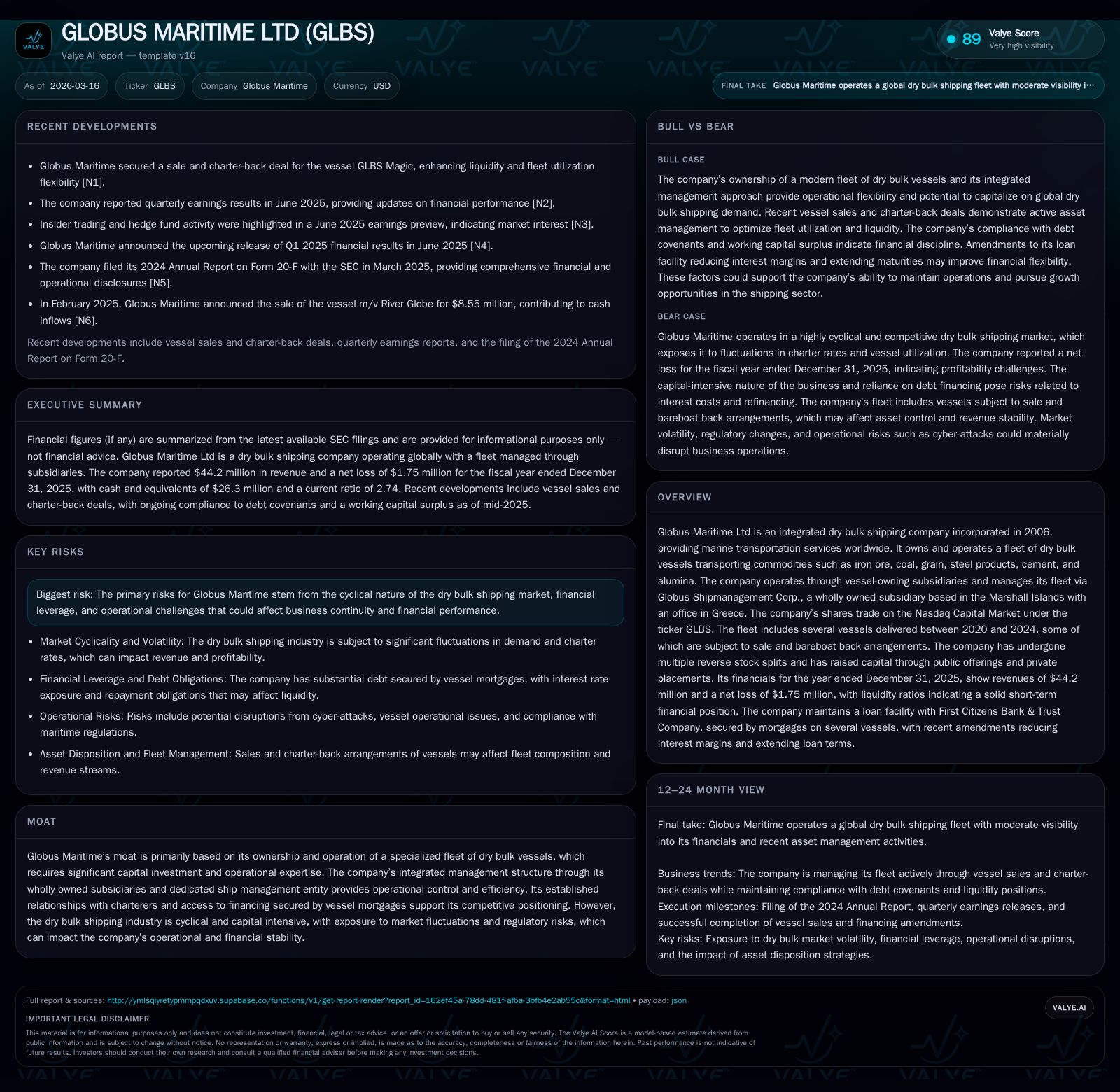
Globus Maritime Ltd reported a significant rebound in revenue to $44.2 million in 2025, driven by vessel deliveries from 2020 through 2024 and diversified cargo transportation. However, the company faced a net loss of $1.75 million amid rising financing costs and market cyclicality. Recent amendments to its CIT Loan Facility have improved debt terms, reducing interest margins and extending maturities. The sale and bareboat charter-back of the GLBS Magic vessel reflect ongoing strategic fleet capacity management in response to freight rate volatility and operational headwinds. Globus maintains a strong liquidity position with a current ratio of 2.74 at year-end 2025 but continues navigating an industry marked by cyclical earnings and capital demands.
Fleet Evolution and Revenue Drivers Through 2025
Globus Maritime Ltd's revenue increased notably from about $31.2 million in 2023 to $44.2 million in 2025, representing a robust 26.8% year-over-year expansion [F1]. This top-line growth correlates strongly with the company's strategic fleet evolution: several vessels were delivered between 2020 and 2024, expanding operational capacity. The dry bulk carriers transport essential commodities such as iron ore, coal, grain, steel products, cement, and alumina globally [S1]. This diversified portfolio of cargoes offers some resilience against demand fluctuations typical of specific commodity sectors.
The company's integrated business model centers around ownership through subsidiaries paired with Globus Shipmanagement Corp., its wholly owned management arm based in the Marshall Islands with an operational presence in Greece [S1]. This structure facilitates efficient voyage planning, crewing, maintenance, and compliance vital for maintaining fleet uptime amidst the rigorous demands of dry bulk logistics.
Despite recovering revenues post-2022's sharp contraction — when revenue was $61.7 million — the company’s net income exhibited increased volatility (see table), reflecting sector-wide cyclical pressures impacting freight rates and operating costs.
Historical performance (annual)
| FY | Rev ($mm) | Net ($mm) | Rev YoY | Net YoY |
|---|---|---|---|---|
| 2025 | 44 | -2 | +26.8% | -505.3% |
| 2024 | 35 | 0 | +11.7% | -91.8% |
| 2023 | 31 | 5 | -49.5% | -78.3% |
| 2022 | 62 | 24 |
Source: SEC companyfacts cache [F1].
Capital returns and efficiency (annual)
| FY | ROE% |
|---|---|
| 2025 | -1.0 |
| 2024 | 0.2 |
| 2023 | 3.0 |
| 2022 | 14.2 |
Source: SEC companyfacts cache [F1].
Earnings normalized as a percentage of equity show a circa -1% ROE for 2025 despite the healthy asset base [F1].
Market Cyclicality and Operational Headwinds Ahead
Dry bulk shipping remains highly cyclical due to supply-demand imbalances influenced by global industrial activity levels and commodity markets [S1]. The company explicitly acknowledges exposure to freight rate fluctuations which directly impact charter revenues—time charter equivalent rates vary widely across market cycles [S1]. Regulatory compliance costs are another headwind; evolving environmental rules can increase operating expenses through required investments or fuel switching.
Market data underscores these challenges: Globus’s recent sale and bareboat charter-back arrangement of the GLBS Magic vessel exemplifies strategic asset optimization under volatile conditions [N1]. This transaction injects liquidity into the balance sheet while transferring operation-related risks through lease obligations; although it improves capital efficiency, it also introduces fixed lease expenses that could compress margins during downturns. Such structured financing maneuvers are common in shipping as operators seek flexibility amid freight pricing uncertainty.
Capital Structure Amendments and Financing Trajectory
Globus Maritime has actively managed its debt profile to align cost structures with cash flow realities and improve financial flexibility [S3][S4][S5][S11][S12]. The CIT Loan Facility—initially contracted at about $34 million in mid-2021—expanded incrementally through top-up loans to $72 million by late-2023 with first preferred mortgages granted over newly acquired vessels including Diamond Globe, Power Globe, and Orion Globe [S4].
In September 2025, amendments lowered the applicable margin on all credit tranches from previously above 2.7% down to approximately 1.95%, coupled with aligned repayment schedules extending termination dates to August 10, 2027 [S3]. Interest is now set at Term SOFR plus margin (3%) versus earlier LIBOR-based benchmarks—reflecting broader market benchmark transitions [S4]. These refinancings reduce near-term interest burdens amid prevailing higher base rates.
Such proactive capital structure adjustments demonstrate measured risk management: securing asset-backed financing on vessels provides collateral strength while balancing leverage against cash flows generated by the full enterprise.
Cash Flow Dynamics and Return Metrics Analysis
At December 31, 2025, Globus held roughly $26 million in cash with total current assets at about $31 million against current liabilities near $11 million—a current ratio approximating a solidly liquid position around 2.74x [F1]. This liquidity cushion supplements operational continuity within the cyclical dry bulk backdrop.
Nevertheless, profitability strains emerge when assessing returns; the company posted a net loss for FY25 of $1.75 million compared to modest profits earlier years [F1]. Operating cash flow generation flattened near $1.2 million for H1’25 vs $7.7 million prior year half—a dynamic partially attributed to tighter working capital management margins [S5][S13][S18].
Capital allocation has not focused on distributions: no dividends or share repurchase programs were declared or executed during reported periods [S6][S7][S8][S9][S10]. Instead, proceeds from public offerings historically facilitated fleet expansion and debt servicing alongside warrant issuances that have lapsed unexercised or remain outstanding unexercised as they approach expiration between mid-2025 through mid-2026 [S22][S10].
Implications of Recent Vessel Sale and Charter-Back Deal
The recent sale and bareboat charter-back of vessel GLBS Magic marks a strategic recalibration of fleet capacity underpinned by liquidity needs amid spot market uncertainties [N1]. Sale-leaseback arrangements provide immediate cash inflows while ceding direct vessel operation control yet maintain service availability through bareboat charters.
From a maritime finance perspective, this aids in trimming upfront capital intensity on asset ownership yet creates recurring lease obligations potentially sensitive to market supply-demand shifts affecting earnings volatility [N1]. For Globus Maritime—given its integrated fleet management—it constitutes a flexible tool balancing operational presence with financial discipline.
Key Milestones and Factors to Monitor
Looking ahead into late-2026 horizon watchers should monitor upcoming warrant expirations (notably January ’21 Warrants expiring July ’26), scheduled principal repayments related primarily to amended CIT Loan Facility tranches due August ’27 as well as any further disposal or acquisition announcements indicative of fleet scaling directionality [N1][S1][S2].
Regulatory developments targeting emissions standards or ballast water treatment could pressure operational cost curves further requiring careful compliance budgeting impacting profitability prospects. Notably absent are explicit revenue or profit guidance disclosures within filings—making external freight market trajectories critical barometers for future performance outlooks.
Operational integration efficacy—the ability of Globus Shipmanagement Corp., alongside its subsidiaries managing vessel upkeep, crewing and certification—remains pivotal given narrow margin environments prevalent within dry bulk markets.
Disclaimer: This report is for informational purposes only and does not constitute investment advice or recommendations regarding securities of Globus Maritime Ltd.
Disclaimer: This is research-only, informational analysis and not investment advice. It may include AI-generated interpretation and general industry context. Always verify important details using primary sources.

Comments