
Capricor Therapeutics’ Quest for FDA Approval and Commercial Breakthrough
Deramiocel's August 2026 PDUFA date frames Capricor’s transition from clinical promise to commercial execution under financial and regulatory duress.
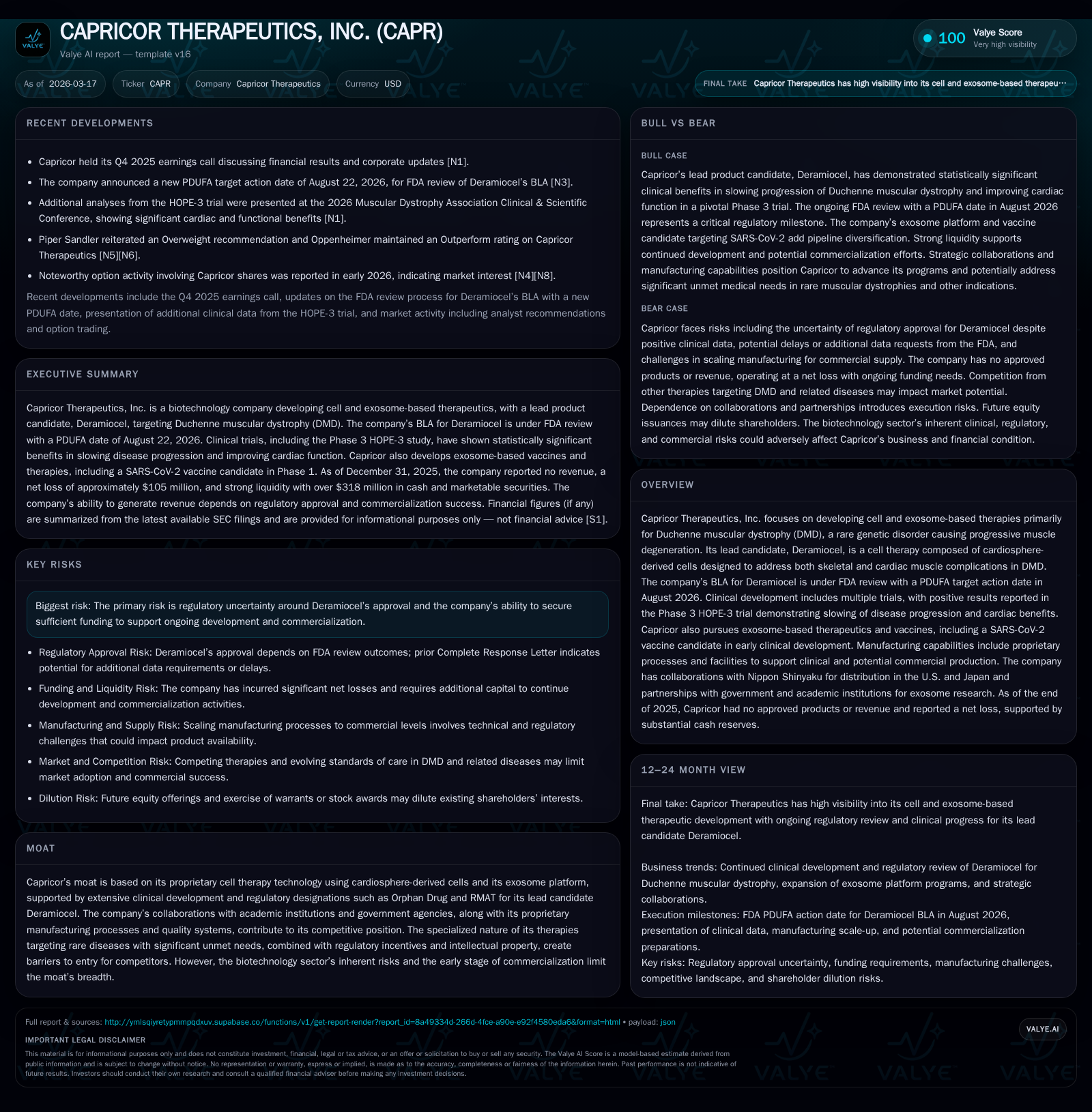
Capricor Therapeutics is poised at a critical juncture with its lead cell therapy, Deramiocel, targeting Duchenne muscular dystrophy. The company’s clinical advances have culminated in an FDA BLA submission under review for August 2026. However, the path forward is clouded by mounting operating losses, manufacturing scale-up challenges, and the complex economics of rare disease markets. Capricor’s cash position supports near-term operations but amplifies pressure to secure approval and successful market penetration amid regulatory uncertainties and payer negotiations.
Deramiocel’s Clinical Evolution and Historical Growth Drivers
Capricor Therapeutics’ core asset, Deramiocel, is a cardiosphere-derived cell (CDC) therapy targeting Duchenne muscular dystrophy (DMD), an ultra-rare genetic disorder characterized by progressive degradation of skeletal and cardiac muscles. Unlike mutation-targeted approaches such as exon-skipping or gene therapies, Deramiocel mediates multifaceted benefits via immunomodulation, anti-inflammatory, pro-angiogenic, and anti-fibrotic actions largely attributed to CDCs’ exosome secretion containing microRNAs and signaling molecules. These mechanisms converge to stabilize cardiac function while slowing skeletal muscle decline—critical endpoints given cardiomyopathy’s role as a leading cause of mortality in DMD.
Capitalizing on this unique biological profile, Deramiocel progressed through an extensive clinical development pipeline culminating in the Phase 3 HOPE-3 trial [N1][S1]. These clinical landmarks underpin Capricor's revenue recognition during FY2023 ($25.2M) and FY2024 ($22.3M), predominantly driven by milestone payments linked to governmental grants and collaborations rather than commercial sales [F1]. Revenue fell to zero by FY2025 as commercial launch had not commenced; the company remained investment-intensive with continued R&D spending reflected in expanding operating losses.
Historical performance (annual)
| FY | Rev ($mm) | Net ($mm) | CFO ($mm) | OpInc ($mm) | Rev YoY | Net YoY |
|---|---|---|---|---|---|---|
| 2025 | 0 | -105 | -70 | -108 | -100.0% | -159.6% |
| 2024 | 22 | -40 | -40 | -43 | -11.5% | -81.6% |
| 2023 | 25 | -22 | -26 | -24 | +886.8% | +23.2% |
| 2022 | 3 | -29 | 5 | -30 |
Source: SEC companyfacts cache [F1].
Capital returns and efficiency (annual)
| FY | FCF ($mm) | ROE% |
|---|---|---|
| 2025 | -73 | -34.4 |
| 2024 | -41 | -27.8 |
| 2023 | -27 | -98.6 |
| 2022 | 3 | -246.2 |
Source: SEC companyfacts cache [F1].
Table: Capricor Therapeutics Fiscal Years (FY) 2022–2025 Financial Performance Summary [F1]
These figures reflect a company heavily weighted toward R&D with no commercial product revenues yet; operating income worsened drastically reflecting expanded clinical activities and preparatory investments for potential launch.
Regulatory Review Milestones and Prospective Catalysts through 2026
Capricor’s defining near-term catalyst centers on the FDA's Prescription Drug User Fee Act (PDUFA) target action date set for August 22, 2026 [N3]. This deadline encapsulates comprehensive assessment of Deramiocel's Biologics License Application (BLA), including rigorous evaluation of clinical safety/efficacy data alongside manufacturing reliability—a crucial factor given the complex biologic nature of CDC products [S1].
Should approval be secured without delay or extraordinary post-marketing commitments such as Risk Evaluation and Mitigation Strategies (REMS), Deramiocel could become among the few cell therapies approved for DMD addressing both muscle domains simultaneously—a notable clinical advancement underscored by its Orphan Drug status conferring exclusivity incentives [S14]. Conversely FDA may require confirmatory trials or impose label restrictions potentially delaying reimbursement discussions.
Pharmacovigilance readiness will be pivotal as regulators scrutinize real-world safety profiles; any emerging adverse signals could temper labeling scope or prompt risk management programs increasing commercialization complexity [S24]. Furthermore international regulatory agencies represent future approval frontiers contingent upon satisfying respective local requirements [S26].
Investors should monitor outcomes from advisory panel reviews if convened alongside FDA communications post-PDUFA—for indications on potential labeling restrictions or further data requests [N3][S1]. The ultimate approval timeline will shape commercial planning and partnership negotiations significantly.
Commercial Readiness Amid Rare Disease Market Complexities
Capricor envisions initiating U.S. commercialization upon FDA approval with consideration of international licensing collaborations to broaden access [S1]. Given DMD’s prevalence under FDA orphan criteria (<200k patients), commercialization necessitates a specialized distribution ecosystem tailored for cell therapies requiring cold-chain logistics and precise dosing protocols at designated centers of excellence.
Nonetheless securing payor coverage remains a principal challenge due to orphan drug pricing scrutiny amidst ongoing U.S. healthcare reform efforts aimed at cost containment [S6][S16]. Payors may demand pharmacoeconomic justifications demonstrating long-term cost offsets from delayed disease progression relative to high upfront therapy costs [S25]. Negotiations over formulary placement—including potential step therapy requirements or restricted coverage—could impede patient uptake initially.
Moreover physician awareness campaigns must navigate FDA promotional constraints delineated strictly around approved indications mitigating off-label risk exposures [S6]. Patient advocacy engagement will be essential to drive demand within this tightly defined patient population.
Capricor also confronts reimbursement dynamics complicated by government program participation rules such as Medicaid Drug Rebate obligations affecting net realized prices [S4][S22]. Persistent regulatory vigilance regarding reporting accuracy under transparency laws will further complicate market access efforts.
Manufacturing Scale-up and Proprietary Exosome Platform Potential
Manufacturing represents a linchpin in Capricor’s strategic trajectory: Deramiocel production depends on qualified donor human hearts yielding CDCs subjected to proprietary isolation followed by expansion processes under current Good Manufacturing Practices (cGMP) [S1]. Scalability bottlenecks arise from donor tissue availability constraints as well as process replication fidelity necessitating extensive validation across all manufacturing stages.
The company has invested in internal facilities augmented by third-party manufacturer relationships intending to satisfy anticipated demand post-approval; however risks persist around capacity sufficiency and cost control [N1][S1]. Process validation complications or deviations during scale-up can result in supply interruptions adversely impacting launch timing.
Parallelly evolving is Capricor’s exosome platform harnessing extracellular vesicles for therapeutic payload delivery—a candidate technology diversifying revenue streams but still nascent relative to Deramiocel’s maturity [N1][S1]. Vaccine candidates including SARS-CoV-2 efforts leverage this platform illustrating technological breadth though development timelines extend beyond Deramiocel's immediate horizon.
Careful optimization of raw material sourcing coupled with robustness in process controls remains critical amid escalating regulatory expectations on manufacturing quality for cell-based therapies [S12][S26]. Emerging standards emphasizing comparability between clinical and commercial lots heighten operational complexity.
Capital Allocation Dynamics: Cash Burn and Investment Priorities
Financial statements underscore Capricor’s trajectory typified by intensifying cash consumption driven primarily by R&D expansion aligned with late-stage trial activity ramp-up and preparation for potential commercialization scaling [F1]. FY2025 operating loss approached $108 million representing a substantial increase from prior years’ losses reflecting heightened operational intensity.
Operating cash flow remained negative at approximately $69.8 million in FY2025 compounded marginally by capital expenditure increases associated largely with manufacturing scale investments totaling roughly $2.9 million last year—the largest annual capex over four years evidencing facility expansions or equipment upgrades aligned with commercial readiness preparations.
Despite this burn rate pushing negative free cash flow near $72.7 million (-$69.8M CFO minus $2.9M capex), Capricor carried a substantial liquidity buffer with cash & equivalents nearing $288 million entering FY2026 supporting runway into key milestone events including BLA decision [F1].
Equity base expanding markedly from ~$23 million end-FY23 to over $305 million end-FY25 corresponds to recent equity financings fueling R&D endeavors absent debt issuance indicating shareholder dilution but maintaining balance sheet flexibility [F1]. Reported approximate return on equity stands at about -34%, reflecting ongoing losses detrimental to equity value until product revenue materializes profitability is unlikely.
No dividends or share repurchases have been declared consistent with typical biotech praxis prioritizing reinvestment over yield distributions at this stage [F1]. Near-term capital allocation will likely sustain investment into pivotal regulatory activities alongside manufacturing scale-up activities critical ahead of anticipated commercial launch.
Risk Landscape: Regulatory Approval Uncertainties and Funding Constraints
Regulatory risks permeate Capricor’s outlook encompassing uncertainty inherent in BLA outcome timing along with potential FDA-requested label limitations or additional clinical study requirements post-approval that could delay revenue realization or increase operating expenditures significantly [N1][S1][S24]. Equally salient are manufacturing scale-up hazards where failure to expand production capacity efficiently may create supply shortages restricting market penetration.
Funding dependencies remain material despite ample cash reserves; should approval be delayed or fail outright re-capitalization needs could trigger dilutionary offerings which would weigh negatively on existing shareholders given persistent unprofitability trends [F1][S4]. Additionally healthcare policy volatility focusing on drug pricing transparency initiatives—such as most favored nation pricing proposals—pose downstream impacts threatening sustainable pricing power undermining orphan drug premium expectations historically observed in rare disease therapeutics [S16][S21][S25].
Compliance challenges related to increasingly complex healthcare laws governing marketing practices (including Anti-Kickback Statute ramifications), privacy regimes like HIPAA/GDPR overlapping state mandates such as CCPA further elevate operational risk exposures demanding substantial cost allocations toward governance infrastructure thereby scoping net margins in near-term commercial phases [S10][S19][S27][S28].
Collectively these factors highlight that while scientific innovation provides a strong moat leveraged through intellectual property rights and designated regulatory exclusivities protecting against competition broadly; the narrow therapeutic niche coupled with external systemic pressures instantiate significant headwinds requiring meticulous risk management going forward.
This analysis synthesizes factual data from SEC filings and recent market disclosures without extrapolating beyond documented sources. It is intended solely for informational purposes among professional audiences familiar with biotechnology sector dynamics.
Disclaimer: This is research-only, informational analysis and not investment advice. It may include AI-generated interpretation and general industry context. Always verify important details using primary sources.

Comments