
Standard BioTools Inc. Transitions After Divestiture with Persistent Losses
The company’s divestiture of SomaLogic realigns focus on core biotechnology platforms amid ongoing financial challenges.
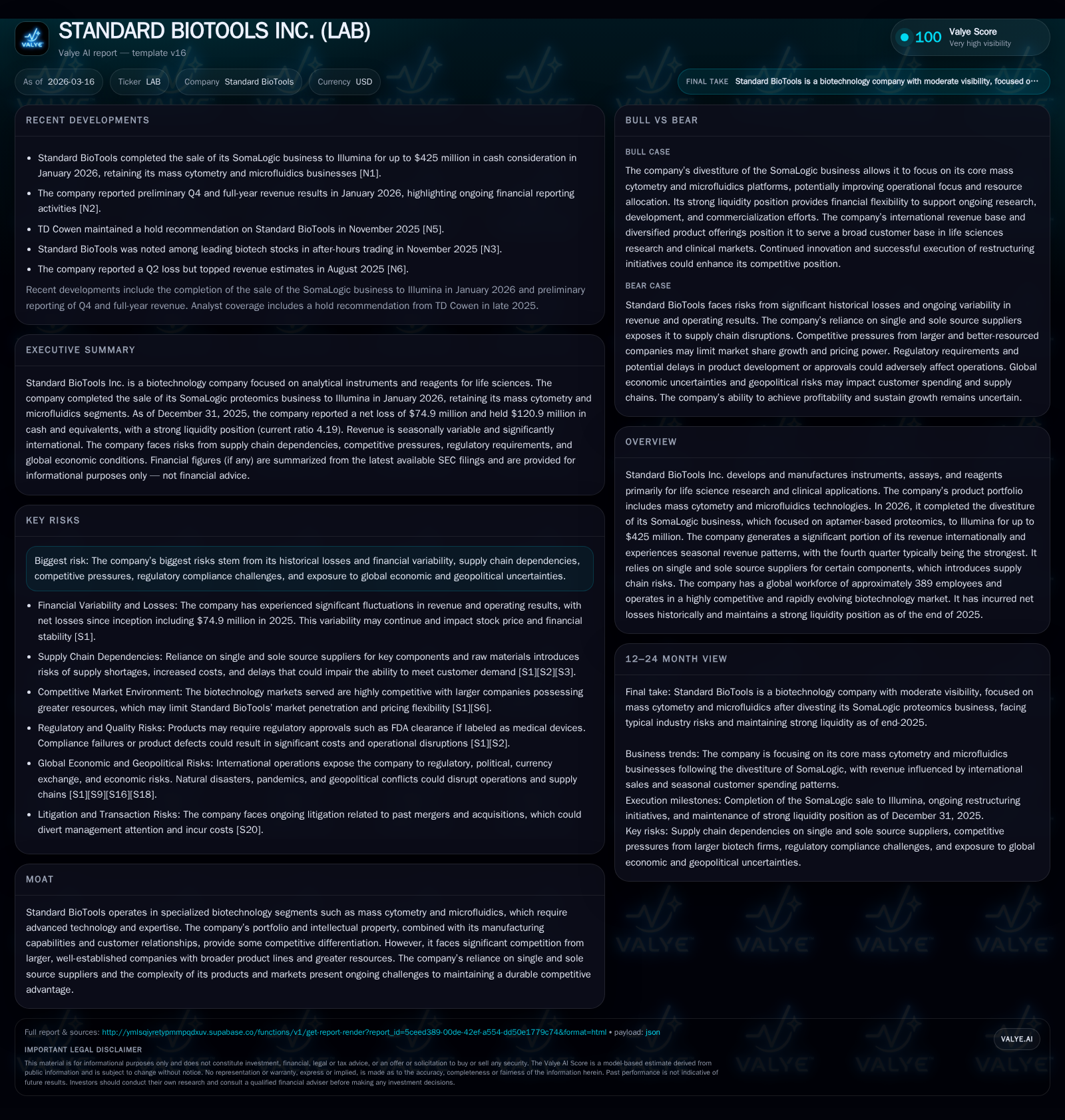
Standard BioTools Inc. completed the divestiture of its SomaLogic business in 2026, refinancing its strategic focus around mass cytometry and microfluidics technologies. Despite a 10.6% revenue increase in 2025 to $277 million, the firm sustained sizable operating losses though improved from prior years. The company faces supply chain vulnerabilities due to reliance on single and sole source suppliers, compounded by a competitive market landscape and ongoing legal disputes tied to its recent merger activities. Liquidity remains strong, but persistent negative cash flow and loss generation highlight operational risk as the firm navigates its portfolio transition.
Evolution of Revenue and Operating Losses (2017-2025)
Standard BioTools' financial trajectory over the past decade has been marked by fluctuating revenues alongside persistent operating losses. The company's revenue showed volatility from FY2014 through FY2017, peaking at roughly $33.5 million in 2014 before dipping below $28 million in 2017 [F1]. After completing the divestiture of SomaLogic in early 2026, the company reported revenue for FY2025 at approximately $277 million—signifying a marked increase compared to earlier years but still reflecting ongoing structural challenges. This represents a 10.6% year-over-year growth relative to the prior fiscal period [F1].
Despite revenue gains, operating income remained deeply negative at -$110 million in FY2025; though this marks a notable improvement from the prior year's -$175 million loss, it underscores continued pressure on margins and profitability [F1]. Net income followed a similar pattern with losses contracting but persisting at nearly -$75 million in 2025. The operating cash flow position remains weak with cumulative outflows exceeding $74 million for FY2025 [F1]. These figures converge toward a negative return on equity of approximately -17.7%, highlighting sustained challenges in translating top-line growth into earnings [F1].
This financial pattern illustrates the difficulty Standard BioTools faces balancing investment-intensive research and development efforts with commercial scalability within niche biotechnology fields.
Impact of SomaLogic Divestiture and Portfolio Realignment
In early 2026, Standard BioTools finalized the sale of its SomaLogic unit—the arm specializing in aptamer-based proteomics—to Illumina for potential proceeds up to $425 million in cash . This strategic divestiture signifies an explicit refocus on the company’s core proprietary technologies centered around mass cytometry and microfluidics platforms.
While this narrower portfolio may streamline operations and reduce complexity, it also reduces diversification, heightening exposure to demand fluctuations within specialized bioscience markets. The pivot removes one avenue of proteomics-based revenue while doubling down on highly technical product segments requiring precision manufacturing and ongoing innovation.
Yet this shift comes alongside unresolved operational challenges: the company must maintain competitiveness amid well-capitalized rivals offering broader life sciences solutions [S10]. The transaction also alleviates some near-term capital needs via liquidity infusion but imposes pressure on sustaining organic growth through mass cytometry and microfluidics expansion alone.
Geographic Reach and Seasonality Effects on Revenue
A majority portion of Standard BioTools' revenue stream—67% during FY2025—derives from international customers, emphasizing its global footprint across Europe, Asia-Pacific, and Canada markets [S4]. This geographic dispersion intensifies exposure to diverse economic conditions, compliance requirements, and currency fluctuations.
The company reports significant seasonality with Q4 typically yielding peak sales volumes owing to client budget spending behaviors ahead of fiscal year-ends [S4]. Q1 generally sees slower sequential activity as spending resets across sectors.
Moreover, Standard BioTools’ long-lived assets are largely concentrated in manufacturing hubs within the U.S., Singapore, and Canada — locations integral to producing both mass cytometry instrumentation and microfluidic consumables [S4]. This operational footprint supports global distribution but also increases vulnerability to localized geopolitical or environmental disruptions.
Supply Chain Constraints: Single and Sole Source Dependencies
Supply chain limitations persist as critical raw materials integral to Standard BioTools’ Delta Gene assays, Single Nucleotide Polymorphism (SNP) Type assays, Access Array target-specific primers, and Maxpar reagents depend heavily on single or sole source suppliers without formal contractual agreements locking supply terms [S4].
Such dependencies impose risks related both to component availability and pricing volatility. The company typically aims for minimal inventory levels but occasionally acquires incremental buffer stock strategically when supply risks intensify—a practice common among biotech firms dealing with specialized reagents where supplier diversity is limited [S4].
This vulnerability could disrupt lead times or inflate manufacturing costs if alternate sources are unavailable or if geopolitical tensions impact these suppliers’ countries.
Outlook: Growth Drivers, Market Competition, and Operational Risks
Though explicit forward guidance is scarce within public disclosures, investor attention should focus on several key indicators for Standard BioTools’ future trajectory: backlog trends (noted as unreliable due to cancellable purchase orders), new product releases particularly around mass cytometry enhancements, effective management of regulatory approvals for assay applications including those leveraging microfluidics technology, and litigation outcomes related to merger disputes [N3][S26].
Competitive pressures come sharply from large-cap peers such as Agilent Technologies, Thermo Fisher Scientific, Bio-Rad Laboratories in genomics elements; Cytek Biosciences and Becton Dickinson in flow cytometry; NanoString Technologies and 10x Genomics within spatial biology—markets characterized by innovation velocity and aggressive go-to-market tactics [S10].
The company’s niche expertise affords differentiation but requires continuous R&D success amidst potential patent litigations surrounding next-generation synthetic DNA assay technologies . Additional constraints arise from economic uncertainties affecting government research budgets impacting customer purchasing patterns [S14].
Capital Allocation Dynamics: Liquidity, Investment, and Shareholder Returns
Standard BioTools ended FY2025 with robust liquidity evidenced by cash & equivalents totaling approximately $121 million against current liabilities near $108 million—yielding an enviable current ratio near 4.19 that provides operational runway amid ongoing losses [F1][S23].
Capital expenditures remain relatively modest at about $8.3 million (flat YoY), appropriated chiefly toward sustaining manufacturing capabilities supporting mass cytometry instruments and microfluidic consumables production facilities in Canada and Singapore respectively [F1][S21][S24].
Despite sizeable operating deficits translating into free cash flow deficits exceeding $82 million annually (CFO minus Capex), management opted out of repurchasing shares post-2024 after ~$40 million buybacks occurred previously signaling a conservative capital stewardship conditioned by loss mitigation priorities [F1]. Dividend distributions are absent reflecting typical biotech sector reinvestment strategies during growth restructuring phases.
Legal Landscape and Intellectual Property Challenges
Standard BioTools faces multifaceted legal exposures relating primarily to lawsuits stemming from its merger integration with SomaLogic as well as patent disputes common in biotechnology involving proprietary nucleic acid inventions .
Litigation includes stockholder derivative suits contesting fiduciary duties during merger execution—with trials scheduled into early 2027—and contract breach claims over milestone payments linked to Palamedrix technology acquisition fallout [S5][S9].
Intellectual property matters further complicate operational stability. Supreme Court precedent distinguishes non-patent eligibility of naturally occurring genomic DNA versus patentability of synthetic DNA constructs underlying many assay innovations pursued by Standard BioTools [S6][S15]. Third-party claims alleging unauthorized use may force license negotiations or costly settlements impacting cost structures.
Additionally, indemnity obligations extend liability risk as products sold globally face varied infringement controversies through customers' clinical application contexts necessitating vigilant legal risk management.
Key Performance Table: Historical Financial Overview
Historical performance (annual)
| FY | Net ($mm) | CFO ($mm) | OpInc ($mm) | Capex ($mm) | Net YoY |
|---|---|---|---|---|---|
| 2025 | -75 | -74 | -110 | 8 | +46.1% |
| 2024 | -139 | -143 | -175 | 8 | -86.0% |
| 2023 | -75 | -43 | -77 | 3 | +60.7% |
| 2022 | -190 | -89 | -116 | 4 |
Source: SEC companyfacts cache [F1].
Capital returns and efficiency (annual)
| FY | Buybacks ($mm) | FCF ($mm) | ROE% |
|---|---|---|---|
| 2025 | 0 | -83 | -17.7 |
| 2024 | 40 | -152 | -29.4 |
| 2023 | 5 | -46 | 50.4 |
| 2022 | 1 | -93 | 233.3 |
Source: SEC companyfacts cache [F1].
Note: Financials reflect continuing operations post-SomaLogic divestiture; data gaps reflect unreported metrics per source.
Standard BioTools Inc.’s recent divestiture crystallizes a strategic inflection prioritizing core competencies in mass cytometry and microfluidics over diversified proteomics endeavors previously housed within SomaLogic. While top-line momentum appears modestly positive heading into 2026, profound operating losses continue alongside material cash burn cautioning prudential capital management.
The intrinsic complexities spanning global supply chains reliant on specialized inputs like Maxpar reagents’ metals sourced from sole providers emphasize operational fragility inherent in such high-tech biotechnologies. Furthermore, fierce competition coupled with evolving patent landscapes injects uncertainty into innovation returns.
Investors should monitor quarterly revenue seasonality patterns beyond headline growth rates plus developments tied to resolution or escalation of ongoing litigation which could influence future expense profiles or distract management focus.
Liquidity balances lend short-term stability; however achieving sustainable profitability requires steadfast execution against formidable industry incumbents alongside successful regulatory navigation for novel assay introductions targeting expanding life science research markets.
Disclaimer: This analysis is informational only based on publicly available data as of March 16, 2026; it does not constitute investment advice or recommendations.
Disclaimer: This is research-only, informational analysis and not investment advice. It may include AI-generated interpretation and general industry context. Always verify important details using primary sources.

Comments