
Perion Network Ltd.'s 2025 Results Reflect Market Challenges and Strategic Realignment
Perion’s 2025 financials show revenue contraction and operating losses amid restructuring and acquisition-driven growth, with significant stock-based compensation supporting talent retention.
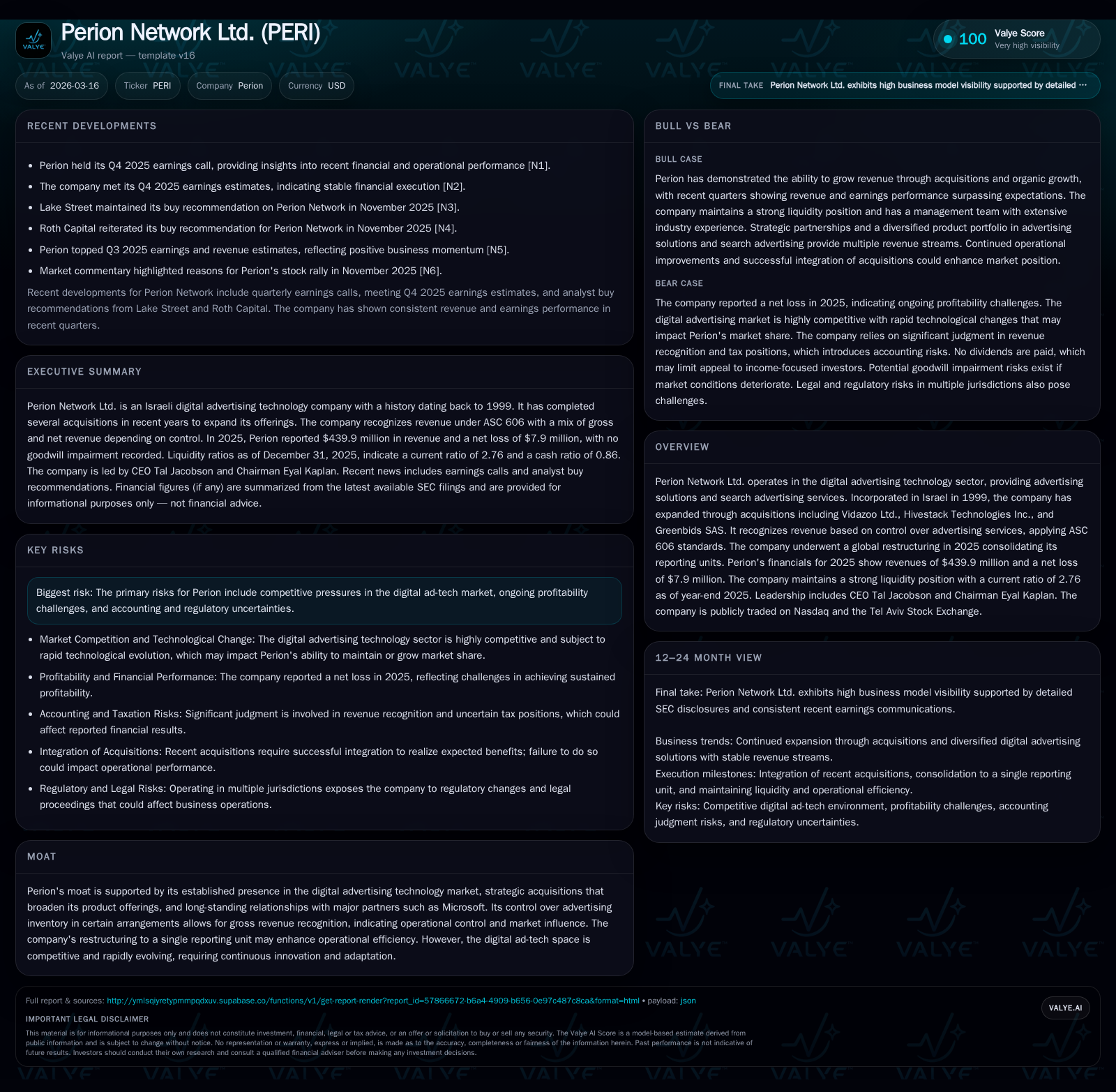
Perion Network Ltd. reported a revenue decline of 11.7% to $439.9 million in 2025, alongside an operating loss of $14.9 million and a net loss of $7.9 million, reflecting market pressures and restructuring costs [F1], [S1]. The company expanded its programmatic advertising capabilities through acquisitions including Vidazoo, Hivestack, and Greenbids, which increased goodwill balances without immediate profit improvement [S1], [S5], [S7]. Revenue recognition under ASC 606 involves judgment on gross versus net reporting depending on control over advertising inventory [S1]. A global restructuring consolidated reporting units to streamline operations [S1]. Despite losses, Perion generated positive operating cash flow of $41.9 million and maintains strong liquidity with a current ratio of 2.76 [F1]. Capital allocation emphasizes stock-based compensation totaling $31.1 million in 2025, with no recent dividends declared [S1], [S4].
Financial Performance Overview: Revenue Decline and Losses in FY2025
Perion Network Ltd.'s annual report for fiscal year 2025 reveals a continued decline in revenues alongside worsening operating results compared to prior years [F1], [S1]. Revenue decreased by 11.7% year-over-year to approximately $439.9 million from $498.3 million in 2024 [F1]. This follows a steeper decline from the peak revenue level of $743.2 million realized in 2023.
Operating income deteriorated substantially, moving from a modest operating loss of $3.0 million in FY24 to a larger loss of $14.9 million in FY25, a negative change exceeding 390% [F1]. Similarly, net income shifted from positive $12.6 million in FY24 to a net loss of $7.9 million in FY25 [F1]. These results reflect ongoing pressures within the digital advertising sector combined with costs related to corporate restructuring.
Historical performance (annual)
| FY | Rev ($mm) | Net ($mm) | CFO ($mm) | OpInc ($mm) | Rev YoY | Net YoY |
|---|---|---|---|---|---|---|
| 2025 | 440 | -8 | 42 | -15 | -11.7% | -162.9% |
| 2024 | 498 | 13 | 7 | -3 | -32.9% | -89.3% |
| 2023 | 743 | 117 | 155 | 117 | +16.1% | +18.3% |
| 2022 | 640 | 99 | 122 | 109 |
Source: SEC companyfacts cache [F1].
Capital returns and efficiency (annual)
| FY | FCF ($mm) | ROE% |
|---|---|---|
| 2025 | 38 | -1.2 |
| 2024 | 0 | 1.7 |
| 2023 | 155 | 16.3 |
| 2022 | 121 | 17.0 |
Source: SEC companyfacts cache [F1].
Table: Key financial metrics illustrating Perion's revenue contraction coupled with widening losses despite positive cash flow generation.
Acquisition Strategy Expands Capabilities but Challenges Profitability
Perion has pursued growth through acquisitions including Vidazoo Ltd., Hivestack Technologies Inc., and Greenbids SAS over recent years up to mid-2025 [S1]. These transactions have enhanced Perion’s programmatic advertising capabilities, especially within connected TV (CTV) inventory via Hivestack.
The acquisitions have resulted in increased goodwill on the balance sheet due to purchase price premiums over identifiable net assets [S5], [S7]. While these investments broaden market reach, they have not yet translated into improved profitability, highlighting integration complexity and synergy realization challenges.
As of December 31, 2025, no goodwill impairments were recorded, suggesting management's confidence in the acquired assets’ valuation despite uncertain near-term profit contributions [S5], [S7].
ASC Topic 606 Revenue Recognition Policy Highlights
Perion applies ASC Topic 606 for revenue recognition, which involves critical judgments around whether it acts as principal or agent in its advertising contracts [S1]. When Perion controls the specified good or service before transfer—such as controlling ad inventory or pricing discretion—it recognizes revenue on a gross basis representing total customer payments.
Conversely, when acting as an agent without control over inventory or pricing discretion, revenue is recognized on a net basis after deducting amounts payable to publishers or third parties [S1]. This accounting approach materially affects reported revenue amounts and their comparability across periods depending on contract mix.
Operational Restructuring for Enhanced Efficiency
During fiscal year 2025, Perion undertook a global restructuring that consolidated its prior two reporting units into a single segment aimed at streamlining operations and improving decision-making agility [S1].
This consolidation may reduce reporting granularity but is intended to enhance operational efficiency amid evolving market conditions.
Capital Allocation: Focus on Stock-Based Compensation and Cash Management
In fiscal year 2025, Perion recorded stock-based compensation expense totaling approximately $31.1 million distributed across cost of revenue ($3.3M), research & development ($5.4M), selling & marketing ($12.6M), and general & administrative expenses ($9.8M) according to ASC Topic 718 guidance [S1]. These equity incentives are critical for retaining talent amid operational headwinds.
Capital expenditures declined by about 44.7% year-over-year to $3.8 million reflecting cautious investment during profitability challenges [F1], [S4], [S16]. The company did not declare or pay dividends during the period consistent with its policy prioritizing reinvestment over distributions given liquidity considerations [S9].
Perion maintained strong liquidity at year-end with current assets of approximately $519.8 million against current liabilities near $188.6 million yielding a current ratio of about 2.76 [F1]. Operating cash flow was positive at $41.9 million resulting in free cash flow (operating cash flow less capex) of roughly $38 million for the year—a key strength amid reported losses.
Risks and Outlook Considerations
Risks facing Perion include intense competition within digital ad technology markets impacting pricing power and margins; uncertainties related to regulatory scrutiny over data privacy and advertising practices; ongoing litigation concerning historical disclosures; and complexities inherent in accounting estimates particularly surrounding revenue recognition and goodwill valuations ([S6], [S9], [S10]).
While explicit multi-year guidance is not provided ([N1], [N2]), key performance indicators such as improvements from operational restructuring, adoption of AI-driven products like Outmax ([N3]), contract mix shifts affecting revenue recognition, partner relationship stability, and regulatory developments will be important metrics for investors.
This analysis is based solely on publicly available information cited herein and does not constitute investment advice or recommendations.
Disclaimer: This is research-only, informational analysis and not investment advice. It may include AI-generated interpretation and general industry context. Always verify important details using primary sources.

Comments