
Grayscale’s GSOL Trust: Financial Trends, Strategic Shifts, and Regulatory Challenges
Analyzing Grayscale Solana Staking ETF’s financial results, strategic rebranding to staking focus, and regulatory risks shaping its outlook.
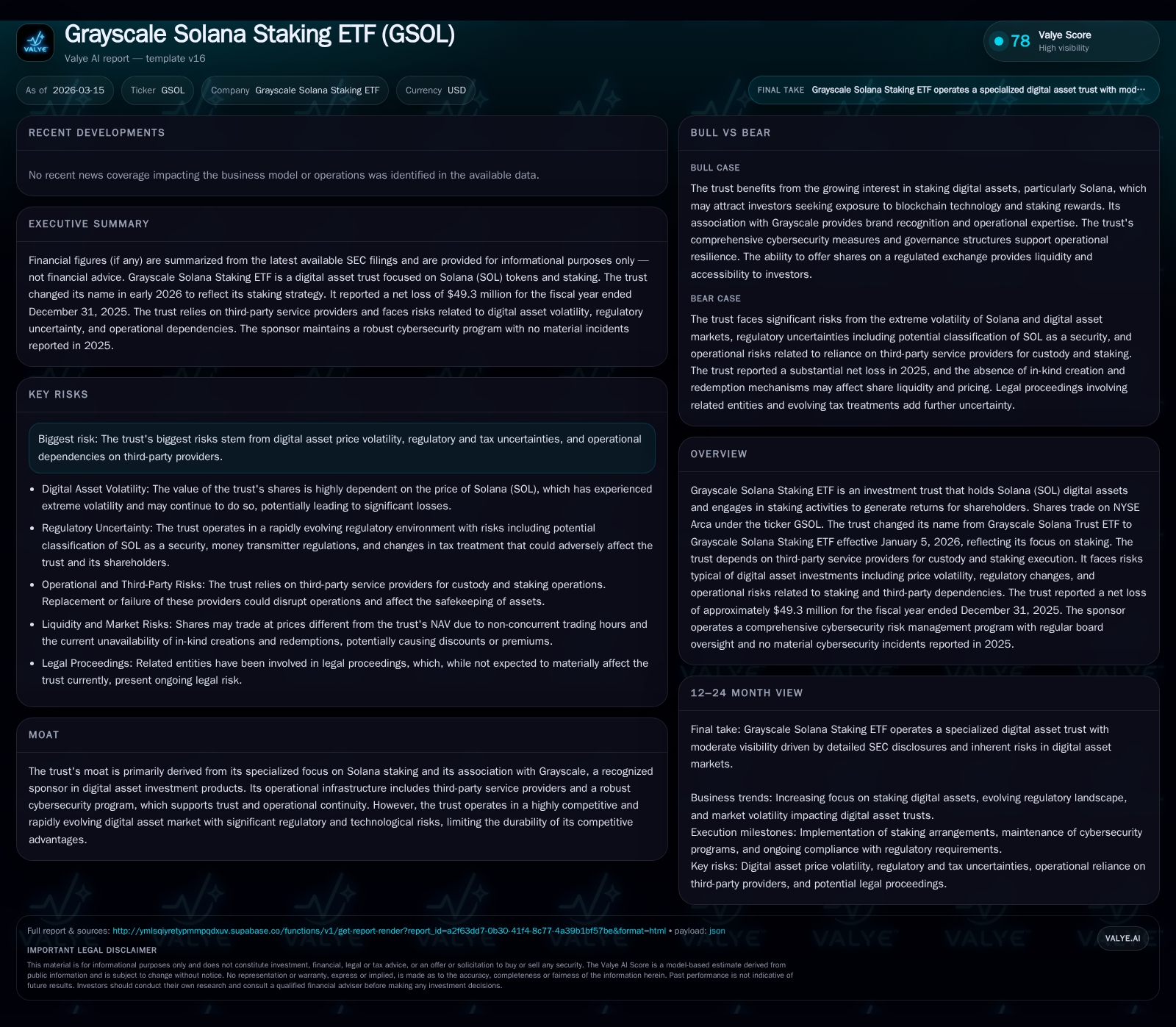
Grayscale Solana Staking ETF (GSOL) underwent a strategic transition with its January 2026 rebranding emphasizing active staking of SOL tokens. The trust reported a net loss of $49.3 million for fiscal year 2025 amid volatile digital asset markets and operational costs from staking activities. Staking offers potential yield enhancement but introduces liquidity constraints and reliance on third-party service providers. The evolving regulatory environment poses uncertainty over classification, tax treatment, and permissible activities for digital asset trusts. Monitoring GSOL’s staking compliance, redemption program functionality, and regulatory responses will be critical to assessing future performance.
Historical Financial Performance
Grayscale Solana Staking ETF (GSOL), formerly Grayscale Solana Trust ETF until early 2026, holds substantial positions in Solana (SOL) tokens. For the fiscal year ended December 31, 2025, the trust reported a net loss of approximately $49.3 million reflecting market volatility and operational expenses related to its strategic shift toward active staking [F1].
Before uplisting shares to NYSE Arca on October 29, 2025, GSOL's shares traded on OTCQX where prices often deviated significantly from net asset value (NAV), driven by non-aligned trading hours limiting arbitrage opportunities. Post-uplisting observations indicate improved NAV tracking by share prices [S2].
Effective October 1, 2025, the NAV calculation transitioned from the CoinDesk Solana Price Index (SLX) to the CoinDesk SOL CCIXber Reference Rate — a composite benchmark drawing from multiple trading venues — enhancing robustness against distortions typical in digital asset pricing [S2].
Historical performance (annual)
| FY |
|---|
| 2025 |
Source: SEC companyfacts cache [F1].
Strategic Shift: Name Change and Staking Focus
On January 5, 2026, the trust formally changed its name to Grayscale Solana Staking ETF to signify its intensified commitment to leveraging staking rewards within the Solana blockchain ecosystem [S16][S25].
Staking involves delegating SOL tokens to network validators who secure transactions in exchange for protocol-generated rewards expressed as annual yields. This approach aims to enhance returns beyond passive holding.
However, staked assets are subject to lock-up periods governed by network consensus rules that restrict liquidity. Failure to meet required "staking conditions" can affect reward payments or result in penalties [S4]. The trust relies heavily on third-party custodians and validator service providers for secure custody and effective staking execution.
Operational Considerations: Rewards Potential vs Liquidity Risks
Solana's blockchain enables prescribed staking yields that offer GSOL avenues for growth beyond price appreciation alone. By retaining rewards within the trust rather than distributing them immediately, shareholders may benefit from compounding effects over time.
Nevertheless, SOL remains highly volatile; market fluctuations could overshadow incremental rewards over short terms [S6][S7]. Lock-ups create liquidity constraints potentially challenging redemption demands.
Third-party validators introduce counterparty risks; disruptions or service failures could impair staking continuity or security [S1].
Regulatory Landscape and Legal Risks
Regulatory uncertainty is a significant risk factor. Classification of SOL as a "security" by U.S. regulators could impose compliance costs or force registration impacting operations [S4][S6].
Potential money transmitter regulations affecting authorized participants or sponsors might reduce liquidity or raise operational expenses [S4].
Tax treatment ambiguity means shareholders might incur tax liabilities without corresponding cash distributions—posing challenges for yield-focused investors [S9].
Litigation involving related entities such as Digital Currency Group affiliates adds legal uncertainty though management does not anticipate material impact on GSOL directly [S5].
Governance and Risk Management: Custody and Cybersecurity
Critical functions like custody of SOL assets and staking operations are outsourced to vetted third-party providers subject to rigorous risk assessments overseen by a seasoned Chief Information Security Officer (CISO) at Grayscale Investments Sponsors LLC [S1][S8].
Providers undergo regular cybersecurity audits including penetration testing and business continuity drills with findings reported quarterly to Grayscale's Enterprise Risk Committee and board.
No material cybersecurity incidents affecting operations or financial condition were identified during fiscal year 2025—a key factor supporting operational resilience.
Capital Allocation: Losses Limit Returns Metrics; Focus on Operations
With a net loss of $49.3 million reported for FY2025, traditional profitability metrics such as Return on Equity (ROE) remain negative [F1]. There is no record of dividends or share repurchases; capital allocation prioritizes maintaining operational capacity and supporting staking infrastructure amid transition phases [S11–S16].
The trust operates without leverage or derivatives exposure supporting a conservative capital structure suited for volatile markets.
Redemption programs initiated post-uplisting facilitate liquidity through authorized participants exchanging creation baskets consisting of blocks of 10,000 shares against underlying SOL deposits [S2].
Market Dynamics: NAV Behavior & Trading Price Volatility
The transition from OTCQX trading with notable NAV deviations toward NYSE Arca listing has improved price alignment but market dynamics remain sensitive due to asynchronous trading hours between exchange sessions versus continuous digital asset markets causing occasional premiums or discounts [S6][S7].
Suspension risks related to redemption eligibility may exacerbate discount scenarios undermining arbitrage mechanisms vital for transparent pricing.
Outlook: Key Factors Influencing Future Performance
Monitoring several evolving factors will be critical:
- Changes in Solana network protocol impacting staking yields or lock-up durations;
- Efficiency of authorized participant processes influencing liquidity profiles;
- Regulatory developments clarifying securities classification and compliance requirements;
- Legal outcomes involving related corporate entities affecting market sentiment;
- Updates from custodian or validator partners regarding operational reliability.
Non-compliance with stipulated "staking conditions" could reduce reward capture capacity detrimentally impacting trust value [S4]. Likewise, effective functioning of redemption programs remains essential for maintaining investor confidence.
This report summarizes factual financial data combined with strategic shifts and risk disclosures directly sourced from official SEC filings without speculative forecasts. Given digital assets’ volatility alongside evolving regulatory frameworks globally, ongoing vigilance is advised when considering investments in similar trusts.
Disclaimer: This is research-only, informational analysis and not investment advice. It may include AI-generated interpretation and general industry context. Always verify important details using primary sources.

Comments