
TerrAscend Corp.'s Return to Operating Profit Contrasts Persistent Net Losses and Regulatory Headwinds
The vertically integrated cannabis operator shows a rebound in operating income amid ongoing federal legal challenges and capital constraints.
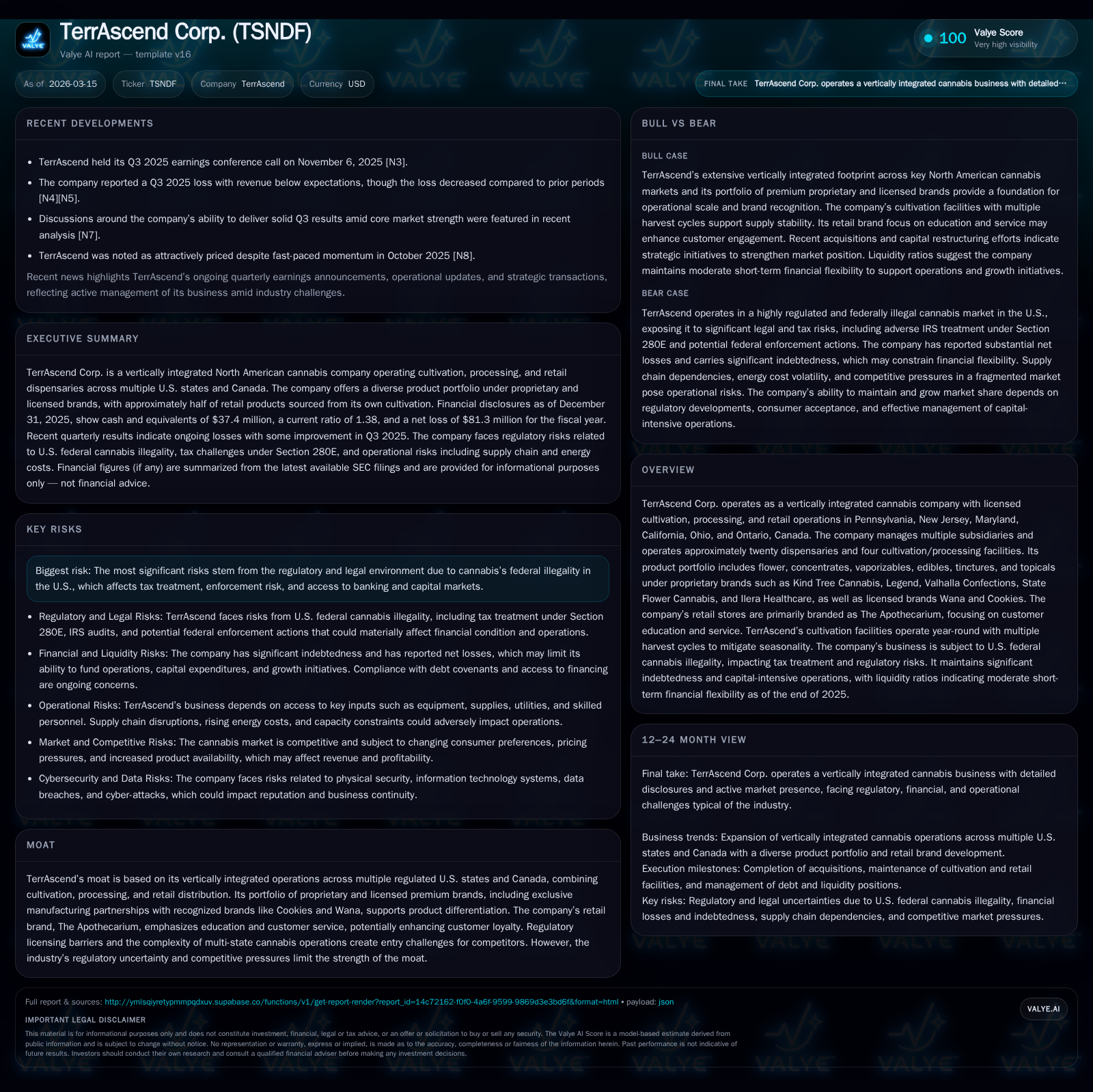
TerrAscend Corp. demonstrated a marked improvement in operating income for fiscal 2025, shifting from substantial operating losses in prior years. Despite this, the company remains challenged by significant net losses, largely driven by non-operating expenses and persistent federal tax burdens under Section 280E. Its vertically integrated presence across multiple U.S. states and Canada, combined with premium brand licensing partnerships, underpin its growth prospects, but regulatory uncertainty and capital structure risks persist. Cash flow generation improved, enabling modest share repurchases while capex spending remains controlled amid ongoing debt obligations.
Historical Financial Performance
TerrAscend Corp., a vertically integrated cannabis company, has experienced a notable turnaround in operational profitability during fiscal year 2025. The company's operating income swung from negative $17.1 million in 2024 to positive $42 million in 2025, an approximate 346% improvement year-over-year [F1]. This reversal reflects increased operational efficiencies across the group's cultivation, processing, and retail units primarily in Pennsylvania, New Jersey, Maryland, California, Ohio, and Ontario. The synergy of managing around twenty dispensaries alongside four cultivation/processing sites has begun to manifest in operating leverage.
Despite these operating improvements, TerrAscend remains unprofitable on a net basis. Net losses slightly widened to $81.3 million in 2025 from $72.7 million in the prior year [F1]. This disconnect arises largely from non-operating charges including significant tax expenses related to Section 280E of the Internal Revenue Code—an adverse federal tax provision barring deduction of many ordinary business expenses for cannabis companies—and interest costs on outstanding debt facilities.
Underlying cash flow generation has turned positive consistently since 2023 with cash flow from operations (CFO) of $21.5 million reported in 2025, though down from the previous year's $37.9 million as working capital fluctuations have moderated [F1]. Capital expenditures dipped moderately to $8.6 million in 2025 compared to nearly $9.4 million a year earlier as expansion projects pause amid tougher market conditions [F1]. Equity capital has contracted markedly over recent years from highs near $321 million at the end of 2022 to just under $100 million at year-end 2025 due primarily to accumulated losses impacting retained earnings and equity value [F1]. The balance sheet shows current assets exceeding current liabilities by roughly $31 million for a current ratio of 1.38x [F1], indicating manageable near-term liquidity.
Historical performance (annual)
| FY | Net ($mm) | CFO ($mm) | OpInc ($mm) | Capex ($mm) | Net YoY |
|---|---|---|---|---|---|
| 2025 | -81 | 22 | 42 | 9 | -11.9% |
| 2024 | -73 | 38 | -17 | 9 | +16.2% |
| 2023 | -87 | 27 | -23 | 8 | +73.3% |
| 2022 | -325 | -26 | -336 | 40 |
Source: SEC companyfacts cache [F1].
Capital returns and efficiency (annual)
| FY | Buybacks ($) | FCF ($mm) | ROE% |
|---|---|---|---|
| 2025 | 410000 | 13 | -82.1 |
| 2024 | 215000 | 29 | -41.1 |
| 2023 | 20 | -36.0 | |
| 2022 | -66 | -101.3 |
Source: SEC companyfacts cache [F1].
*Revenue not explicitly provided; omitted per data availability guidelines.
Business Model and Market Position
TerrAscend's business model integrates cultivation, processing, and retail distribution across key regulated markets including Pennsylvania (6 dispensaries), New Jersey (4 dispensaries), Maryland (4 dispensaries), California (4 dispensaries), Ohio (1 dispensary), and Ontario via Cookies Canada retail locations [S1,S18]. The firm leverages proprietary brands such as Kind Tree Cannabis alongside licensed products like Wana and Cookies — collaborations that bolster brand equity and market positioning within the competitive cannabis space [S1].
Retail operations primarily under "The Apothecarium" banner emphasize consumer education and experiential selling environments designed to differentiate from commoditized cannabis offerings seen elsewhere [S1]. Multiple harvest cycles within climate-controlled indoor growing facilities reduce seasonality impacts common in agricultural operations [S1], enhancing supply stability.
However, regulatory complexity varies by state within the U.S., challenging harmonization of sales, marketing, packaging compliance, and distribution strategies which may limit scalability or cross-market synergies compared to industries with less fragmented regulation frameworks .
Regulatory Environment & Risks
The most critical constraint on TerrAscend's financial performance remains regulatory uncertainty stemming from cannabis's federal illegality in the U.S., classified as Schedule I under the Controlled Substances Act . This classification contributes directly to heavy tax burdens under IRC Section 280E that disallow routine business deductions that benefit most other companies — no relief is currently assured despite ongoing court challenges [S1].
This unfavorable tax treatment inflates effective federal income tax rates materially beyond comparable sectors.
Banking access is restricted due to federal prohibitions complicating capital raises or credit usage despite significant indebtedness totaling approximately $245 million as of December 2025 — predominantly a FG Loan tranche — complete with covenants limiting dividend payments, additional borrowings or transactions without lender consent [S4,S6,S9]. These debt constraints impair flexibility, narrowing ability to fund capex or acquisitions without refinancing or equity raises.
Regulatory risk extends beyond federal legality: local licensing renewals could be delayed or denied; marketing restrictions vary substantially by jurisdiction restricting promotion activities; product recalls due to safety issues or labeling may disrupt supply chains; ongoing litigation including intellectual property disputes exist but so far are not expected to exert material financial impact . Cybersecurity threats present further operational vulnerabilities given handling of sensitive health-related customer data under numerous privacy regimes [S10,S18,S22].
Environmental factors inherent from indoor agriculture — insect infestation or supply chain disruptions for key utilities such as water or electricity — also pose non-trivial operational risks despite controlled growing environments [S29].
Growth Prospects & Constraints
Future growth hinges heavily on expanding market share within existing regulated states through brand loyalty and product innovation across multiple categories including flower, concentrates, edibles, tinctures and topicals [S1]. Retail network expansion opportunities exist but must align with state caps on dispensary counts or cultivation space restrictions which differ markedly among jurisdictions [S28,S26].
The company’s licensed brand portfolio combined with proprietary offerings supports differentiation but depends on successful marketing adaptation within complex regulatory frameworks limiting advertising methods accessible compared with mainstream consumer packaged goods industries.
Federal rescheduling or legalization would dramatically ease tax burdens and financing access; however no fixed timeline exists amidst shifting political landscapes ([S1] references executive orders encouraging research but rescheduling remains pending). Such changes could materially accelerate profit realization making current losses potentially temporary hurdles.
Competition intensifies both from new licensed entrants encouraged by regulatory loosening at some state levels plus illicit market operators which often exert downward pricing pressure detrimental to margins especially wholesale pricing that constitutes an industry-wide challenge presently noticeable across all players ([S24]). Cannabinoid product developments incorporating innovations such as standardized dose pens or infused wellness supplements hint at growth vectors but require constant R&D investment amid cost control pressures ([S11],[S26]).
Capital Allocation & Returns Profile
TerrAscend has not paid dividends historically nor does it intend foreseeable payouts given reinvestment focus required by ongoing industry maturation ([S17]). Returning value directly via share buybacks resumed timidly with about $410k repurchased in FY2025 against the backdrop of debt service commitments restricting discretionary cash deployment ([F1],[S14]).
Approximate return on equity remains negative at -82%, reflecting loss carryforwards burdening shareholder equity levels dominated by accumulated deficits ([F1]). Free cash flow harvested remains positive yet modest ($12.9 million estimated for FY2025 after capex), emphasizing continued prudent spending cognizant of capital-intensive facility maintenance needs along with funding working capital requirements ([F1]). Managing leverage is critical given covenant restrictions that may hamper strategic maneuvers without lender approvals ([S4],[S6],[S9]).
What To Watch Going Forward (Analysis)
Key milestones include any shifts in legislation or regulatory clarity at the federal level regarding taxation or legal status of cannabis which could reshape margins significantly. Monitoring quarterly cash generation trends alongside incremental margin improvement will illuminate operational scalability gains. Debt refinancing efforts could alter capital structure burden if more favorable terms emerge. Signs of expansion either through increases in retail footprint or entry into new legalized markets would signal appetite for growth offsetting competitive pressures. Innovations expanding product portfolio breadth encompassing emerging cannabinoid derivatives may create new revenue streams where regulatory approval allows. Continued management response towards evolving marketing constraints will indicate ability to sustain brand strength amid compliance complexities. Lastly, how ongoing IRS audits related to Section 280E are resolved bears substantially on long-term tax liabilities affecting net profitability prospects ([S1]).
This analysis is based on publicly available filings and reports as of March 15, 2026 . It aims to provide an informed perspective on TerrAscend Corp.'s business status without offering investment opinions or predictions about future financial performance.
Disclaimer: This is research-only, informational analysis and not investment advice. It may include AI-generated interpretation and general industry context. Always verify important details using primary sources.

Comments