
Horizon Kinetics Holding Corp: Contrarian Investing Through Market Cycles
A detailed analysis of Horizon Kinetics reveals how its contrarian investment philosophy supports resilience amid volatile financials and AUM trends.
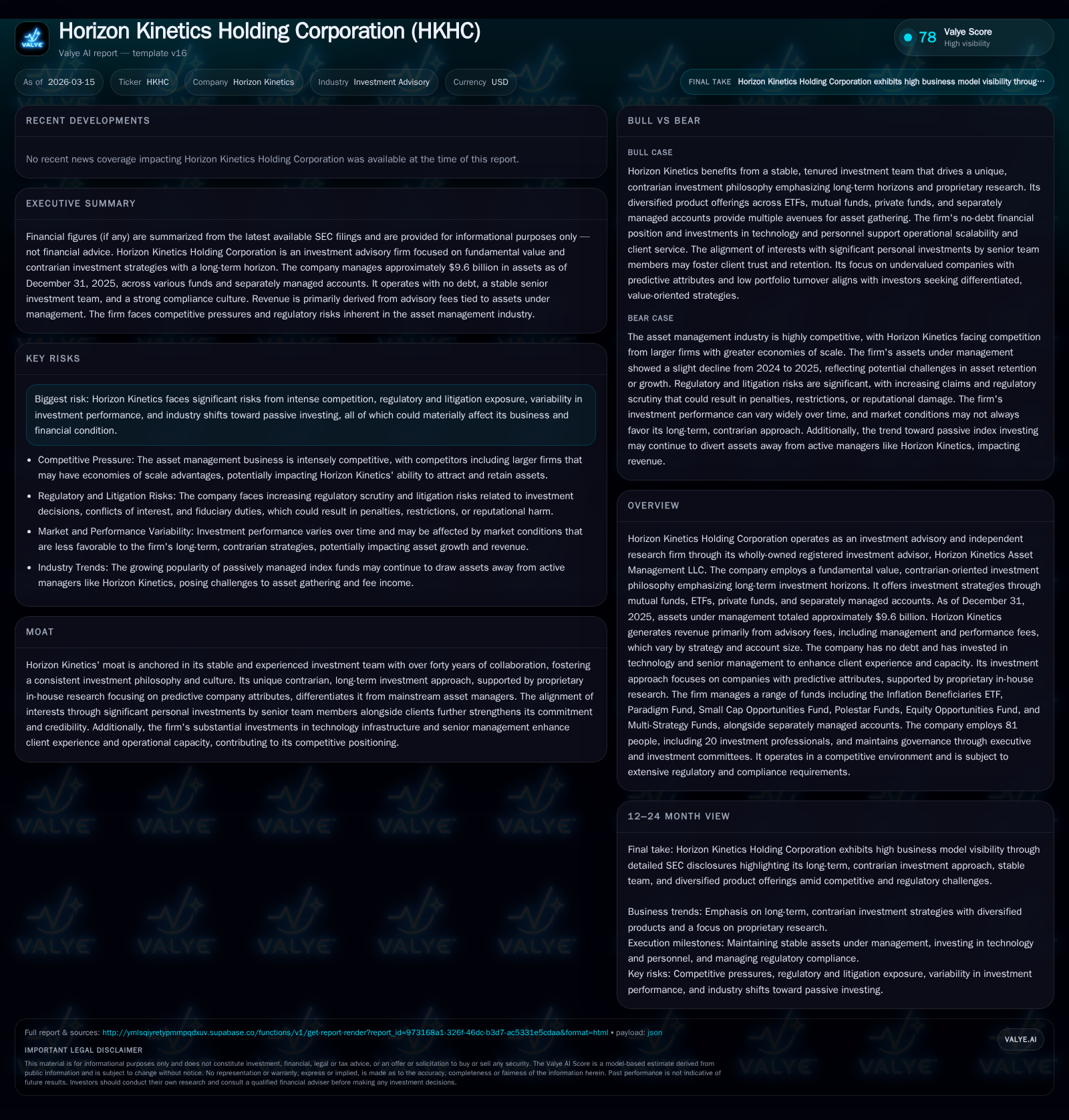
Horizon Kinetics Holding Corp operates with a fundamental value, contrarian strategy emphasizing long-term horizons, which differentiates it from mainstream asset managers increasingly dominated by passive investing. Despite facing multi-year operating losses from 2022 to 2024, the firm achieved a substantial operational turnaround in 2025 with positive operating income growth of over 170%. Assets under management remained largely stable but slightly declined to $9.6 billion at year-end 2025, impacting advisory fee revenue. Capital allocation policies balance dividend payouts against sizable negative free cash flow, fueled by increased capital expenditures and cautious cash management. Key risk factors include regulatory scrutiny, litigation exposure due to complex portfolio activities, and ongoing industry shifts favoring passive strategies that challenge fee structures and market share.
Historical Growth and Key Performance Drivers
Horizon Kinetics experienced a pronounced shift in its financial performance trajectory between FY2022 and FY2025. The company recorded consecutive operating losses from FY2022 through FY2024, peaking with an operating loss of nearly $15.5 million in FY2024. However, FY2025 marked a clear operational turnaround with operating income reaching approximately $11.1 million, representing a striking year-over-year increase of about 171%. This swing illustrates meaningful operating leverage benefits likely driven by improved cost controls or business scaling amid fluctuating revenue bases.
Despite this rebound in operating profitability, net income contracted sharply by 94.5% year-over-year to roughly $5.1 million in FY2025. This divergence suggests non-operating factors such as one-time charges or investment volatility significantly tempered bottom-line results.
Operating cash flows further underscore volatility; CFO turned meaningfully negative at -$43.1 million in FY2025 versus positive inflows of $11.8 million in the prior year. Capital expenditures surged over five-fold to $315 thousand as Horizon Kinetics increased investments in technology infrastructure to enhance capacity.
Assets under management (AUM), the firm's primary revenue driver, remained relatively flat but edged down slightly from approximately $9.8 billion in 2024 to $9.6 billion at FY-end 2025 [F1][N2]. This modest decline coupled with fee structure sensitivity contributes to nuanced revenue impacts reflective of broader market forces (more detail below).
Historical performance (annual)
| FY | Net ($mm) | CFO ($mm) | OpInc ($mm) | Capex ($) | Net YoY |
|---|---|---|---|---|---|
| 2025 | 5 | -43 | 11 | 315000 | -94.5% |
| 2024 | 92 | 12 | -16 | 47000 | +24234.7% |
| 2023 | 0 | -1 | -5 | +104.3% | |
| 2022 | -9 | -2 | -8 |
Source: SEC companyfacts cache [F1].
Capital returns and efficiency (annual)
| FY | Div ($mm) | FCF ($mm) | ROE% |
|---|---|---|---|
| 2025 | 6 | -43 | 1.5 |
| 2024 | 1 | 12 | 27.2 |
| 2023 | 11.6 | ||
| 2022 | -313.9 |
Source: SEC companyfacts cache [F1].
Table: Horizon Kinetics Summary Financials & Key Metrics (FY2022-FY2025) — All figures per [F1]
The volatility highlights the firm's vulnerability to both market-driven asset fluctuations impacting fees and episodic financial events including increased capex investments.
Investment Philosophy That Defies Market Conventions
Central to Horizon Kinetics' identity is its steadfast commitment to a fundamental value, contrarian investment philosophy that emphasizes extended time horizons rather than short-term trading norms that have proliferated across modern markets [S1][S6]. This approach refrains from benchmark-dependent investing typical of many asset managers; instead, it concentrates on companies exhibiting "predictive attributes" such as spin-offs, owner-operated businesses, and entities with hidden or dormant value not fully appreciated by broad index coverage [S7].
The firm’s substantial proprietary research capacity—produced entirely in-house—is a cornerstone supporting unique security selection processes that focus on deep business model analysis rather than merely relative valuation metrics [S7]. This discipline allows them to uncover investment opportunities typically outside mainstream ETF universes or common index constituents.
Moreover, personal alignment through significant co-investment by senior management reinforces adherence to this philosophy while fostering client trust [S6]. Such embedded incentives help maintain consistency across market cycles.
Portfolio construction commonly involves concentrated holdings with low turnover characteristic of long-duration mandates pursuing asymmetric expected return profiles that manifest over multi-year horizons [S13]. This methodology requires patience and tolerance for near-term price variability but aims for durable compounded returns over market cycles.
Assets Under Management Trends and Fee Revenue Dynamics
Horizon Kinetics primarily generates revenue through advisory fees gleaned from managing client assets across mutual funds, ETFs (notably the Inflation Beneficiaries ETF), private funds, and separately managed accounts [S9]. These fees include baselines management fees plus variable performance fees dependent on client account structures.
AUM levels serve as a proxy for potential revenue pools but are subject to considerable flux driven by market valuations alongside net subscription and redemption activity [N2][S9]. The modest decrease from $9.8 billion at December 31, 2024 down to about $9.6 billion at the end of 2025 demonstrates this sensitivity amid volatile markets.
Fee base normalization thus faces headwinds when AUM contracts or fails to grow meaningfully despite potentially stabilizing inflows/outflows within specific strategies or product lines [S10]. In addition, Horizon Kinetics’ focus on differentiated strategies like its inflation-sensitive ETF can mitigate some fee pressure but overall market shifts towards low-cost passive options challenge active share retention [S7][S17].
Their product mix attempts balancing niche long-term alpha-oriented funds with more accessible ETFs aimed at capturing thematic exposures that appeal during inflationary regimes [S10]. Nevertheless, maintaining sustainable revenue amidst fluctuating AUM demands ongoing investor education and demonstrable outperformance—which internal research capabilities aim to support.
Operational Turnaround: From Losses to Positive Operating Income
The jump into positive operating income territory in FY2025 marked a key milestone following years of cumulative losses attributed primarily to margin compression amid challenging top-line conditions [F1][N2]. The approximate $26 million improvement versus FY2024 reflects enhanced operational efficiency or successful expense management counterbalancing fee revenue headwinds.
This shift evidences improved operating leverage whereby fixed cost absorption has benefited from either tighter expense control or scaling effects associated with their growing investments in technology infrastructure [S13]. However, net income’s steep fall suggests caution—potentially influenced by increased one-time costs or adverse mark-to-market movements not immediately visible within operating metrics alone.
Such dynamics are common among asset managers deploying active strategies encumbered by episodic payout obligations and accounting items linked to performance incentives or unrealized portfolio gains/losses.
Capital Allocation: Balancing Dividends with Negative Free Cash Flow
Despite reporting substantial negative free cash flow—estimated around -$43 million driven mostly by high cash consumption from operations coupled with rising capital expenditures—Horizon Kinetics continued distributing dividends totaling roughly $6.3 million in FY2025 [F1][S10][S26].
This juxtaposition raises questions about payout sustainability given cash flow strain; however, the firm’s zero-debt policy positions it conservatively without reliance on leverage for growth financing [S11]. The dividend increase from prior years signals confidence in long-term earnings power but suggests capital recycling via equity issuance or careful cash reserves management might be necessary if negative CFO persists.
Rising capex—the spike over fivefold year-over-year—aligns with stated strategic initiatives focused on fortifying technological platforms and expanding investment team capabilities central for scaling delivery without commensurate linear cost increases [S10][S13].
Asset managers frequently navigate such trade-offs balancing distributable earnings against reinvestment needs critical for competitive differentiation amid evolving client expectations around service quality and digital access.
Risks Including Regulatory, Litigation, and Industry Pressures
The industry landscape presents material risk factors for Horizon Kinetics encompassing regulatory scrutiny that evolves continuously along with increasing litigation frequency targeting investment decisions and conflicts-of-interest issues inherent in complex portfolio activities [S4][S5][S8][S14–17].
As an active manager engaging in niche segments including spin-offs and private fund structures—the company could face heightened fiduciary risks reflected through potential allegations of mismanagement or duty breaches despite comprehensive compliance frameworks overseen by dedicated teams [S12].
Competitive pressures arise prominently from the expanding footprint of passive indexing products eroding active fund flows hence compressing management fees industry-wide; Horizon Kinetics must demonstrate persistent alpha generation amid these headwinds to sustain its positioning [S17]. Larger competitors benefit possibly from economies of scale absent here due to modest AUM size relative to giants dominating institutional mandates.
Furthermore, talent retention—significant given the firm’s culture-centered differentiation—remains crucial as employee expertise underpins proprietary research output vital for performance stability [S7][S17].
What to Watch: Growth Catalysts and Potential Constraints Ahead
Post-earnings disclosures spotlight product innovation avenues notably through development of ETFs like the Inflation Beneficiaries ETF—which grew its net assets from $1.1 billion (end-2024) to $1.4 billion at end-2025—as promising vehicles aiding asset gathering especially during inflationary macro environments [N2][S6][S9][S10].
Technology investments designed for scalable client servicing represent an important strategic lever enabling operational bottleneck alleviation so critical amid active fundamental research intensity.
Absent explicit forward guidance given recent filings, monitoring quarterly AUM evolution alongside relative fund performance rankings will inform sustainability of recent operational improvement patterns.
Potential constraints remain tied chiefly to ongoing industry shifts favoring low-cost indexing which may limit fee base expansion unless accompanied by meaningful alpha generation capable of retaining discerning investors emboldened by lower-fee competition.
Equally important will be maintaining senior team stability underpinning firm culture—a key moat element—as Horizon navigates regulatory complexity while seeking selective acquisition or partnership opportunities aligned with core competencies [S6].
Disclaimer: This analysis is based strictly on publicly available financial data and official filings as cited; it is intended solely for informational purposes without conveying investment advice.
Disclaimer: This is research-only, informational analysis and not investment advice. It may include AI-generated interpretation and general industry context. Always verify important details using primary sources.

Comments